




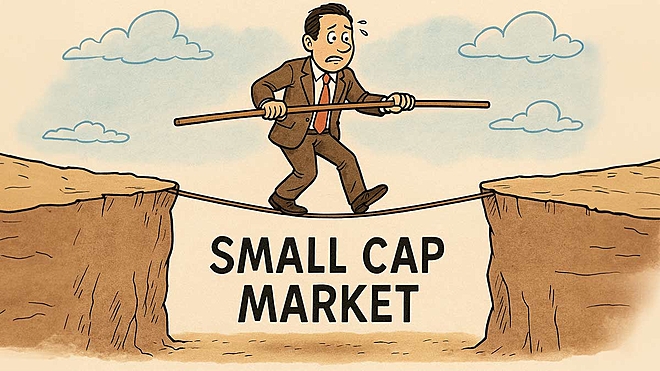
 Sakshi/AI-Generated Image
Summary: What you’ll read about small-cap investing might sound terrifying. And rightly so. So, buckle up as we reveal how many times the Nifty Smallcap 250 TRI has crashed more than 20 per cent since 2005, and how long it took for the universe to break even from these painful slumps.
Small-cap funds are the darlings of Indian investors. Everyone wants a piece of the next fast-growing company that turns Rs 10,000 into Rs 1 lakh. And to be fair, the returns over the long run have justified the craze, with even an average small-cap fund gunning out 28 per cent annualised returns in the last five years. No wonder small-cap funds have become the most popular equity fund category today. Over 2.7 crore unique investors have collectively parked more than Rs 3.6 lakh crore into this universe.
But here’s the dark side: small caps don’t rise in straight lines. They test your patience, shake your confidence and often make you regret your timing.
So, let’s pull back the curtain and see just how brutal some of these downturns have been over the past two decades, and how painfully long investors had to wait just to get back to where they started.
The painful six-year period (2008–2014)
Between January 1, 2008, and February 28, 2009, the small-cap index crashed by a staggering 73 per cent. That means Rs 10 lakh became Rs 2.7 lakh in just 14 months.
But here’s the real kicker: it wasn’t a quick comeback. It took the Nifty small-cap index nearly 69 months — that’s five years and nine months — to regain its pre-crash levels. Only in November 2014 did investors finally see their portfolios break even again.
And even during this recovery phase, the journey was littered with setbacks. Between February 2009 and November 2014, the index fell by more than 15 per cent on four separate occasions:
- 27 per cent between November 2010 and February 2011
- 23 per cent between November and December 2011
- 18 per cent between January and March 2013
- 18 per cent again between May and August 2013
Every time investors thought the worst was over, the market reminded them who’s boss.
The second slump (2016)
Just when confidence returned, another sharp correction arrived. Between January and February 2016, small caps fell nearly 24 per cent.
Even though they recovered over the next few months, another 10 per cent fall followed in November–December 2016. Effectively, investors who had entered at the start of 2016 had to wait until April 2017 — more than a year later — just to break even.
The third prolonged fall (2018–2020)
This was the one-two punch that tested even the most seasoned investors. Between January 2018 and August 2019, the small-cap index tumbled 40 per cent. And before it could recover, Covid-19 arrived, triggering another 40 per cent collapse in February–March 2020.
Combined, this period wiped out years of gains. It took nearly 40 months (three and a half years) for small-cap returns to even get back to square one.
The most recent correction (2025)
History, as they say, doesn’t repeat, but rhymes. Between January and February 2025, the small-cap index once again slumped by 22 per cent. While the index clawed back some ground in the following months, July–August 2025 brought fresh pain. As of now, investors who entered at the start of this year are still waiting for their portfolios to recover, with the index still down over 3 per cent year-to-date.
The uncomfortable truth
Small-cap investing looks exciting in hindsight. But when you live through these cycles, it’s anything but glamorous.
There have been multiple 20 per cent-plus drawdowns every few years, and each recovery has demanded immense patience. Investors who exited during fear-driven phases locked in losses, while those who stayed the course — ideally through systematic SIPs — eventually reaped the rewards.
The lesson is clear: small-cap investing isn’t about timing the highs; it’s about surviving the lows.
What this means for you
If you’re investing in small-cap funds, three rules can help you stay sane:
- Think in decades, not years.
The volatility in small caps smooths out only over seven to 10 years. You can read more about why seven to 10 years is ideal here. - Don’t go overboard.
Even if past returns tempt you, keep small caps to no more than 20 per cent of your equity portfolio, unless you are a seasoned investor with a time horizon stretching over a couple of decades. - Stay disciplined.
SIPs help you buy more when markets fall and average your costs during recoveries, something lumpsum investors often miss. You can check out why SIPs score over lumpsum investing in small-cap funds here.
Want to start a Rs 5,000 SIP in a small-cap fund?
Explore Value Research Fund Advisor. The platform is built on decades of experience, as Value Research has been helping Indian mutual fund investors for nearly 30 years.
With Fund Advisor, you don’t have to sift through hundreds of schemes on your own. The service offers a curated list of expert-recommended funds, including small-cap funds that meet strict performance and consistency criteria.
Each fund on the list is chosen after an in-depth analysis of returns, risk, portfolio quality and fund manager track record. The recommendations are also updated periodically to reflect any major changes in market conditions or fund performance, so you always know which small-cap funds are worth your SIP money today.
Also read: Is investing in an active small-cap fund still a good idea?
Ask Value Research 
 New episodes every Friday









 New Process Alert
  Seems like you've uploaded a wrong QR code. Please upload the QR code downloaded from MF Central platform.


