




 Aditya Roy/AI-Generated Image

Summary: Let’s find out what an average small-cap fund would have delivered if you’d invested for just one year. Here’s a hint: the small-cap index gave more than 50 per cent returns 16 per cent of the time. So, does it make sense to invest in small-cap funds for just a year?
Small-cap funds have always been an investor favourite. The high-growth, high-drama corner of the mutual fund world. And investors continue to pour money into them like never before. In just this financial year (since April 1, 2025), small-cap funds have attracted over Rs 22,700 crore of fresh inflows.
And why not? Their performance is tantalising. Over the last five years, small-cap funds have delivered a stunning 27.6 per cent annualised return. Stretch that to 10 years, and they still boast a very healthy 17.4 per cent annualised return. To put that in perspective, a Rs 1 lakh investment 10 years ago would have grown to roughly Rs 5 lakh today, five times the original investment.
Given such a track record, it’s no surprise that small caps grab attention. They promise fast growth, multibagger stories and overnight wealth creation. But here’s the crucial point that most investors miss: your time horizon matters more than you think.
Investing in small caps for just one year can fetch you rollicking returns but its fraught with high risk.
One-year returns: High risk, high drama
Let’s start by asking a simple question: what happens if you invest in a small-cap fund for one year?
To find out, we looked at the rolling one-year returns of the BSE 250 Smallcap TRI over the last 10 years (September 2015 – September 2025).
On a side note, we chose the BSE 250 Smallcap TRI because it offers a long and consistent data history, serves as a reliable proxy for small-cap funds and closely mirrors what a diversified small-cap portfolio might deliver. And by rolling returns, we simply mean that we looked at every possible one-year period. For example, we measured one-year returns from September 1, 2015, to September 1, 2016, then from September 2, 2015, to September 2, 2016, and so on. This gives a much better picture of what an investor might have experienced, rather than cherry-picking specific dates.
Here’s what we found:
- Negative returns: 31.6 per cent of the time
- 0–10 per cent: 18.2 per cent of the time
- 10–20 per cent: 16.5 per cent of the time
- 20–30 per cent: 21 per cent of the time
- Above 30 per cent: 33.9 per cent of the time
In plain English: investing in a small-cap fund for just one year is like flipping a coin with your money. You had nearly a 50-50 chance of either losing money or making more than 30 per cent returns. It’s the ultimate live-by-the-sword, die-by-the-sword game. One year, you look like a market wizard at family dinners; the next, you’re left asking yourself why you ever bothered in the first place.
So, why would you want yourself and your hard-earned money to go through such an emotional wringer?
What if you invested in the small-cap index for three years?
Now, what if you stretch that time horizon to three years?
Here’s how the distribution of returns changes:
- Negative returns: 11 per cent of the time
- 0–10 per cent: 13.9 per cent of the time
- 10–30 per cent: 65 per cent of the time
- 30–100 per cent: 10 per cent of the time
The volatility comes down significantly. Your chances of losing money drop from 31.6 per cent over a one-year period to 11 per cent. While earning negative returns are still high, the odds are now in your favour.
Interestingly, the majority of outcomes (about two-thirds) fall in the 10–30 per cent range. That means most three-year investors would have earned solid returns.
What if you invested in the small-cap index for five years?
When you look at five-year rolling returns, the picture becomes much more comforting:
- Negative returns: Just 2 per cent of the time
- 0–10 per cent: 32.6 per cent of the time
- 10–20 per cent: 41.7 per cent of the time
- Above 20 per cent: 23.3 per cent of the time
This is a much more palatable outcome for most investors. Your chances of actually losing money over five years are now just 1 in 50. And your chances of earning more than 10 per cent annualised returns? A very healthy 65 per cent.
Of course, the eye-popping triple-digit returns of the one-year period disappear over five years. But you'd rather want your hard-earned money to compound steadily, not hope for the moon on a stick.
What if you invested in the small-cap index for seven years?
Here’s where the magic really kicks in. Over any seven-year period between 2015 and 2025, the small-cap index never delivered negative returns. Never.
Here’s how the distribution looks:
- 0–10 per cent: 31.6 per cent of the time
- 10–20 per cent: 44.9 per cent of the time
- Above 15 per cent: Nearly 25 per cent of the time
You can see that a seven-year horizon completely changes the game for small-cap investing. Over any seven-year period between 2015 and 2025, a small-cap portfolio never delivered negative returns, not even once. That’s a powerful statistic because it tells you that if you simply stayed invested long enough, your chances of losing money dropped to zero.
And it gets better. Nearly one in four times, the returns were above 15 per cent a year, which means your Rs 1 lakh investment would have grown to roughly Rs 2.7 lakh over seven years. Even more striking, over half the time, your investment would have at least doubled (assuming a conservative 12 per cent annualised return).
This is why small-cap funds are not a one-year trade; they are a seven-year-plus commitment. The longer you stay invested, the more the wild swings of small-cap stocks smooth out and start working in your favour.
Quick take
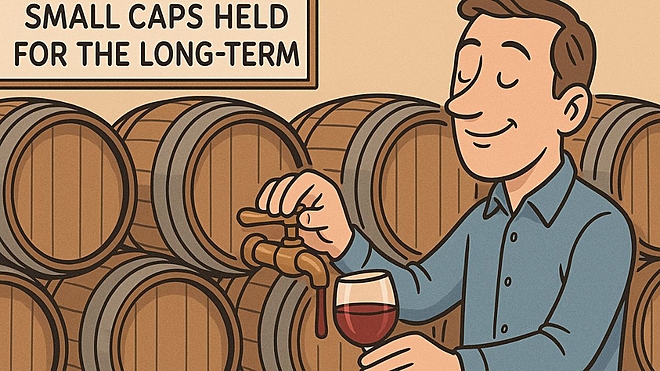
Think of small-cap investing like ageing fine wine. If you open the bottle too soon, you risk getting a bitter taste. Give it time, though, and it matures into something far more rewarding.
So, if you’re thinking about small-cap funds, be prepared to lock in your money for at least seven years. Anything shorter is just speculation, and that’s not what you want to do with your hard-earned money.
Want to learn how to invest?
Check out Money, Markets and Mistakes, a curated collection of Value Research CEO Dhirendra Kumar’s most insightful 2024 columns.
Across six sections, the book distils a turbulent year for Indian investors, from AI hype to SEBI’s F&O crackdown, Bitcoin’s allure to small-cap mania, with clarity, wit and perspective.
But beyond market headlines, this is really a book about behaviour: mastering your own psychology, avoiding common pitfalls and building the mindset for long-term success.
Organised by theme, it covers investing basics, personal finance choices, mutual fund strategies, market trends and timeless principles.
Also read: Small-cap funds gave 5x returns in 10 yrs. A new normal?
Ask Value Research 
 New episodes every Friday











 New Process Alert
  Seems like you've uploaded a wrong QR code. Please upload the QR code downloaded from MF Central platform.


