




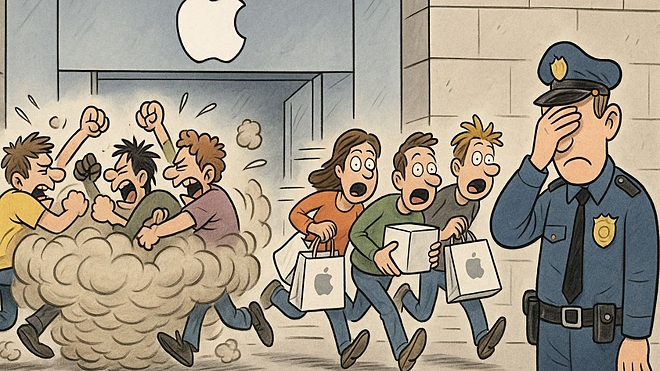
 Aditya Roy/AI-Generated Image


The scenes outside Apple stores on Friday morning were quite something. People queuing from two in the morning, camping overnight in humid September heat, fighting over queue positions – all for a phone. The iPhone 17 launch in India was like a tutorial in human psychology and financial priorities gone astray.
I used to have an office directly above a store run by an Apple reseller, and the manager once shared a fascinating observation about customer behaviour. Almost all their sales, he told me, were for either the cheapest model or the most expensive one. The middle variants barely moved. It struck me then that this had nothing to do with functionality or features – it was entirely about status signalling. I suspect luxury car dealerships see exactly the same pattern.
The cheapest iPhone buyers are often young people stretching every rupee, taking loans or EMIs they can barely service, driven by social pressure rather than genuine need. The most expensive buyers are making a different kind of statement altogether. Both groups are solving the same underlying problem: how to signal their place in the social hierarchy. The phone itself is almost incidental.
There's nothing inherently wrong with this impulse. Status signalling is a fundamental human need, as basic as food or shelter in many ways. We're social creatures, and how others perceive us affects everything from career prospects to relationships. The problem isn't the desire to signal status – it's the timing and the method.
Consider this: the base iPhone 17 costs around Rs 83,000, roughly equivalent to 160 days of the average Indian urban salary. For someone earning Rs 30,000 a month, that's nearly three months of total income before taxes and living expenses. The top-end model pushes that to five months. Yet people will queue for hours and plan elaborate financing schemes to acquire what is, fundamentally, a depreciating gadget that will be obsolete in a few years.
The same psychological energy that drives someone to research iPhone colours and storage variants, compare EMI schemes and endure overnight queues could be redirected towards something far more powerful: building actual wealth. But wealth building doesn't offer the immediate gratification of walking out of a store with a shiny new status symbol in your pocket.
Here's where the maths becomes interesting. That Rs 83,000 invested in a diversified equity fund, assuming historical returns, could grow to around Rs 4 lakh over a decade. The Rs 1.5 lakh spent on the top-end model could become Rs 7 lakh. These aren't abstract numbers – this is real money that could fund better education, a house deposit, or even more impressive status signalling later in life.
This isn't about suggesting people live like monks or abandon all material pleasures. Full disclosure: I'm still using an iPhone 12, making me precisely the kind of customer Apple dreads – someone who bought their product and then had the audacity to keep using it for years. It's about recognising that a few years of restraint in status signalling can enable much more powerful signalling later. Instead of struggling to afford the latest iPhone every two years, imagine having the financial freedom to buy whatever you want without checking your bank balance. That's a different kind of status altogether.
The path requires channelling the same planning energy that goes into gadget purchases towards systematic investing. The same discipline that makes someone queue overnight needs to be applied to monthly SIPs. The young professional taking an EMI for an iPhone today could, with the same monthly outflow directed towards equity funds, be driving a car in 10 years instead of still cycling through phone upgrades. The choice isn't between having nice things and not having them – it's between having them now while remaining financially constrained, or waiting a bit and having genuine financial freedom.
The queues outside Apple stores weren't just about phones. They were about priorities, timing and understanding what real wealth looks like. The people inside those stores made their choice. The question is: what's yours?
Also read: Save your children from the hidden persuaders
Ask Value Research 

 New episodes every Friday











 New Process Alert
  Seems like you've uploaded a wrong QR code. Please upload the QR code downloaded from MF Central platform.


