




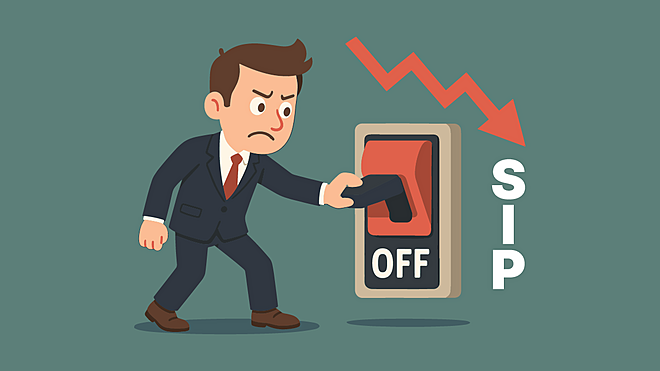
Summary: SIPs are built for long-term discipline. But sometimes life throws a curveball. This story explores four valid reasons to pause an SIP and why emotional exits aren't one of them.
Rohit had always prided himself on being a disciplined investor. Month after month, his SIPs (systematic investment plans) went through like clockwork. Even when markets crashed, he stayed the course. And it had worked out well for him.
But lately, something felt off. For the first time in years, he wondered if it was time to hit pause.
He wasn’t panicking. He wasn’t reacting to headlines. Yet, a voice in his head nudged him to reassess.
Still, the thought of stopping his SIPs? It felt like giving up on discipline. Like abandoning long-term goals. Like cheating on compounding.
And that’s a thought many long-term investors grapple with: Is it ever okay to stop your SIPs?
The short answer? Yes, sometimes it is.
4 valid reasons to stop your SIP
Here are some real, valid reasons why pressing pause might be the right call:
1. Your income has dropped, and it’s not just a blip
A salary cut, a job loss or a slowdown in business, if your income has taken a significant hit and you're struggling to manage essentials like EMIs or household expenses, it's perfectly okay to stop your SIPs.
This isn't failure. It's financial prioritisation. You can't invest what you can't afford. And that's not just common sense, it's self-care.
Your first job is to stabilise your finances. Build back your emergency fund. Find your footing. Once you're back on track, SIPs can easily be resumed. The market isn't going anywhere.
Most mutual fund houses allow you to pause your SIPs for up to six months. They restart automatically after that. Just avoid letting them bounce. If you miss three or more instalments (without pausing formally), the SIP may get cancelled. So, if you need a breather, do it the right way. Pause it, don't ignore it.
2. Your asset allocation has gone off balance
Let’s say you began investing with a mix of 70 per cent equity (stocks) and 30 per cent debt (safer fixed-income options). But after a strong equity rally, you now find 80 per cent of your portfolio in equities.
Continuing your SIPs blindly into equity funds might worsen the skew. And that could make your portfolio more volatile than you’re comfortable with.
In such cases, it’s smart to stop or reduce equity SIPs and redirect that money into debt funds. This is not a step back; it is a way to restore balance and lower risk. Sometimes, hitting pause is how you stay in control.
3. Your fund just isn’t pulling its weight anymore
Every fund has its ups and downs. But if your SIP has been in a fund that’s consistently underperforming, say, for nearly three years—and there’s no sign of turnaround—it's time to take stock.
Especially if other funds in the same category are doing significantly better, and your fund house hasn't made meaningful changes, such as hiring a new manager or changing strategy, it’s a red flag.
Stopping SIPs into such a fund isn’t abandoning your goals. It’s protecting them. You can always shift to a better-performing fund and keep your plan moving forward.
4. You’re close to your goal. It’s time to get safe.
SIPs work brilliantly for long-term goals. But if that goal is just around the corner, say your child’s college starts next year or you’re buying a house soon, it’s time to get cautious.
Continuing SIPs into equity so close to the goal can backfire if markets turn volatile. A sudden dip could derail years of disciplined investing.
In these situations, stopping equity SIPs and moving your corpus to safer havens like short-duration debt funds or liquid funds is the smart move. You’ve run the race. Now, it’s about protecting the finish line.
Preserving your goal is more important than chasing returns.
What’s not a good reason to stop
- "Markets are too high right now."
- "My fund didn't beat the index last quarter."
- "I want to take a break from investing. It feels boring."
These might feel like good reasons at the moment. But they're not. They're emotional reactions, often to short-term noise. And reacting emotionally is one of the biggest ways investors lose out in the long run.
At Value Research, we do not recommend stopping SIPs unless absolutely necessary, like in the situations discussed above. SIPs are designed to work through market highs and lows. That's their power. They remove timing from the equation and let discipline do the heavy lifting.
If you're facing a tight month, even reducing your SIP to as little as Rs 500 is far better than stopping altogether. It keeps the habit alive. It keeps your plan on track.
The bottom line
Rohit didn’t stop all his SIPs. He reviewed them one by one.
He exited the underperforming fund. Paused the small-cap SIP that was skewing his equity exposure. And moved some money into debt for a goal just a year away.
It wasn’t quitting. It was adapting.
That’s the real strength of a good investor: not blind consistency, but thoughtful adjustments when life or markets change.
So, the next time you feel the need to stop an SIP, don’t panic or feel guilty. Just ask yourself: Is this a break for better balance or a break from discipline? If it’s the former, you already know what to do.
Like reading insightful, relatable stories like this one?
At Value Research Online, we share practical guidance, time-tested principles and thoughtful takes on personal finance without the jargon.
Whether you're navigating SIPs, picking the right mutual funds or just trying to make better investing decisions, we’re here to help.
Keep reading. Keep learning. And stay invested the smart way.
This article was originally published on September 03, 2025.
Ask Value Research 
 New episodes every Friday




 New Process Alert
  Seems like you've uploaded a wrong QR code. Please upload the QR code downloaded from MF Central platform.


