




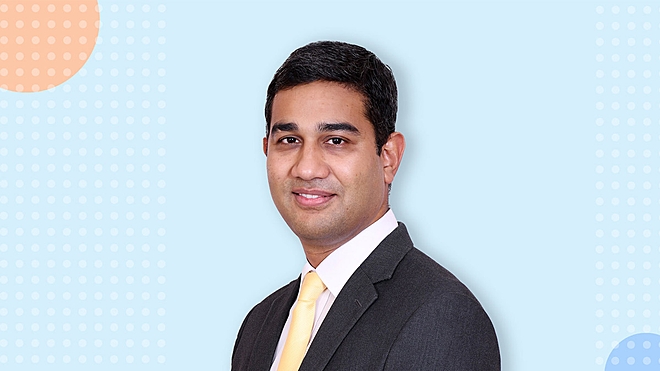
Summary: Despite a tough year for the IT sector, the SBI Technology Opportunities Fund stood out with positive returns, outperforming its peers. In this interview, fund manager Vivek Gedda explains the factors behind the fund’s resilience.
The past year hasn’t been easy for the Indian IT sector. Macroeconomic uncertainty and slow revenue conversion have kept the sector under pressure. Despite the downturn, the SBI Technology Opportunities Fund managed to post nearly 6 per cent returns in the last one year, the highest in its category. Its fund manager, Vivek Gedda, attributed this to a disciplined portfolio strategy: avoiding heavy bets on large caps and focusing more on companies with strong growth drivers and potential to generate alpha.
Managing both the SBI Technology Opportunities Fund and the SBI Innovative Opportunities Fund, with a combined asset base of about Rs 12,000 crore, Gedda shares why he’s comfortable with single-digit growth for IT, his take on AI’s impact on the Indian IT services model, how local players compare with global peers and the positioning of the fund to ride both near-term cycles and long-term tech themes.
With US and European clients tightening their tech budgets, how do you expect this to impact the growth trajectory of Indian IT companies over the next 12 to 18 months?
I believe we are already at a stage in the cycle where expectations have moderated significantly. The outlook for growth going forward is mid-single-digit growth in terms of dollar revenues. I am comfortable with that number for a few reasons.
The total contract value (TCV) of deals won by IT companies over the last few quarters appears strong. However, the conversion of these deals to revenues has been slow. It is similar to how in small towns, when you are building a large house, which, let's say, may cost Rs 1 crore. While this total capital is committed, there are months when cash flow may be tight, and one slows down work, only to resume it when conditions improve.
Similarly, even when strong TCVs are announced, large clients may not immediately convert those deals into revenues. Once there is greater business confidence, which is dependent mainly on reducing macroeconomic uncertainty, these deals should begin to convert into revenues.
In our view, even as the macro environment in the US remains relatively weak, the uncertainty is beginning to moderate. For instance, the uncertainty caused by tariff-related developments in the first half of the year is expected to settle down. More than the macroeconomic weakness, it is the uncertainty that hinders decision-making. Therefore, a reduction in uncertainty bodes well for IT services. The likelihood that some of the large deals announced will convert into actual revenues increases.
With mid-single-digit growth expectations, I believe the outlook is fairly comfortable. The uncertainty that had been present for the past six to eight months is now beginning to dissipate, and that is a positive development for the sector.
AI and automation are rapidly changing client priorities. Do you see this as a near-term disruption, or does it fundamentally challenge the traditional Indian IT services model?
This is something I struggle with every single day. I would hesitate to take a medium-term call on this because things are very fluid at the moment. Thus, it is quite different from past technology disruptions and very complicated. It is therefore challenging to make an informed prediction at this time.
What I can say, though, is that at least from a top-down perspective, the situation does not seem as alarming as some of the prevailing narratives suggest. Every global enterprise will still need to allocate a certain share of its revenues to technology. Let's call it 'X' per cent. It's very hard for me to assume that this X per cent is going to shrink meaningfully. Yes, there could be near-term cyclicality or macro weakness, but looking at the medium to long term, I would still expect the overall pool of technology spending to expand. The key challenge in assessment will be allocating these dollars effectively. Within that pool, a larger share is likely to get absorbed by hardware and software, and the real question to understand is how much of that spend will continue to flow into IT services.
So, my stance right now is more of a 'wait and watch' approach. The overall pie will grow, but the share that services capture within that pie is what we need to monitor closely. Often, when there is a significant overhaul of hardware and software, enterprises need help from IT services vendors. It is not yet straightforward to imagine the benefits and drawbacks of how GenAI may impact the need for help.
How do Indian IT companies compare with their global peers in capturing new growth areas, such as AI, cloud, cybersecurity and digital engineering?
I think it's important to clarify that we are making a like-for-like comparison. If we consider global IT services peers, a few names, such as Accenture and some niche players, may be slightly ahead in terms of the depth of proof-of-concepts (POCs) or the percentage of incremental revenues they generate from areas like Generative AI. But I don't think Indian IT is significantly behind. In fact, with every passing technology cycle, the capability gap between Indian IT companies and their global peers has been narrowing steadily. This is also evident in increasing market share for Indian IT vendors in the global addressable spend.
How do you compare Indian IT companies to global tech companies like OpenAI (ChatGPT) or Google, which are developing AI products? Do you foresee Indian companies developing such products, or will their role remain service-oriented mainly in the future?
That's an interesting question. To begin with, I don't think Indian IT services firms will be the ones to develop their own large language models (LLMs). Building LLMs requires a massive investment, and at this stage, I believe we are already behind in creating an entirely new LLM from scratch.
What I do see, however, is that some Indian players, especially the startups, could build very strong wrappers around the existing, already well-evolved models. These wrappers would likely be vertical-specific or domain-specific solutions. For example, SaaS companies in India could integrate Generative AI into their products by building these specialised wrappers, essentially tailoring global models to meet industry-specific or function-specific needs.
In summary, I expect Indian companies to focus more on services and solutions, leveraging existing global models rather than competing directly with them. Their strength will lie in domain expertise, integration and building scalable applications on top of these foundational models.
With IT majors adopting cautious hiring and even layoffs, do you see this as a red flag for the sector's growth prospects, or more as a cost-optimisation measure that could support margins?
I don't see this as a red flag. In my view, it is more about cost optimisation and ensuring efficiency. In organisations that traditionally have not been known for involuntary attrition, there are still instances where some degree of performance-based exits occur. This happens on a much smaller scale across all organisations and is generally aimed at making them more performance-oriented.
Therefore, the recent headcount reduction announced by one of the large IT companies is unlikely to snowball into a significant trend for the overall industry. I would view it more as fine-tuning of operations to support margins.
That said, over the medium term, we should expect headcount growth for the industry to moderate, driven by productivity gains from Generative AI, which will decouple itself from revenue growth.
Despite sectoral challenges, the SBI Tech Opportunities Fund delivered returns of around 6 per cent over the past year. Which specific strategies or stock selections were the key contributors to this resilience?
The way we think about portfolio construction is essentially across three buckets.
The first bucket comprises large-cap names with significant weightings in the benchmark index, which in our case is the BSE Tech Index. Here, the approach is more about getting the direction right and adjusting weights accordingly. Since these stocks have a very high representation in the index, we cannot afford to take an outsized active bet on them. The focus here is to ensure that we don't make the wrong move and that we manage them with an eye on relative performance versus the benchmark.
The second bucket is where we play long-term themes and strong ideas that can compound over the medium to long term. These are thematic and could span areas such as quick commerce, media or travel tech. We look for trends where structural growth drivers exist and try to ride those opportunities patiently.
The third bucket is where we aim to generate significant alpha. This involves smaller companies with differentiated technology or niche positioning, where the risk-reward equation is highly favourable. In some of these cases, there may also be near-term catalysts that can unlock value.
Ultimately, performance is often a function of striking the right balance across these buckets.
Did the outperformance come from focusing on large-cap stability, mid-cap alpha or selective bets in niche tech companies?
Interestingly, while some of the larger names did contribute positively, the highest alpha came from mid-cap names. These were more secular and played out very well for us over the past year.
What exactly is the investable universe for the fund? Beyond IT services, do you also consider niche companies, technology platforms or software businesses?
The investable universe includes all technology-oriented companies. This could mean IT services, platform companies, media and telecom companies. To elaborate, it includes e-commerce platforms, travel tech companies, software companies and niche technology businesses.
Anything that is part of the broader technology ecosystem, whether platforms, products or services, can fall within the universe of the fund.
How are you positioning the SBI Tech Opportunities Fund in the current environment, striking a balance between near-term challenges and long-term structural opportunities in the technology sector?
As I mentioned earlier, the fund's philosophy remains essentially unchanged. Of course, to the extent that I believe we are in a cycle that is closer to the bottom, if not already at the bottom, we are making some tactical adjustments. The fund is significantly underweighted on traditional IT services companies and instead has a much larger allocation to technology-oriented businesses outside the traditional IT services space.
The way we are looking at it right now is to realign the fund slightly to benefit from the bottoming out of IT services, while also making adjustments to positions in companies where tactical trades have already been executed. Essentially, the positioning is designed to balance near-term cyclical opportunities in IT services with long-term secular opportunities across other technology themes.
Also read: IT mid caps still offer good opportunities: Kotak Mahindra Mutual Fund's Atul Bhole
Ask Value Research 
 New episodes every Friday








 New Process Alert
  Seems like you've uploaded a wrong QR code. Please upload the QR code downloaded from MF Central platform.


