




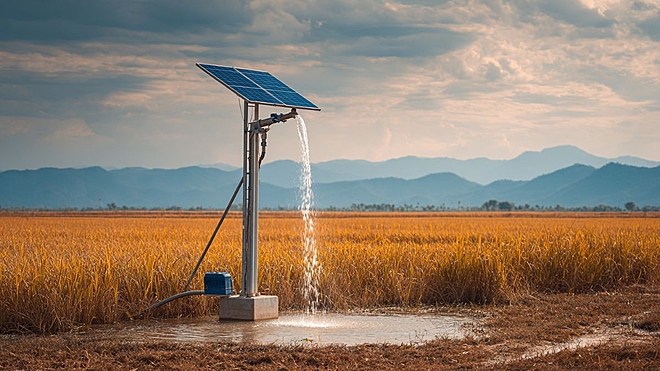
 Aditya Roy/AI-Generated Image
Summary: The renewable energy sector continues to command premium valuations. But there are two solar energy businesses that stand out for their reasonable prices and exponential growth. Are these hidden gems? Let’s find out
Renewable energy is among the hottest themes in Indian markets today. From rooftop panels to wind farms, investors are chasing anything with a green energy tag, assigning pricey valuations of 40 to 50 times. In many cases, this also reflects a disconnect from their fundamentals.
This is where two outliers stand out. In the richly-priced sector, Oswal Pumps and Shakti Pumps trade at modest earnings multiples of 34 and 25 times, respectively, begging the question whether the market is overlooking their potential or pricing in actual risks. We take a detailed look at the businesses and the industry dynamics to find the answer.
How the duo rides industry tailwinds
Oswal Pumps and Shakti Pumps make solar-powered irrigation pumps, a niche within the renewable energy ecosystem that massively benefits from government policy support (through the PM-KUSUM scheme). Since solar pumps are powered by solar power rather than diesel and electricity, they give farmers freedom from expensive fuel, high electricity costs, erratic supply and also provide significant lifetime savings.
Economics of agri pumps
|
Pump type
|
Diesel pump | Grid pump (with electricity subsidy) | Solar pump (PM-KUSUM 60 per cent subsidy) |
|---|---|---|---|
| Pump Cost (Rs) | 1,00,000 | 1,00,000 | 3,00,000 |
| Subsidy (Rs) | - | - | 1,80,000 |
| Farmer cost after subsidy (Rs) | 1,00,000 | 1,00,000 | 1,20,000 |
| Maintenance (10Y) (Rs) | 40,000 | 30,000 | 5,000 |
| Fuel/electricity cost (10Y) (Rs) | 12,82,638 | 2,51,295 | - |
| Govt subsidy* (Rs) | - | 2,51,295 | 1,80,000 |
| Total cost for farmer (Rs) | 14,22,638 | 1,30,000 | 1,25,000 |
| Total cost (farmer + govt) (Rs) | 14,22,638 | 3,81,295 | 3,05,000 |
| Residual life (after 10 years) | Need replacement | 3-5 years | 5-10 years |
| Source: Oswal Pumps' RHP Govt subsidy reflects the subsidies provided by the government for grid pumps (through electricity cost) and solar pumps (through product subsidy) |
|||
Supported by government subsidies (pumps are sold to farmers at a discount), the solar pump market has expanded at a blistering 114 per cent per annum from FY19 to FY25, albeit on an extremely small base.
Naturally, the strong demand is reflected in the financials of the two companies. Oswal Pumps’ revenue and profit have leapt 58 and 155 per cent per annum from FY22 to FY25. Margins expanded from 5 per cent to 20 per cent and return on equity (ROE) touched an eye-popping 87 per cent in FY25.
Peer Shakti Pumps, a more established player, saw its revenue and profit growing 29 and 85 per cent per annum over the same stretch. Despite a rough FY23, Shakti bounced back strongly with margins of 16 per cent and an ROE of 35 per cent in FY25.
It’s then natural to wonder why the two stocks are valued modestly, relative to other peers of the industry, despite such robust metrics and the market’s explosive growth. The answer probably lies in the risks that are as monumental as the growth.
Where the growth story hiccups
1) High receivables: Looking closely at the books reveals a cash crunch problem as a result of steep receivables. For Oswal Pumps, receivables have ballooned from 11 per cent of sales in FY22 to 44 per cent in FY25. Operating cash flow, as a result, was a negative Rs 151 crore in FY25 despite record profits. Shakti Pumps, too, is struggling with the same problem. Its FY25 receivables made up for a staggering 42 per cent of sales.
This is the classic risk of selling to the government: orders come in, but payments are delayed. Investors may recall Va Tech Wabagand and Tejas Networks, both with the government as their client, which ran into serious trouble in 2014 and 2018–19, respectively, due to receivables piling up. Profits on paper, but no free cash in hand.
2) The commoditised nature of the business: Another challenge is commoditisation. Government contracts are tender-based; the lowest bidder usually wins. That caps pricing power and makes margins vulnerable. On top of this, entry barriers are low and bigger players are joining the fray. Crompton, a household appliances major, entered the solar pump market in FY24. Larger balance sheets and stronger brands could trigger price wars, squeezing smaller players.
3) Extreme policy dependence: Solar pump adoption is heavily subsidy-driven. If subsidies are cut back, as seen with the FAME scheme in the case of EVs, industry growth could slow sharply. For most farmers, the upfront cost of solar pumps is still unaffordable without subsidies.
4) Market opportunity: Solar pumps still make up just 0.1 per cent of India’s operational groundwater pumps, leaving an exponential runway. The market size could grow three times to Rs 50,000 crore a year, when also including replacement demand. This, however, also means the industry growth that had been an eyewatering 114 per cent in the past will likely sober up to a modest 10 per cent per annum by FY30. Still healthy but not as explosive as in the last six years.
Our take
For long-term investors, the picture is mixed. On one hand, the market for solar pumps is still expanding, supported by policy incentives and a clear replacement opportunity. Oswal and Shakti boast strong financials, high margins and enviable ROE. And unlike frothy renewable names, they are priced more reasonably.
On the other hand, growth has its limits. Even in the best-case scenario, the market will expand by only three to four times, beyond which it will plateau. Receivables, cash flow strain and tender-driven commoditisation remain crucial risks. Layer that with the high reliance on subsidies, which adds policy risk.
In short, both businesses are valued reasonably, perhaps because the market opportunity is limited. The prospective buyers, mainly farmers, offer a market where customer growth comes with a ceiling. While it remains untapped for now, once solar pumps are adopted across the farmer population, new growth will have to come from newer segments or parallel solar markets. Until then, it’s wise to not expect exponential returns from these businesses.
Want to profit from the green energy theme?
In a frothy market, like in the renewable space, the real winners aren’t just the cheapest stocks. They’re the ones backed by strong fundamentals, clear growth runways and businesses you can hold for the long term.
That’s exactly what we do at Value Research Stock Advisor: go beyond hype to identify companies with both value and durability, built on deep research. Join Stock Advisor and find out which green energy companies feature in our recommendations that combine both opportunity and staying power.
Also read: At 70% discount, is this holding company stock a bargain?
Ask Value Research 

 New episodes every Friday












 New Process Alert
  Seems like you've uploaded a wrong QR code. Please upload the QR code downloaded from MF Central platform.


