




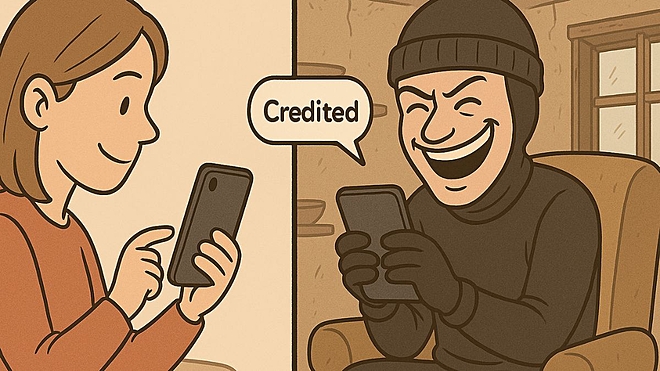
 Aditya Roy/AI-Generated Image
Summary: Peer-to-peer lending offers tempting 12 per cent returns, but beneath the sleek interface lies layered risk and responsibility. Is it really safer than traditional credit?
In the early days of Indian banking, credit was personal. You borrowed from someone who knew your family or could have access to your farmland or fixed deposit. Defaults were rare, not just because borrowers were trustworthy, but because lenders were careful.
Today, the act of lending has been stripped of familiarity and replaced with frictionless design. You open an app, tap a few buttons and become a lender to dozens of strangers across the country. You don’t know them. You don’t meet them. You may not even know what they do for a living.
What you do know is that you’ll earn 12 per cent a year.
Welcome to the world of P2P lending, where returns are high, risks are higher and the only thing more sophisticated than the platform interface is the illusion of safety it creates.
The new middleman
P2P (peer-to-peer) lending platforms position themselves as disruptors, slicing through bureaucracy to bring savers and borrowers together. In India, where formal credit still excludes large swathes of the population, this sounds like a public good.
But look closer.
- These platforms are not banks.
- They don’t assess risk with decades of borrower data.
- They don’t set aside capital to absorb losses.
- They don’t offer deposit insurance.
- And they are not answerable when loans go bad.
They simply match you, the lender, with a borrower who couldn’t get money elsewhere. And they take a fee for doing so.
The system, in effect, is built on a quiet transfer: the risk that once sat with the bank now sits with you.
The seduction of the dashboard
Fintechs are experts at designing confidence. A smooth interface, daily updates, slick dashboards. Payouts arrive like salary credits, and it all feels safe. Familiar.
But behind that glass is a reality the design tries hard to hide.
The borrower you’re funding may have no collateral. No formal income proof. No credit history. The platform may be using behavioural signals such as smartphone usage, app activity, even social media likes to assess creditworthiness.
And when the loan fails, as they can do, it doesn’t show up as a broken promise. It just disappears from your expected returns.
The numbers they do show you
Here’s what platforms report as their gross non-performing assets (NPAs), a measure of how many loans haven’t been repaid.
| Platform | Loans not repaid (Gross NPA) | Promised returns (per year) |
|---|---|---|
| Cred Mint (LiquiLoans) | 2.07% | Up to 9% |
| 12% Club (LenDenClub) | 3.78% | Up to 12% |
| IndiaP2P | 16.70% | Up to 18% |
| Faircent | 2.10% | 14–25% |
| Data as per platform disclosures as of June 30, 2025; Liquiloans data from December 2024. Derived from best estimations | ||
The numbers are revealing, not just for what they show, but what they don’t. Platforms offering the highest returns often carry the highest default risk.
Regulation exists. Protection doesn’t.
The Reserve Bank of India does regulate P2P lending. It bars platforms from guaranteeing returns or offering credit insurance. It mandates NPA disclosures at the lender level.
These are good rules but they are guardrails, not safety nets. They prevent misrepresentation, not misfortune. If your borrower defaults, no one steps in. If your loan isn’t repaid, no one cushions the blow. If your portfolio underperforms, no grievance officer can fix it. And sometimes, they work against you. For instance, when RBI barred instant withdrawals in 2024, platforms like Mobikwik Xtra froze investor funds mid-cycle—locking them in without consent, citing compliance.
This is not a fixed deposit. It’s not a mutual fund. It’s not even a corporate bond. Its retail lending in its rawest form, only digitised and atomised.
The uberisation of lending
P2P lending is not just a product. It’s a phenomenon—part of a larger trend where technology intermediates finance, displaces institutions and devolves responsibility onto the user.
Just as ride-hailing apps turned drivers into entrepreneurs, P2P platforms turn savers into underwriters. The model works beautifully, until something breaks.
And in credit, something always breaks.
Platforms are built to scale. But risk is deeply personal. You may see 12 per cent annual returns on the brochure. But your personal return, after a few defaults, could be far lower. Or even negative.
Unlike a mutual fund, there is no pooling, no smoothing, no averaging out. You bear the loss. Quietly, individually, invisibly.
Final word
P2P lending is not inherently bad. But it is fundamentally misaligned with the average investor’s skillset, knowledge and temperament.
It’s lending without underwriting. Risk without pricing power. Investment without protection.
If you want 12 per cent returns, equity funds can offer that with far more transparency and better odds in the long run. If you want steady income, look to debt mutual funds. If you want safety, choose FDs.
But lending to strangers through an app? That’s not investing. That’s just wishful thinking in a digital wrapper.
Want real returns without roulette? You’re not alone. Too many investors are spinning the wheel—chasing stock tips, hopping between funds, or trusting gut over guidance. The result? Missed goals, inconsistent returns, and a whole lot of regret. What you need isn’t luck. It’s a plan.
Let Value Research Fund Advisor guide you to proven, research-backed mutual funds—built for your goals, not gimmicks.
This article was originally published on July 29, 2025.
Ask Value Research 

 New episodes every Friday







 New Process Alert
  Seems like you've uploaded a wrong QR code. Please upload the QR code downloaded from MF Central platform.


