 Widely read:



There’s one mutual fund category that’s quietly become the go-to choice for investors seeking stability and growth — and with good reason. They’ve attracted over Rs 56,000 crore in net inflows and delivered impressive risk-adjusted returns.
This deep dive unpacks why this set of mutual funds is foundational. We analyse the numbers, break down portfolio trends and reveal the top-performing funds.
The best funds today aren’t necessarily the most aggressive or the most conservative — they’re the ones that adapt. That’s why flexi-cap funds have steadily risen in prominence.
This isn’t a passing trend. Over the past year, flexi-cap funds have attracted over Rs 56,000 crore in net inflows, making them one of the most trusted equity categories despite market fluctuations. Even during periods of market uncertainty — such as the current correction — the category saw continuous investments, reflecting investors’ growing conviction.
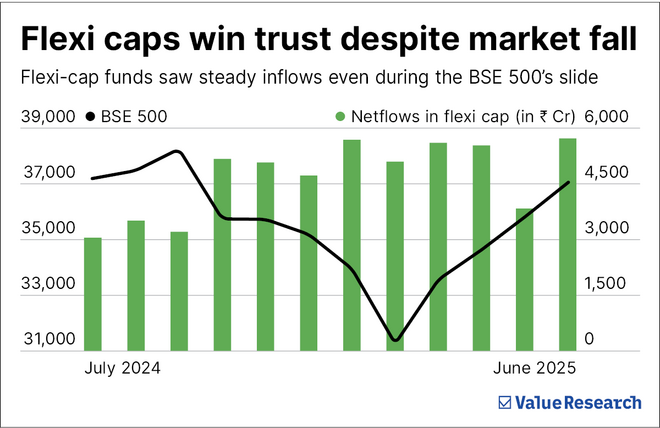
The recent inflow pattern reflects not just investor preference, but also increasing awareness of what flexi-cap funds offer: freedom to reposition without structural constraints.
What makes flexi-cap funds unique
The biggest strength of flexi-cap funds lies in their name — flexibility. As defined by SEBI, these equity schemes are free to invest across large-, mid- and small-cap stocks without any minimum allocation constraints.
This sets them apart from other categories like multi-cap and large-and-mid cap funds, which come with rigid allocation rules. Multi-cap funds must maintain at least 25 per cent each in large, mid and small caps, while large-and-mid cap funds must invest a minimum of 35 per cent in both large and mid caps.
Such rigidity can become a disadvantage when certain market segments face sharp drawdowns. In contrast, flexi-cap funds can avoid overvalued pockets and shift to more reasonably priced opportunities.
As Ajay Khandelwal, fund manager at Motilal Oswal Mutual Fund, puts it: “Multi-cap or large-and-mid cap funds are required to follow SEBI-mandated allocations, whereas a flexi-cap fund has the freedom to allocate dynamically across market caps based purely on market opportunities and valuation comfort. This flexibility enables the fund manager to adjust allocation between large caps for relative stability and mid and small caps for potential growth depending on the prevailing macro environment and market outlook.”
Amey Sathe, fund manager at Tata Mutual Fund, echoes this view: “The absence of market capitalisation constraints provides the flexibility to allocate across segments purely based on valuation, fundamentals and market outlook. This becomes especially valuable during periods of elevated market valuations.”
Risk and return: The category’s performance
Flexi-cap funds aren’t just structurally flexible — they’ve backed it up with solid numbers. Our analysis of three-year performance shows that these funds have delivered on both fronts: strong returns and controlled risk.
The top quartile of funds generated an alpha of 6.5 per cent. What does that mean? Simply put, alpha is the extra return a fund delivers over and above the market benchmark, after adjusting for risk.
Flexi-cap funds: Strong, steady and versatile
With balanced risk metrics, flexi-cap funds prove to be a reliable choice across market phases.
| Period | Category avg return (%) | Top quartile (%) | Bottom quartile (%) | Alpha | Standard deviation (%) |
|---|---|---|---|---|---|
| 3Y | 20.9 | 26.1 | 16.0 | 6.5 | 13.8 |
| Returns as of July 10, 2025 and risk measures as of June 30, 2025. | |||||
This data confirms two things: there’s meaningful performance among the best-managed funds, and risk has been well-contained.
A look inside the portfolios
On average, flexi-cap funds hold 50 to 70 per cent in large caps, 10 to 25 per cent in mid caps and 5 to 25 per cent in small caps.
Sector-wise, the top bets across flexi-cap funds (as of June 2024) are:
Where flexi-cap funds are placing their biggest bets in 2025
| Sectors | Average allocation (%) |
|---|---|
| Financial | 29.2 |
| Technology | 13.9 |
| Consumer Discretionary | 12.8 |
| Industrials | 11.9 |
| Healthcare | 7.6 |
| Based on the sector allocation as per portfolio disclosures up to June 30, 2025. | |
How fund managers use this freedom
Many fund managers follow a sector-first approach. They identify macro themes or sectoral tailwinds, and then pick stocks — whether large or small — that best represent those ideas.
Sathe of Tata Mutual Fund elaborates: “We focus on sectoral opportunities first. Market cap is a byproduct. Liquidity is considered only when small-cap positions are significantly illiquid.”
This flexibility becomes especially useful during volatile or uncertain periods. In a discussion with us, Ajay Khandelwal, fund manager at Motilal Oswal Mutual Fund, revealed that between January and June, when the market was oscillating from pessimism to optimism, its flexi-cap fund increased large-cap allocation (for stability) from 37.2 per cent to 49.5 per cent, while reducing exposure to mid caps from 42.9 per cent to 38.6 per cent and small caps from 3.3 per cent to 1.9 per cent.
Interestingly, some worry that as funds grow in size, they lose flexibility. But top fund houses argue that portfolio design, not just size, determines agility.
“We believe that getting sector calls right is the key to navigating the challenges of large AUM. When sector allocation is well-aligned with macro and valuation trends, stock selection becomes a natural extension of that thesis — and market capitalisation is simply the outcome of that process, not a constraint,” explained Sathe.
The flexi-cap fund scorecard
If you’re looking for standout performers, the following table ranks leading flexi-cap funds on two key metrics: SIP returns and alpha.
Top performers of the last three years
| Fund name | 3Y SIP Return (%) | 5Y SIP Return (%) | 10Y SIP Return (%) | Alpha (%) |
|---|---|---|---|---|
| BSE 500 TRI | 17.5 | 17.8 | 16.4 | - |
| Invesco India Focused | 29.4 | - | - | 8.0 |
| Motilal Oswal Flexi Cap | 28.2 | 22.5 | 16.6 | 8.2 |
| ICICI Prudential Retirement - Pure Equity Plan | 27.9 | 27.1 | - | 7.2 |
| Invesco India Flexi Cap | 26.6 | - | - | 7.6 |
| ICICI Prudential Focused Equity | 25.6 | 24.3 | 19.8 | 6.7 |
| HDFC Focused | 24.4 | 26.4 | 19.5 | 9.5 |
| HDFC Flexi Cap | 23.7 | 25.2 | 19.9 | 7.9 |
| Bank of India Flexi Cap | 23.2 | 23.6 | - | 4.7 |
| Bandhan Focused | 22.8 | 19.7 | 16.4 | 3.8 |
| Parag Parikh Flexi Cap | 22.6 | 21.5 | 20.9 | 8.8 |
| Funds have been sorted based on three-year SIP returns. Returns as of July 10, 2025; risk measures as of June 30, 2025. | ||||
Clearly, several funds are delivering strong, consistent returns across timeframes — while staying within acceptable risk bands.
Who should invest — and how much?
Flexi-cap funds are best suited for investors looking for a core equity allocation that can remain relevant across market cycles. Because they don’t rely on any one cap segment, they reduce the risk of being caught on the wrong side of a market trend.
A prudent allocation in the equity asset class could be:
- 50 to 70 per cent of your equity portfolio in a flexi-cap fund
- Supplemented by select mid-cap, value, or small-cap funds for diversification
But not all flexi-cap funds are equal. When evaluating, focus on consistency across cycles, drawdown control and fund manager tenure. Avoid funds that are under-diversified or take too many riskier allocations.
Final thought
In investing, adaptability often beats aggression. Flexi-cap funds are designed to adapt. They allow fund managers to reposition, protect and participate — without being boxed in by regulatory allocation limits.
For investors, that means fewer switches, less stress and a smoother compounding journey.
Want to start a Rs 10,000+ SIP in a flexi-cap fund?
One (or more) of these flexi-cap funds could be the smartest SIP decision you make this year. They're built to adapt, built to last and built to compound across market cycles.
Want to know which fund/s can anchor your portfolio — and why our analysts think highly of them? Subscribe to Value Research Fund Advisor and get expert-backed fund recommendations tailored to your goals.
Also read: Guess which funds have got Rs 43,000 crore in last 90 days?
Disclaimer: This content is for information only and should not be considered investment advice or a recommendation.
For grievances: [email protected]
Ask Value Research 
 New episodes every Friday










 New Process Alert
 Seems like you've uploaded a wrong QR code. Please upload the QR code downloaded from MF Central platform.


