 Widely read:




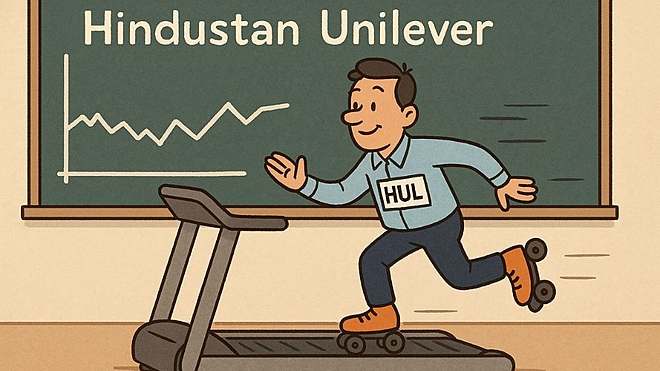 AI-generated image

Investors often cheer rising profits, assuming that more earnings automatically mean better shareholder returns. But what if a company’s profits are growing and yet its stock price barely moves? Case in point: FMCG giant Hindustan Unilever (HUL).
HUL: A growth story that didn’t pay off
HUL has grown its profits at a respectable 8.6 per cent annually over the past five years. But its stock price was up just 1.3 per cent a year in the same period. The problem? Poor efficiency.
After acquiring GSK Consumer in 2019 (integration completed by 2021), HUL’s shareholder funds or book value surged by Rs 40,000 crore. This was a massive 480 per cent jump in shareholder equity in FY21, but sales rose only 18 per cent in the same year. Naturally, profit growth did not keep pace either.
As a result, its return on equity (ROE), which averaged a stellar 43.8 per cent in FY20–22, dropped to 20.6 per cent in FY23–25.
This was a textbook example of inefficient capital allocation. The acquisition did not lead to a commensurate profit surge and HUL effectively overpaid for an asset that didn’t deliver incremental returns.
Why ROE is as important as earnings
This case study highlights the role of ROE (profit after tax/shareholders’ equity) —a metric that tells you how efficiently a company is using shareholder money to generate profit.
Higher ROE means a company is squeezing more profits out of its equity base—an indicator of good capital allocation and efficient business execution. Warren Buffett, famously, prefers tracking ROE over EPS growth for this very reason.
But if a company’s shareholder equity balloons faster than profits, as in HUL’s case, ROE falls, signalling that the company is earning less for every rupee of shareholder capital.
Berger Paints is another example of how profit growth might not be enough for generating returns.
Berger Paints: Growth under pressure
Berger Paints saw its profit grow by 12.4 per cent annually over the last five years. But shareholders earned a modest 4.8 per cent annualised return on the stock.
Why?
In recent years, intensified competition—especially from Grasim’s entry into the paint business—forced Berger to protect its turf by keeping volumes up and prices low, sacrificing margins. As a result, profits couldn’t keep pace with the rise in book value.
The company’s ROE slid from a three-year average of 24.1 per cent (FY20-22) to 21.4 per cent (FY23-25). It’s not a dramatic collapse, but it signals a squeeze on efficiency, stemming from pricing pressure.
The lesson
Both HUL and Berger Paints remind us that growth in isolation is not enough. What matters is the quality of that growth. If a company is piling on equity without earning more per rupee invested, ROE drops. And when ROE drops, shareholder returns usually follow.
So, as an investor, don’t stop at green profit numbers or upbeat commentary. Dig deeper. Track ROE trends across time. If a company is expanding but earning less per unit of shareholder capital, it’s not creating value but diluting it.
Also read: Why HDFC Life, Bata, 3 others have lagged Sensex for 5 years
Ask Value Research 

 New episodes every Friday











 New Process Alert
  Seems like you've uploaded a wrong QR code. Please upload the QR code downloaded from MF Central platform.


