




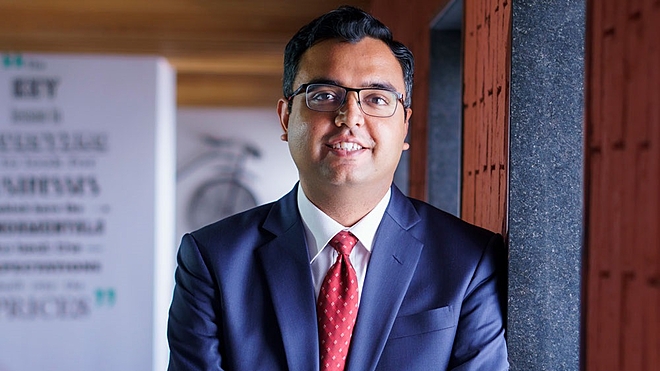

Rukun Tarachandani doesn’t believe in chasing momentum. As Fund Manager at PPFAS Mutual Fund, he lets the opportunity set do the talking. And when valuations look stretched, he’s perfectly comfortable sitting on cash.
Today, Tarachandani oversees five schemes at PPFAS with total assets under management of Rs 1.10 lakh crore. Among them is the PPFAS Flexi Cap Fund—rated five stars by Value Research—known for its disciplined, bottom-up stock picking and willingness to wait.
In this conversation, he explains the principles that guide his stock selection, how cash holdings are a by-product, not a strategy, and why 15-20 per cent of the market still holds value despite elevated valuations. Below is the edited transcript of the interview.
How do you see global issues like geopolitical tensions and potential US tariffs affecting Indian markets in the near to medium term?
In the near term, there will be volatility, primarily because the stance on tariffs is unclear. One day, there’s talk of tariffs on the pharmaceutical sector, and the next day, there isn’t. The uncertainty around which sectors will ultimately face tariffs, the quantum of those tariffs, and which geographies will be affected creates ambiguity. As this evolves, we may continue to see stock- and sector-specific volatility in the markets in the near term.
However, in the medium to long term, it’s ultimately the fundamentals of a firm—its earnings growth and business fundamentals—that will drive returns for individual stocks and the stock market as a whole.
So, when do you see fundamental factors, like earnings growth and economic recovery, coming back into focus?
At a macro level, we don’t actively track or forecast what the earnings of the index will be over the next six months or a year. Our focus is predominantly on bottom-up stock picking. Even now, earnings are mixed—some companies are delivering strong results, while others are facing challenges.
For instance, sectors like paints and wires are experiencing intense competition, which may persist for a while. At the same time, other sectors and firms are performing well. As bottom-up stock pickers, we aim to identify companies with stable prospects for the next three to five years.
With the recent volatility and high valuations in Indian markets, what key signals are you watching to spot risks or signs of recovery?
As I mentioned, we focus heavily on bottom-up analysis and stock-specific fundamentals and earnings. We don’t place much emphasis on top-down indicators like GDP growth or macroeconomic factors such as disposable income. While we’re aware of these factors and keep them in mind when evaluating opportunities, our decisions to buy or sell are driven by the fundamentals of individual stocks. One aspect we do track is how valuations of stocks and the market as a whole evolve over time.
For instance, the median P/E ratio of the top 500 stocks is around 40 times. Even during the recent correction, this dropped to about 30–32 times. In aggregate, valuations remain expensive, but roughly 15–20 per cent of the market is still reasonably valued, offering opportunities we aim to capitalise on.
Can you share your investment philosophy and what guides your stock picking at PPFAS?
The first guiding principle is corporate governance and management quality. As minority shareholders, we prefer to invest in firms where the majority shareholder or promoter treats minority shareholders fairly.
The second principle is that we seek firms with strong cash flows and balance sheets that, over a full cycle, deliver a return on capital significantly higher than their cost of capital. As long-term investors, we typically hold companies for four, five, or more years. During this period, there may be three good years and two bad ones, so we want companies that can survive and thrive during tough times, which is where balance sheet strength and cash flows are critical.
Finally, we aim to buy firms at attractive valuations. We believe every stock, no matter how strong the management or business, has a fair value, and we seek to buy at a discount to that value to ensure a margin of safety. These three principles guide our stock-picking process.
The Flexi Cap Fund has maintained a cash holding of over 20 per cent, which cushioned the impact of the correction we saw from September 2024 to February 2025, but may have missed gains in the recent rally. What factors drive your decision to hold such a high cash allocation?
Our stock picking is bottom-up, and our cash allocation is not a top-down decision. Many external observers assume we have a model based on macro indicators or market levels dictating a 20-25 per cent cash holding, but that’s not the case. Our cash allocation is a residual outcome of the stock-picking opportunities we identify. If we find good investment opportunities that we believe will deliver decent returns over five years, we invest. If not, we’re comfortable holding cash in the interim.
Our decision to deploy cash isn’t tied to market levels. For example, we don’t wait for the Nifty to correct to a specific point. If a stock on our watchlist corrects to an attractive level, even if the Nifty remains unchanged, we’re happy to deploy cash. That’s how we approach cash allocation.
Given the current market rally and high valuations, what specific triggers are you waiting for to deploy the Flexi Cap Fund’s cash reserves?
We’re not waiting for any external event to deploy cash. We actively track a watchlist of about 80–100 names, though our broader research coverage is larger. These 80–100 stocks are ones we debate regularly. If any correct due to short-term reasons and their valuations become attractive, or if we gain more confidence in a business and believe a higher valuation is justified, we may deploy cash to include them in the portfolio. There’s no specific external trigger we’re waiting for.
You’re currently holding around 85 to 90 stocks in the Flexi Cap Fund’s portfolio. How many stocks are on your watchlist, and how do they flow into the main portfolio?
The 85–90 stock figure is higher than our core holdings because it includes arbitrage positions, which don’t drive our equity returns. The core equity stocks number between 25 and 30.
Regarding the watchlist, roughly 15–20 per cent of the top 500 stocks—about 100 names—are businesses we like from a fundamental perspective and are at valuations where, if they correct by 15–20 per cent or if we gain more confidence through earnings updates or channel checks, they become investable. These stocks may gradually trickle into the portfolio.
How does the Dynamic Asset Allocation Fund shift between equity, debt, and other assets based on market changes? What factors guide these decisions?
Our Dynamic Asset Allocation Fund is designed for conservative investors who prefer a higher debt allocation. We maintain unhedged equity at less than 20 per cent of the portfolio. To achieve tax efficiency, we ensure total equity, including arbitrage positions, exceeds 35 per cent, with the rest in debt.
This structure provides long-term capital gains tax benefits for investors holding for over two years while keeping volatility low due to the 80 per cent or higher allocation to arbitrage and debt, making it suitable for those seeking a debt-heavy portfolio.
What makes your Dynamic Asset Allocation Fund stand out from other balanced or hybrid funds (in delivering stability for investors), especially in a high-valuation market?
Most balanced advantage funds target equity-oriented investors, with equity allocations between 40 per cent and 70 per cent, leading to higher volatility driven by equity returns.
In our case, with unhedged equity below 20 per cent, volatility is significantly lower, making it ideal for investors seeking a higher debt allocation with tax efficiency. They avoid taxation at their slab rate, making this an attractive product for conservative investors.
Can you walk us through the fund’s strategy for capitalising on arbitrage opportunities and how it ensures low-risk returns in a fluctuating market?
In our Arbitrage Fund, we buy the underlying stock and simultaneously short its futures. For example, if a stock is at Rs 100 and its futures are at Rs 101, we capture the one-rupee spread, which, after transaction costs, determines the fund’s return. This return is uncorrelated with equity market volatility, so whether the stock or market moves up or down, the fund should earn that spread over the holding period.
Historically, arbitrage fund returns are similar to liquid funds but offer tax advantages, as hedged equity exceeds 65 per cent, providing capital gains taxation benefits, which is especially valuable for investors in higher tax brackets.
PPFAS is known for launching funds only when there’s a genuine need to serve investors. Do you foresee a multi-asset or aggressive hybrid fund offering from the AMC in the near future?
As of now, there are no plans to launch either of those funds.
Also read: Valuations better, but far from cheap: HDFC's equity head
Ask Value Research 

 New episodes every Friday




 New Process Alert
  Seems like you've uploaded a wrong QR code. Please upload the QR code downloaded from MF Central platform.


