




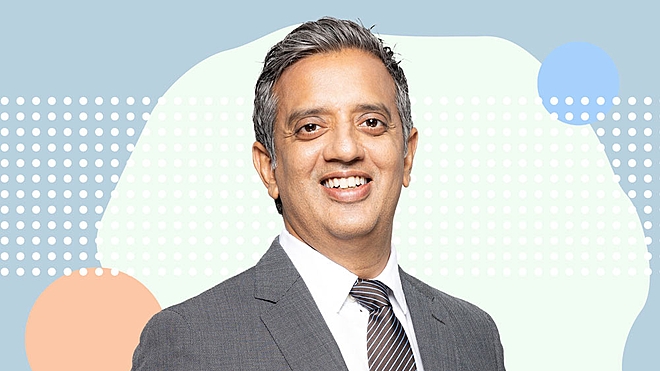

Simple. Steady. Sharp. That’s how many would describe Chirag Setalvad. As Head of Equities at HDFC AMC, Setalvad manages over Rs 1.4 lakh crore spread across four equity schemes. His flagship HDFC Mid-Cap Opportunities Fund is among the largest and most respected in its category, holding a five-star rating from Value Research.
But his story isn’t just about AUMs and alpha. It’s about discipline, humility and a philosophy shaped early on by mentor Sanjoy Bhattacharyya. In this interview, Setalvad talks about staying grounded in bull markets, keeping things simple in a noisy world, and why size alone doesn’t dictate fund performance. He also shares how he thinks about valuation in today's market and the real secret to consistent investing.
Here’s an edited excerpt of our interaction.
You've often credited Sanjoy Bhattacharyya for teaching you the core principles of investing. How have those principles guided your career at HDFC AMC?
From a career perspective, I attribute a lot to Sanjoy; he's been pivotal. He introduced me to this business and was incredibly well-read, well-known and intelligent, with a fantastic passion for investing that rubbed off on me over time. He recommended the right books, which made a huge difference, and I read voraciously in those days.
Sanjoy emphasised the importance of long-term investing, margin of safety and independent thinking – core principles that are easy to list but hard to internalise. His passion and knowledge helped me internalise them. Importantly, he gave me a break early in my career. I started managing my first fund just two or three years into my time at HDFC, when I was still wet behind the ears. He told me: Don't be afraid of making mistakes. Don't seek them out, but be confident. That gave me immense confidence. We used to sit with annual reports, reconciling P&L, balance sheets and cash flows, and he patiently explained these concepts when nobody else had the time. I jokingly tell him he gets the credit and the blame, depending on my performance.
You've said your mantra is, 'Work hard, think independently and keep it simple'. How do you apply this philosophy to your investment decisions, especially in today's complex market?
Working hard is important, but it is overstated. You can't be lazy, but this isn't a business where the smartest or hardest-working person always comes out on top. Character and how you think about investing matter more. Every investor is different, and you must play to your strengths.
Growth investors may look down on value investors and vice versa, but the key is intellectual honesty about what works for you. You need to work reasonably hard, stay within your circle of competence and be honest about what you do and don't understand. When investing in things you don't fully understand, know why you're doing it.
Long-term investing is crucial, as is independent thinking, given the many opinions from analysts, colleagues and market gurus. I'm fairly sceptical of what management or analysts say and try to keep things simple. If it's too complicated, it's probably not worth doing. Peter Lynch said you should explain your investment rationale with a piece of paper and a crayon, and I firmly believe that. Hard work helps, but simplicity and independence are key.
Can you walk us through how you evaluate a company, from the initial research to the final investment decision? How does this differ for mid- and small-cap stocks?
The process is largely the same regardless of market cap, and I suspect it's similar for everyone; there's no magic formula. For a new or existing company, we aim for a detailed understanding. We form an independent view, meet the management multiple times (ideally including the CEO or owner) and gain perspective on the industry and competition. We assess valuations from historical and relative standpoints across different metrics to form a holistic view. We challenge ourselves, discuss with others who may support or oppose our view and consult analysts within and outside our team, as well as our competitors.
Execution is critical – scaling into a company in the portfolio, not just theorising. We also analyse the past, not just the future. Looking at historical performance, growth, profitability and how companies handle different environments is vital. Sanjoy introduced me to Capital Markets magazine, a key resource back then, and I still rely on its historical data. We analyse cash flows and ratios to build a comprehensive perspective.
With mid- and small-cap valuations still above their long-term averages, how are you adjusting your approach to investing in these segments?
We don't adjust much, whether it's a raging bull market, bear market or something in between. We operate as if we're agnostic to the market.
In a bull market, you shift from absolute to relative valuations because absolute valuations would leave you with nothing to buy. In a bear market, you're spoiled for choice, but there are more questions about the company, industry or country outlook. Independence means not just thinking independently of others but also the market – don't get carried away in euphoria or despair.
In a bull market, everything is expensive, so you focus on relative value, knowing it's riskier. We're not absolute return investors; if the market drops 10 per cent and we're down 5 per cent, we've done well. The approach remains consistent – the more things change, the more they stay the same.
After the recent market correction, how do you view the current valuation levels in India? Are there any sectors or stocks that seem more attractive now?
We've seen a correction, but a recent bounce-back has erased much of it. Context matters – not just the last two or three years, but the previous decade. Mid- and small-cap 10-year CAGRs are around 14-15 per cent, while large caps are around 12-13 per cent.
After a strong rally, valuations became very expensive. A correction from a reasonable market gets you to cheap quickly; from an expensive market, it gets you to reasonable; from a very expensive market, it takes a lot to reach reasonable. We've gone from a 50-60 per cent premium to a 15-20 per cent premium – better, but still expensive. We're not at long-term averages or a discount to long-term averages. One could argue averages should rise due to lower debt-equity ratios or a higher ROE, but I won't delve into that. The market will likely be volatile and not poised for a runaway rally, given elevated valuations and global uncertainties like tariffs and slowing growth in the big economies like the US and China. That will also take a huge toll on India.
I think the operating margins in India are at a multi-year high, which poses a little bit of a challenge. I would argue we are somewhere in the middle, tilted towards the expensive side. When you're cheap, you get fantastic returns. When you're expensive, we get terrible returns. When you're in the middle, you get normal returns. So, I think a lot of stock picking can be done. We can try adding alpha as far as possible in a volatile environment, which becomes a bit easier.
The HDFC Mid-Cap Opportunities and Small Cap Fund are among the largest in their categories. How challenging is it to deploy steady inflows without compromising your stock-selection framework?
The notion that fund size is the primary determinant of performance is a misconception. Multiple factors, including stock selection, sector allocation, investment style, luck and, to some extent, size, influence performance. Size can impact stock selection, but it is not the sole driver of performance. If size were the only factor, one could simply sort funds by size, such as mid- or small-cap funds, invest in the smallest funds and avoid the largest ones to achieve superior results. This approach would eliminate the need for distributors or fund managers. However, historical evidence does not support this.
For example, HDFC's mid-cap fund, the largest in its category, has experienced periods of bad, average and strong performance over the past decade, all while remaining the largest fund. If size were the only factor, we would have consistently underperformed. Similarly, we would have consistently outperformed if performance relied solely on exceptional management. Instead, a combination of stock selection, sector allocation, style, luck and size drives outcomes.
This pattern is not unique to HDFC. Other fund houses show that large-sized funds can perform well while small-sized funds can underperform. The reality is complex, and performance cannot be reduced to a single factor like size.
The HDFC Small Cap Fund has consistently demonstrated resilience during market downturns. While it may not consistently outperform in euphoric phases, its ability to protect the downside stands out. Could you share the key principles behind your risk mitigation strategy?
Risk in investing stems from not fully understanding what you're doing, as Sanjoy advised me early in my career. The less you understand, the greater the risk. The goal is to build a portfolio of high-quality companies trading at reasonable valuations and managed by honest and competent leadership. However, achieving all these qualities simultaneously is challenging, so compromises are necessary. The key is deciding how much to compromise on valuation, business or management quality, and that's tricky.
We maintain a diversified portfolio, consistently holding 70-80 stocks, regardless of fund size. This diversification spans both stocks and sectors, focusing on reasonable quality. We aim to avoid the extremes of overvalued stocks or low-quality businesses with cheap valuations, instead targeting a balanced middle ground. We also seek opportunities during adversity, whether at the market or stock-specific level, as both good and bad times are temporary for markets and companies.
A conservative, long-term approach further reduces risk. By holding investments for extended periods and avoiding high-churn, high-risk or low-quality portfolios, we enhance the portfolio's risk profile.
Also read: Balanced advantage 'notch higher' than other hybrid funds
Ask Value Research 

 New episodes every Friday




 New Process Alert
  Seems like you've uploaded a wrong QR code. Please upload the QR code downloaded from MF Central platform.


