




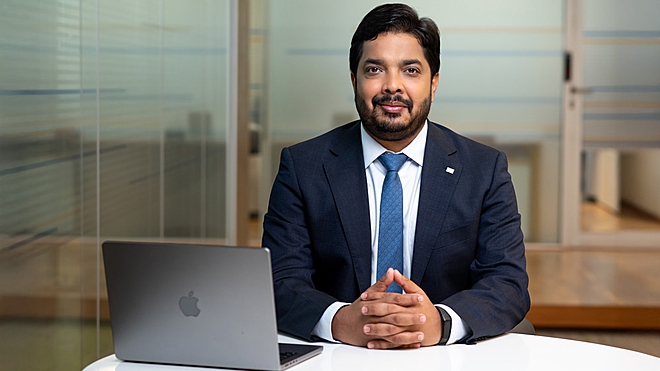

Driven by his passion for investing, Siddharth Srivastava - Head of ETF Product and Fund Manager at Mirae Asset Investment Managers (India) - naturally gravitated towards a career in equities. However, he soon realised that he was drawn to the passive side of things, thanks to its "systematic and method-driven approach".
With a portfolio of seven schemes and nearly Rs 7,000 crore in assets under management, Srivastava plays a key role in shaping Mirae Asset's passive strategy.
As Indian investors increasingly turn to index-based products, he explains what's driving this shift — from consistent underperformance of active funds to why international investing through ETFs is "obvious", especially because Nasdaq and S&P 500 have corrected in recent months.
Here's the edited excerpt of our conversation.
What sparked your interest in equity markets, and why passive funds specifically?
My father was and is an avid investor. He introduced me to mutual funds and investing when I was in college. I also started following news and commentaries, which grew my interest in stock markets. I always liked data and associated analytics within stock markets more than subjective analysis.
I was exposed to plenty of data analytics when I joined my second job at MSCI, an index company. Then, when I was at NSE, I was into index development, where I loved innovating and developing new index products, related back-testing and data analytics. The systematic and method-driven approach of passive investing made me appreciate the entire ecosystem more.
How would you explain an ETF to a first-time investor? And what's behind the growing popularity of ETFs in India?
ETFs are low-cost funds which track the performance of an underlying index. You can buy and sell them on an exchange, just like stocks. Unlike an index or a mutual fund, which you must buy at the day's closing net asset value (NAV), you can buy or sell ETFs at an intraday net asset value. This allows you to use market volatility for several purposes. You can use ETFs for core allocation by investing in simple products like Nifty 50, Sensex 30, Midcap 150, etc. You can also use them for tactical allocation in themes and sectors, or to take advantage of market volatility. For example, if the market is down 2 per cent by noon, you can buy an ETF at a 2 per cent lower price and then sell it whenever you feel the price is at the desired level. That's what ETFs do - they give you flexibility and accessibility which is not the case with other fund types.
Lastly, we believe their popularity is not solely because active funds are underperforming the benchmark, but also because a lot of innovation is happening on the passive side. There are a lot of different products which are only available on the passive platform. So, it's not just active versus passive; it's also about people looking for opportunities to invest in something new, something different, something that finds a lot of flavour in their portfolio.
How should lay investors choose, for example, between Hang Seng or FAANG ETFs?
The overall industry limit for international exposure is $7 billion for investing in overseas securities and an additional $1 billion for investing in international ETFs. Some time back, the industry reached these thresholds and was stopped from making fresh investments unless a room was created because of redemptions. These limits have yet to be revised up by regulators. So, most international funds are closed for investments, including our very popular FANG+ ETF, S&P 500 Top 50 ETF and Hang Seng Tech ETF. But since you've asked, I'll say that when you're investing globally, you're investing for multiple reasons. One is to take exposure to stocks, themes and sectors not present in the domestic market. Is there any semiconductor company in India? The answer is no. Is there any company genuinely doing AI? The answer is no. Is there any robotics company at the global big tech level? The answer is no. So, investors get those exposures.
Second, the correlation of international markets is lower than the domestic equity market, so it helps lower the risk of your overall portfolio. Third, typically, the Indian rupee depreciates in the long term against the dollar, adding to the return you get if you invest in a stronger currency like the US dollar.
I feel investing in selected international markets should be an obvious choice. Recently, FANG corrected, along with NASDAQ and S&P 500, by almost 15-20 per cent; these could potentially be good entry levels for exposure in such segments. Yes, Trump has created a lot of uncertainty and jitteriness in the market. This situation is still evolving. It's difficult to predict the impact on corporate earnings or inflation. Most likely, we might see the onset of a potential recession in the US. But what hasn't changed is the appetite for new-age technologies, semiconductors, AI, cloud, etc. FANG constituents are leaders in their domain, and they're down by 15-20 per cent or so. Any deep correction can help potentially accumulate units in FANG+ or the S&P 500 Top 50, but more so in FANG+. However, please note that due to the limit being closed, ETFs may trade at a premium, and hence, we request all investors to look at the iNAV while transacting in any international ETFS.
As the Head of ETFs at Mirae Asset, how do you design a new ETF? What core principles guide your approach?
First, we are product manufacturers and believe in providing useful solutions to investors. From a utility point of view, people may invest with a long-term view or tactically from a short-term perspective. They can also use products to complete their portfolios. The utility of passive products is enormous right now; numerous use cases exist. When we create a product, it can be cater to a particular use case.
For a simple product like the Nifty 50, a plain-vanilla product, it's pretty simple. If there's an existing popular index, we launch a product on it, if it has a lot of merit in an investor's portfolio, and there is market demand. Typically, we launch it at a very low cost. Simple products are often the best from a long-term point of view.
When it comes to themes and strategies, we do more rigorous checks. We first decide the product's intent, the ideal method to target that intent and the target audience. We also examine whether a particular theme or strategy is scalable and has longevity. We focus on the right portfolio creation because that's the right way to go about things. Once we're sure about a product construct, we approach an index provider to develop a true-to-label index catering to a particular theme or strategy.
For example, we created the EV index with NSE. There's an auto index, but we wanted to target the EV ecosystem because we believe EVs have just started in India. It's scalable and has a lot of potential and longevity. Launching an ETF or an index fund on an auto index to take exposure to EV is insufficient because you have companies in chemical segments, battery manufacturers, companies creating car connectivity software, etc., which are also important players in the EV ecosystem. We approached it by creating a product that gives exposure to the entire EV ecosystem i.e., companies with PLI to develop batteries, underlying chemical producers, tech companies building ADAS systems, automobile manufacturers, part manufacturers key to EVs and autonomous vehicles, etc. That's how the idea was conceptualised, and the index was created to capture the entire ecosystem.
Finally, what key factors should an investor consider when selecting an ETF? For instance, how important are things like which index it tracks, the expense ratio or ensuring it matches their risk appetite?
The most important thing is the index methodology. Look at the index methodology and whether the intent of the index method matches your investment objective. Go into more detail, and look at the portfolio, as well as its long-term and historical performance from a calendar-year point of view. Some products are good in particular market cycles but may not do well in specific market phases. That's especially true for smart beta products like value, momentum, etc.
Once you've shortlisted a particular ETF and an index method, if multiple options are available, look at a fund with a lower expense ratio and an ETF where you see reasonable liquidity on the exchange. Which ETF to choose will depend on your risk profile, whether you're picking it for your core or satellite portfolio or venturing into thematic, international or commodity investing. There are a plethora of options, but use them wisely.
Whether picking an active or passive fund like an ETF, looking at your overall portfolio and its composition is very important. Focus on attaining the right asset allocation, passive or active, doesn't matter.
Also read: Growth in Financials, IT, Energy key to market recovery: DSP Mutual Fund's Rohit Singhania
Ask Value Research 

 New episodes every Friday








 New Process Alert
  Seems like you've uploaded a wrong QR code. Please upload the QR code downloaded from MF Central platform.


