




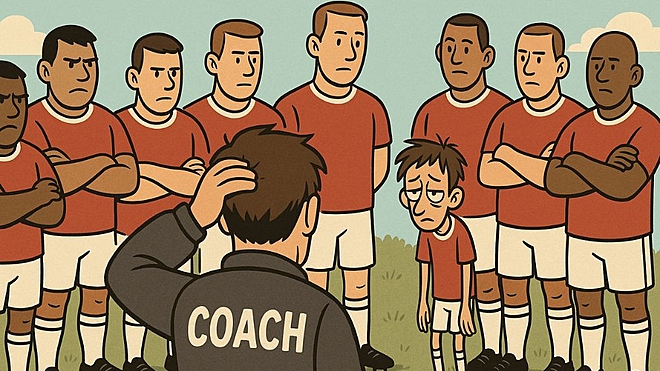
 Aditya Roy/AI-Generated Image
Every investor has that one fund in their portfolio. The underachiever. It doesn't grow when the market soars; it doesn't protect when the market falls. It just... exists. Like a toxic friend.
And yet, you hesitate to part ways. Maybe because you once believed in its potential. Or maybe because—let's be honest—you don't want to pay capital gains tax.
But here's the real cost: Holding on to a sluggish fund can quietly chip away lakhs from your long-term returns. So, let's unpack when you should cut the chord and let it go.
Not all hiccups are red flags, though
Even great funds can have a few dull quarters. Markets are moody, styles go out of favour and even the best fund managers can misread short-term trends. But when underperformance becomes a pattern—not a phase—it's time to dig deeper.
How to identify an underperformer
Spotting a true underperformer means looking beyond one-year returns. Here's what to watch out for:
1. Long-term underperformance: Has the fund consistently lagged its benchmark and category average for at least 2-3 years? A year of bad luck is excusable. Three? Not so much. For instance, if most funds in a category are delivering 12-13 per cent annually over five years and your fund has stuck to 9-10 per cent with no signs of catching up, it's more than just a passing shower.
2. Something's changed behind the scenes: Has the fund manager changed recently? Or has the fund started deviating from its stated style—say, a value fund suddenly chasing momentum stocks? If the DNA of the fund has shifted and performance hasn't improved, it's worth reconsidering.
3. Bloated portfolio, no conviction: If your fund is spread across a large number of stocks without holding significant stakes in any of them, it may have lost its investment focus. Diversification is good, but over-diversification can dilute returns and signal indecisiveness.
So, why don't we sell?
Three words: capital gains tax.
Many investors, even after recognising underperformance, stay put just to avoid paying tax. But here's the thing—not selling doesn't mean you're saving tax. You're simply deferring it.
You'll have to sell that fund eventually. You have to sell when you rebalance, need the money or retire. And when you do, the capital gains tax will still be waiting. It's not going anywhere.
What does go away in the meantime, however, is your opportunity to earn better returns elsewhere.
The 1 per cent trap
Let's say you have Rs 10 lakh in a fund that underperforms the category average by just 1 per cent annually. Over 10 years, here's what that means: A good fund delivering 12 per cent annually grows to about Rs 31 lakh. A lagging fund delivering 11 per cent annually grows to about Rs 28.4 lakh
That's nearly Rs 2.6 lakh lost (9 per cent of the potential corpus), just for holding on to a fund that didn't keep up.
And this assumes only a 1 per cent gap. If the underperformance is greater—as it often is—the long-term impact is even more painful. All to avoid a small tax bill today? That's not smart investing. That's financial procrastination.
When it makes sense to sell
We're not saying jump ship at the first sign of a slowdown. But if the signs are piling up, here's when it's worth taking action:
- The fund has underperformed its benchmark and peers for 2-3 years or more
- You see no improvement in performance, despite market recovery or changes in management
- The fund no longer fits your investment strategy or risk profile
- There are better funds in the same category delivering more, with comparable or lower risk
Final word
Your fund is not your friend. They're vehicles to help you get rich. If one breaks down repeatedly, it's okay to trade it in.
So, if your fund's been taking you nowhere for years, maybe it's time to drive a better one.
Wondering what our analysts think about your mutual fund portfolio? Try Value Research Fund Advisor—our premium service that tells you exactly which funds to keep and which ones to exit.
Also read: The hidden cost of adding 'just one more fund'
This article was originally published on May 01, 2025.
Ask Value Research 

 New episodes every Friday










 New Process Alert
  Seems like you've uploaded a wrong QR code. Please upload the QR code downloaded from MF Central platform.


