 Widely read:




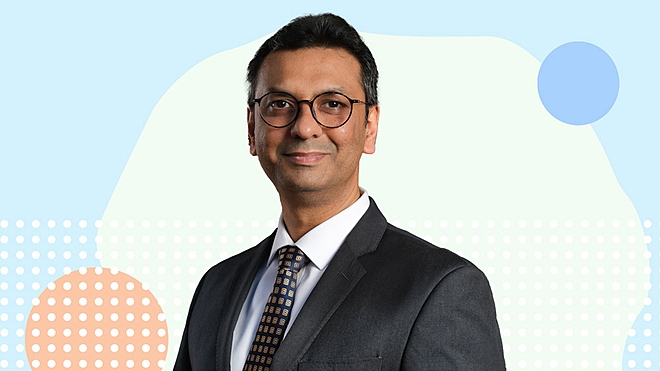

With nearly 25 years of experience in the equity markets, Nimesh Chandan brings a seasoned perspective to investing. The CIO (Chief Investment Officer) at Bajaj Finserv Mutual Fund blends analysis with an intuitive understanding of market psychology—a core element of 'InQuBe', the investment philosophy followed by the fund house.
In this interview, Chandan discusses why he believes large-caps now offer an attractive risk-reward ratio, sectors that look appealing after the correction and the factors that drove the recent outperformance of the Bajaj Finserv Flexicap Fund. Below is the edited transcript of our discussion.
What initially drew you to the world of equity investing?
I was always interested in the market, and the excellent mix of fundamentals and psychology made me even more curious. To be a good investor, one must know about valuation methods, business practices, historical trends and psychology. Since all four are my favourite subjects, they got me interested in the equity market.
What core principles guide your investment decisions? Do you have a specific framework to identify opportunities?
I've built it on a few key assumptions or learnings over the years. The first assumption is that crowds tend to be right on trends and wrong at the ends. Crowds start getting excited about a story; initially, they underreact to the new data and eventually overreact. This happens on the upside due to greed and on the downside due to fear. Therefore, it's crucial to recognise when a trend has become exaggerated or when individuals have overreacted, leading us to adopt a contrarian position.
Second, you must have your fundamentals about understanding a business firmly in place. Ultimately, a good business bought at a reasonable valuation will give you good long-term returns. Markets, economies and businesses have cycles.
Unfortunately, we try to always project in our Excel sheet in a straight line, but life unfolds in cycles, and we need to understand it better.
With these principles in mind, could you walk us through how you build your portfolio and identify opportunities?
As you know, investing is a combination of science and art. We take a top-down and bottom-up approach, trying to freeze as much science as possible. Looking at the top down, we look at megatrends and cycles; we try to track as many economic and business parameters as possible to understand these business cycles. Some of these higher tops and bottoms within the businesses create a trend. And megatrends are long-term changes that create many cycles and trends within themselves. So, we try to classify them and understand where we are in any business or trend. This helps us refine our top-down approach rather than just discussing a set of variables.
The second part is looking at bottom-up ideas. Here, we define bottom-up analysis as looking for companies or businesses that don't come to you through the top-down approach; they may have unique assets or positioning in the market, making them more attractive as a business rather than the whole sector or industry being attractive. Then, we go through certain screeners, which help us identify quality businesses or companies with good growth potential. That's how we shortlist companies. These are the businesses that we should research in depth going forward.
Your investment philosophy - the InQuBe framework - focuses on leveraging informational, quantitative and behavioural edges. Can you explain how this framework translates into your stock selection process? Specifically, how do you filter, evaluate and shortlist stocks for your portfolios?
When developing an investment philosophy for our company, we asked ourselves fundamental questions, such as how we can outperform the market. How can we do better than the crowd? How can we beat the benchmark? The answer is that there are three ways you can do better than the crowd or beat the benchmark. First, you can make better decisions by gathering superior information about businesses. Over the years, particularly in the last decade, we have been inundated with so much information that maintaining this edge has become difficult. Having superior information about all your businesses ahead of the crowd is challenging because information now moves very quickly.
The second edge is the quantitative edge. If you process the same information better than others, you can be a better investor. Therefore, gaining a quantitative edge involves processing economic, financial or market data through a quant, financial or macro model in a way that gives you better output and forecasts.
Some work has been done in this space, but much is still being done. In the future, models will also undergo replication. So, you must switch to the behavioural edge, the third and most vital edge. Even if people have the same information and copy each other's quantitative models, individuals react very differently to the output of those models. For instance, one person will see a falling stock price as an opportunity, while another will be scared. So, you must have a behavioural edge that makes you behave superior to the crowd. To do so, you must remove your own biases. And you must also see that when the crowd is greedy, you must be fearful. So, the behavioural edge acts as a mirror as well as a lens.
All this together forms our InQuBe investment philosophy, a common philosophy for both our equities and fixed-income funds. In equities, we use screeners, portfolio allocation models and quant models. As I said, we look at many different sources of information. We collect and organise this information in terms of cycles, trends and megatrends. We also use certain decision-making tools, like investment journals, behavioural screeners and pre-mortems, which give us a scenario analysis of valuations. We use many of these tools to help us improve our decision-making to select the right companies and allocate the correct weights to them in the portfolio.
With the recent pullback in Indian equities, do you think the worst is behind us, or are we in for more volatility?
It is difficult to time the exact bottom because people are reacting more to headlines than fundamental news these days. But the way correction has come about in the past six months, from the risk-reward ratio, at least the large-cap category looks attractive. However, as I said, many companies in the mid- and small-cap categories have become attractive due to their business growth, cash flow quality and valuations after this correction. So, from here on, suppose we don't get a re-rating upward of the market; there is a high probability that you will at least make compounding returns.
In terms of the compounding of earnings or profit growth, you will get depending on your investment. There's a very low probability of seeing a de-rating from here on. So, if we are not exactly at the bottom, we are somewhere close to the bottom in large caps. As far as mid and small-caps are concerned, though, the category is a little above average in terms of valuation. Many mid and small caps are now coming into a favourable value zone.
After the recent market correction, which sectors or themes look attractive at current valuations, and where do you still see risks?
I would put it this way: large-cap is preferred over mid- and small-cap as a category. Quality as a style and theme is preferred over growth, value and other factors. Third, if you look at themes or sectors, Pharmaceuticals, Healthcare and Consumption look attractive. BFSI is also looking attractive now; maybe this quarter, we will see some pressure on their numbers, but from next quarter onwards, we will start seeing better numbers.
The Bajaj Finserv Flexicap Fund did quite well in 2024. What were the key reasons for its outperformance?
In this fund, we invest in megatrends that unfold over a longer period. I believe we launched it at the right time. This was a unique strategy in the Indian mutual fund space.
We are using a growth style of investing in this fund, which becomes better using a megatrends strategy. Instead of forecasting growth for individual companies, we looked for a strong case for why this company should grow faster. Is it based on any megatrend or change we are seeing in the economy and businesses? During the last two years, we have seen many themes with high growth potential, whether in the Power sector, electric vehicles or even the consumption side, where we saw a good growth pickup. This method of identifying megatrends helped us pick up good companies with strong growth potential. While our target is always to create long-term alpha, we were rewarded by this strategy very quickly in the last one-and-a-half years since we launched the fund.
Also read: Interview with Amit Ganatra, Head of Equities at Invesco Mutual Fund
Ask Value Research 

 New episodes every Friday








 New Process Alert
  Seems like you've uploaded a wrong QR code. Please upload the QR code downloaded from MF Central platform.


