




 AI-generated image

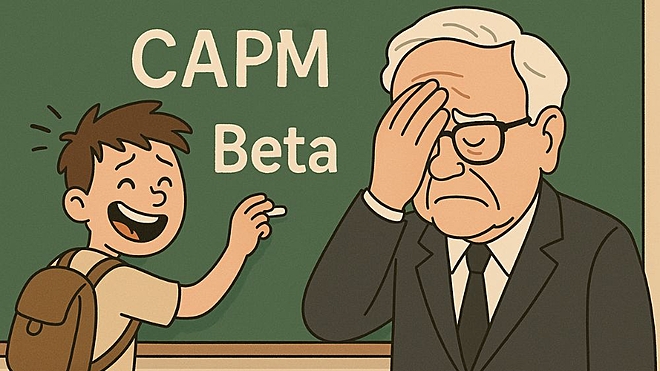
Over the past few weeks, I have been speaking to a bunch of candidates for our equity analyst role - mostly finance graduates, most of them fresh out of college. And nearly every one of them mentioned CAPM (capital asset pricing model) and beta like they were some sort of sacred scrolls. But when I probed deeper—"What is beta actually measuring? How does it relate to risk?"—they were stumped. For them, beta is just a number you plug into a DCF (discounted cash flow) model. CAPM is a formula you use because someone told you that is how you calculate the cost of equity. Not one of them paused to ask what these ideas actually meant.
It reminded me of something Buffett wrote back in 1993, which we are revisiting as part of our ongoing series on his letters. He took a jab at the academic obsession with beta—this idea that volatility is risk, that a stock becomes riskier if its price falls. Buffett called it what it is: fuzzy thinking dressed up in complex equations. After all, how does a price decline make a good business riskier?
The case for a concentrated portfolio
This is why Buffett and Charlie Munger chose concentration over diversification. Their strategy was never about spreading bets wide. It was about waiting patiently, thinking deeply, and betting big when the odds were stacked in their favour. As Berkshire's capital grew, their room for error shrank. So they simplified: they aimed to be smart only a few times in their lives, but smart in the right places.
And here's the thing. Concentration forces clarity. It makes you think harder about what you are buying. It demands that you understand the business, trust the people running it, and know why the price you are paying makes sense. The more you concentrate, the less you can afford to kid yourself.
This is why Buffett argues that portfolio concentration, if done thoughtfully, is not a source of risk. It's a safeguard against it. Because when you go deep instead of wide, you are less likely to mistake noise for knowledge. You won't fall back on a beta of 1.2 to explain away your thesis.
In other words, the more you actually think, the less you need a formula to feel secure.
The three kinds of boards
When people talk about corporate governance, they often speak in sweeping generalities - independent directors, board diversity, shareholder rights, and so on. But Buffett, as always, cuts through the jargon and asks a more fundamental question: what kind of owner-manager relationship are we really talking about?
He outlined three very different governance scenarios. And once you see it through this lens, it's hard to unsee.
Case 1: No controlling shareholder
First, there is the plain-vanilla public company (in the US) —no controlling shareholder, dispersed ownership, and a board that is meant to represent the collective interest of absentee owners. Sounds simple, but here's where it gets murky. The phrase "long-term shareholder interest" gives directors just enough wiggle room to justify almost anything. Hire a mediocre CEO? We are investing in stability. Approve an overpriced acquisition? We are creating long-term synergies. Overpay the top brass? We are aligning incentives.
Buffett's take is clear: in this setup, the board's job is to act like a single, rational owner. That means if management is incompetent - or greedy - the directors should step in, not sit back. And if persuasion fails? Go public. If it's serious enough, resign. The board's silence, not its structure, is often the real failure.
Case 2: Owner = Manager
Second, there is the case where the controlling owner is also the CEO like Buffett himself at Berkshire. Here, the board has no real power beyond persuasion. If the owner-manager goes off course, the best the directors can do is make noise. And if that doesn't work, the honourable move is to walk away. It's not about drama. It's about signalling that something is broken, even if you can't fix it yourself.
Case 3: Controlling owner ≠ Manager
Third, there is a rare but powerful structure: a controlling shareholder who doesn't run the company. In this case, the board's role becomes far more actionable. If the CEO is underperforming or overreaching, the directors can go straight to the owner. Just one conversation. One phone call. And things can change overnight if, of course, the owner is listening.
In all three cases, Buffett brings it back to the basics: the board exists to serve the shareholders, not the CEO. But too often, directors are picked for prestige rather than perspective. They may look good in the annual report, but they add nothing to the room where decisions are made.
Business savvy, independence, and owner-orientation—these are the real qualifications for a board member. Not the ability to nod politely in meetings. And definitely not the ability to stay silent when it matters most.
The final word
The real tragedy is not that most young finance grads can't explain what beta truly means. It's that they have never been taught to question it. Somewhere along the way, finance became a subject of formulas instead of first principles. But investing, as Buffett keeps reminding us, is not a branch of physics. It's not about memorising equations or reverse-engineering DCFs with plug-and-play assumptions. It's about thinking.
And thinking—really thinking—requires slowing down, focusing, and staying within your circle of competence. It means trusting judgement over jargon and clarity over complexity. It means asking what you are buying, why you are buying, and what could prove you wrong.
That is the deeper lesson in Buffett's 1993 letter. Whether he's talking about concentrated portfolios or better boards, he's nudging us towards something rare: a kind of investing that is less about motion and more about meaning.
And if we can teach the next generation of investors to think that way—not in CAPM acronyms but in the business owner's language—then maybe we will stop mistaking precision for understanding.
Also read: How IPOs' Day 1 heroes become medium-term villains
This article was originally published on April 10, 2025.
Ask Value Research 

 New episodes every Friday











 New Process Alert
  Seems like you've uploaded a wrong QR code. Please upload the QR code downloaded from MF Central platform.


