




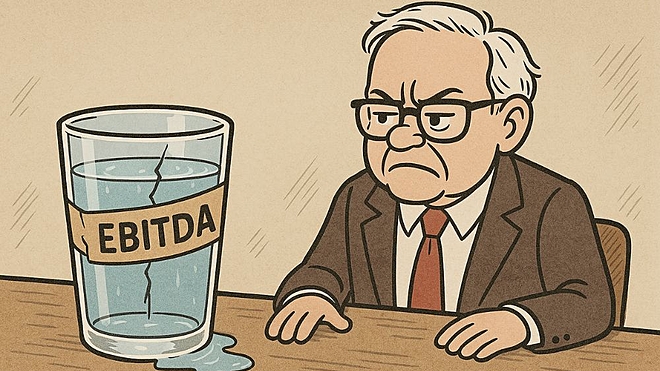
 AI-generated image

When Warren Buffett reflected on his 25 years of investing, it was not just about celebrating success but also dissecting mistakes. That is what makes his 1989 letter stand out. It's one of those brutally honest reflections that make you sit up and pay attention. It's packed with lessons on taxes, look-through earnings, debt-fuelled acquisitions, and why avoiding mistakes is often better than trying to fix them. We break it down in continuation of our story series covering his letters and their investing wisdom.
The power of tax deferral
Compounding works best when left undisturbed, but frequent selling can quietly erode its power. Buffett highlights one often-overlooked culprit: tax. Selling too soon means handing over a portion of your gains to the government, reducing the base on which future returns can grow.
To illustrate, he offers a simple thought experiment. Imagine investing Rs 1 in an investment that doubles every year. If you sell and reinvest each time—paying taxes along the way—you'll end up with around Rs 2.9 lakh after 20 years. But if you simply hold on and let the investment compound without interruption, you'd have Rs 9.2 lakh!
By deferring taxes, you let the full amount snowball for decades before the government takes its cut—giving you a far larger final sum. Buffett's message is clear: the longer you can postpone paying tax, the more powerful compounding becomes.
Look-through earnings: What you don't see might be more valuable
If you think reported earnings tell the whole story, think again. Buffett talks about "look-through earnings" as the real measure of a company's profitability. These are the earnings retained by investee companies that don't show up on Berkshire's income statement but are reinvested by skilled managers.
The key idea here is simple: Just because you don't see it doesn't mean it's not valuable. Buffett's logic is that talented, owner-oriented managers often put retained earnings to better use than shareholders would. The takeaway? Sometimes, the smartest move is to let the experts handle reinvestment instead of demanding it back as dividends.
We will touch upon this topic in detail in the 1990 letter.
Staying wary of the EBITDA illusion
In the 1980s, Wall Street's dealmakers decided that numbers were too boring. So, they cooked up a new recipe for profit—one that conveniently ignored reality. It all started with the leveraged buyout (LBO) craze, where companies were bought using enormous piles of debt. Initially, borrowers (companies) could only get away with this if free cash flow—operating profit plus depreciation and amortisation minus capital expenditure (including working capital)—could comfortably cover interest payments. That made sense. At least on paper.
But as the deal frenzy heated up, debt levels soared to the point where every dollar of cash flow had to go towards interest payments, leaving nothing to actually repay the debt itself. Debt wasn't something to be paid down anymore—it was just something to be refinanced endlessly.
And that's when EBITDA made its grand entrance. Instead of using realistic cash flow measures, companies created EBITDA—earnings before interest, taxes, depreciation, and amortisation—as a way to justify absurd valuations. In this fantasy world, depreciation wasn't treated as a real cost, even though ignoring it was like saying you'll never have to replace worn-out equipment. Real businesses don't get to skip maintenance, and machinery doesn't fix itself. It's like eating junk food and pretending calories don't count.
The result? A company might be bleeding money, but as long as it could show positive EBITDA, it was sold as a winner. Buffett rightly calls this practice delusional because capital outlays can be deferred for a while but not forever. Ignoring depreciation and interest payments just to make deals look good is like pretending a broken engine doesn't matter because the car still rolls downhill.
The real lesson here is that when debt becomes a permanent fixture and expenses are conveniently brushed under the rug, you are not running a business—you are playing financial Jenga, and the collapse is just a matter of time. Buffett's disdain for this kind of creative accounting is clear: reality doesn't care about your fancy acronyms. The numbers need to add up in the real world, not just on paper.
Buffett's mistakes of the first 25 years
Warren Buffett's reflections on Berkshire Hathaway's first 25 years reveal some timeless lessons. Here's a summary of his key takeaways:
- Cigar butt investing doesn't work
- Buying mediocre businesses at bargain prices rarely pays off in the long run.
- Even if you get a few puffs from a "cigar butt" investment, you are still left with a business that struggles to perform.
- A bad business with a temporary boost often returns to its poor performance.
- Time is the friend of a wonderful business, the enemy of a mediocre one
- Great businesses compound value over time, while mediocre ones erode it.
- The longer you hold a poor business, the more its weaknesses become apparent and costly.
- Good jockeys can't fix broken-down nags
- A great manager can't turn around a fundamentally poor business.
- When brilliant management meets a bad business, it's the business's reputation that survives.
- Avoid tough problems, focus on the easy ones
- After decades of experience, Buffett realised that solving difficult business problems is not worth the effort.
- Instead of tackling seven-foot hurdles, he learned to focus on one-foot hurdles that are easy to step over.
- The power of the institutional imperative
- Companies tend to continue on their current path, even when it makes no sense.
- Corporate funds are often spent on unnecessary projects or acquisitions simply because money is available.
- Senior managers tend to justify foolish initiatives with strategic studies and projections.
- Avoid associating with mediocre management
- Partner only with people you like, trust, and admire.
- Great people with poor businesses won't guarantee success, but trustworthy partners in good businesses can accomplish wonders.
The institutional imperative: Why smart people do dumb things
One of Buffett's most surprising lessons was discovering the "institutional imperative" —the unseen force that pushes even smart, decent managers into bad decisions. Companies resist change, chase unwise acquisitions, and follow the herd, even when it doesn't make sense. It's a humbling reminder that even the best leaders can fall prey to irrational behaviour.
To avoid this trap, Buffett emphasises surrounding himself with people he likes, trusts, and admires. Good people running good businesses are a winning combination. No strategy is foolproof, but starting with the right people is winning half the battle.
Closing thought
This letter crucially recognises traps that investors and managers fall into. Buffett doesn't just lecture about what went right; he lays bare what went wrong. It's a reminder that investing is more about avoiding mistakes than finding genius ideas. The goal? Stay patient, think long-term, and don't fool yourself with fancy metrics.
Also read: Buffett on inflation, EPS and buybacks (1978-81 letters)
This article was originally published on April 03, 2025.
Ask Value Research 
 New episodes every Friday







 New Process Alert
  Seems like you've uploaded a wrong QR code. Please upload the QR code downloaded from MF Central platform.


