




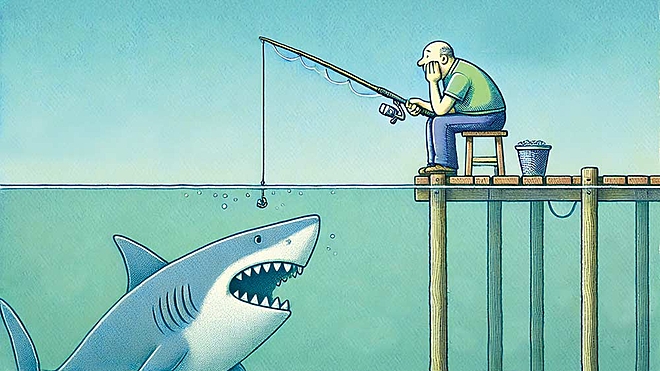
If the Greek king Odysseus had a stock portfolio, he would make an excellent value investor, not by picking bargains but by steering clear of their deceptive lookalikes—value traps. In The Odyssey, a famous ancient Greek story, Odysseus embarks on a long and perilous journey home after the Trojan War. Along the way, he and his crew encounter the Sirens, whose enchanting voices would promise to reveal untold secrets and knowledge but ultimately lead sailors to their deaths. In the stock market, value traps are not any different from these mythical creatures. With their low P/E ratios and seemingly robust financials, these stocks disguise themselves as bargains, enticing value-seeking investors. But their superficial appeal often masks underlying fundamental weaknesses that can't be captured by traditional metrics. For value investors then, it becomes crucial to exercise Odysseus-like restraint who resisted the beguiling siren call by tying himself to the mast of his ship and having his crew block their ears with beeswax. Value investors, too, can fight the temptation of seemingly low-cost winners by determining if they truly are bargains or only pretending to be one. We tell you how to do that. The illusion of value Are value traps that difficult to spot? They often are. Take, for instance, packaged foods company Mishtan Foods, which boasts a staggering 97 per cent five-year annualised profit growth and an enviable 39 per cent ROCE. All this at a staggeringly low P/E of just two times! A novice investor will easily mistake this for an undiscovered gem. But a closer look will reveal the company's high debtor levels have meant poor cash conversion over the years, with a CFO-to-EBITDA ratio of -3.8 times for FY20-24. This means the company struggles to turn its profits into actual cash flows. The result? A paltry 6 per cent annual return over five years, dramatically underperforming the broader market. Value traps don't announce themselves with warning labels. They often lurk behind seemingly attractive financial figures. So, how can one steer clear of such decoys? By evaluating factors that are not always apparent in standard financial statements. Here are some obvious ones to begin with. Spotting value traps: Red flags to keep on radar 1. Profits without cash flow. Profits are naturally seen as the touchstone of all financial performance. But they aren't enough on their own. A low P/E stock that consistently reports earnings growth might be enticing. But if the profits don't match cash flow, it will have no cushion when times get hard. Signs of poor cash flow conversion: Rising debtor levels (indicating revenue is being booked without actual cash collection) Poor CFO to EBITDA Stretched payables High working capital requirements (draining cash despite growing profits) Overstated earnings due to aggressive revenue recognition What to look out for: Compare cash flow against profit after tax over multiple years. If a company's profits are rising but its cash flow isn't, it's a sign of trouble. 2. The perils of a dying industry. Some stocks trade at low valuations not because they are undiscovered, but because investors see what's coming—a long, slow decline. Andhra Paper is a case in point. The company operates in the writing and printing paper industry, which has been shrinking for years due to digitalisation. Over the past 25 years, its median P/E has been just 8.6 times. That may look cheap, but it is cheap for a reason. Despite an impressive five-year median ROCE of 25 per cent, the company has suffered from declining demand. A low P/E ratio, in this case, isn't a sign of undervaluation, but a reflection of reality. What to look out for: Check if the industry is in a secular decline or not. If the answer is yes, even the best company in that sector may be a poor investment. 3. The danger of overestimating market leaders. A market leader available at seemingly attractive levels looks like a steal. However, if the low valuation owes itself to rising competitive threats, it should raise alarm bells. A market share decline, which seems immaterial at first, tends to get overlooked by the stock's appealing valuations as investors bet on its long-standing dominance. However, just because a company was once dominant does not mean it always will be. Jet Airways is a perfect example. Once India's premier airline, it underestimated the rise of IndiGo—a lean, cost-efficient competitor. The warning signs were clear: shrinking market share, falling profit margins, and a bloated cost structure. Investors who assumed Jet Airways would bounce back ended up with a worthless stock. What to look out for: Shrinking market share and declining profitability in a competitive industry. 4. The cyclical value trap. Commodities and cyclical industries often appear most attractive at the top of the cycle when their profits and ROCE are peaking. But the real test of value is how they perform in a downturn. Take Tata Steel. As India's largest steel producer, it has all the hallmarks of a strong business. But like most steel companies, it operates in a brutally cyclical industry. The stock has delivered poor long-term returns for investors who bought in at peak valuations, as seen in the 'A tumultuous ride for Tata Steel' graph. What to look out for: Normalised earnings over a full cycle. If a company looks cheap at the top of the cycle, it's probably not. 5. Poor capital allocation. Not all bad management is about fraud. Sometimes, management simply does not allocate capital well. Many PSU (public sector undertaking) stocks have suffered from bureaucratic inefficiency, excessive cash hoarding and poor reinvestment decisions. As a result, PSUs were deeply discounted for years until their recent rally. What to look out for: Remember that generating cash is not enough. Look for businesses that reinvest their capital efficiently. The case for recovering value traps While avoiding value traps is non-negotiable, value investors sometimes stand to gain from recovering value traps—those on the mend, which can turn into value buys. In rare cases, it happens when: Valuation becomes so cheap that the downside is minimal Business fundamentals actually improve Coal India is a perfect example. Post its market debut in 2010, the company struggled with sluggish growth and stagnant production, making it a classic value trap despite its low P/E of 20 times. But some years later, two things changed. First, its valuation dropped dramatically to a single-digit P/E around six times post-Covid, creating a decent margin of safety even with its slow growth. Second, improved fundamentals changed the stock's fortune for good. A nationwide power shortage led to a surge in coal demand, sharply boosting the company's production and profits. This two-sided shift of valuation and fundamentals allowed Coal India to break free from its value trap status starting 2021. In the next three years, the stock recorded solid annual returns of 46 per cent. Coal India shows that some value traps can become value buys, provided their fundamentals improve alongside a drop in valuation. Without this shift, cheap can stay cheap forever. Investors need to distinguish betwee
This article was originally published on March 01, 2025.

 New episodes every Friday











 New Process Alert
  Seems like you've uploaded a wrong QR code. Please upload the QR code downloaded from MF Central platform.


