




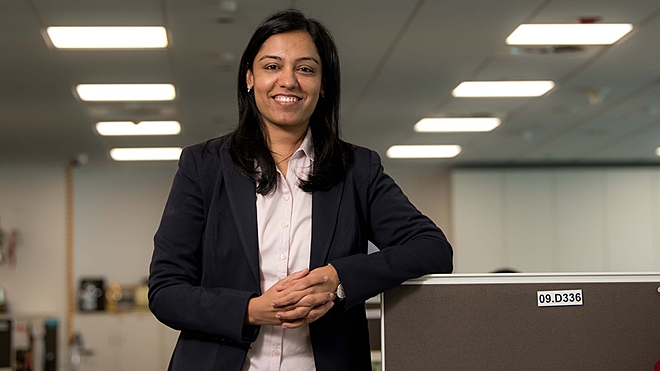

From having little interest in finance to currently managing assets over Rs 43,000 crore, Cheenu Gupta's professional journey is quite the story. Though she started as a coder, a chance meeting with the then chairman and managing director of UTI Mutual Fund in a competition during her MBA days kicked off her career in the mutual fund industry. Currently, the Fund Manager - Equities at HSBC Mutual Fund oversees several schemes, including the three-star rated HSBC Large & Midcap Fund and HSBC Midcap Fund.
In this interview, Gupta shares her insights on the current market landscape, stating that "only select stocks can continue to deliver earnings in an expensive market." According to her, there are still opportunities in sectors emerging from downturns, emphasising the importance of picking the right stocks. Below is the edited transcript.
Indian equities have been hitting new highs frequently, but with global macroeconomic uncertainty brewing, do you think this rally is sustainable in the near term? What market factors or risks concern you the most in the current environment?
I believe that mid-, small- and even large-cap companies have outperformed in recent years. Nifty 50 has delivered good returns versus the global benchmarks. Clearly, the country's macroeconomic conditions have improved significantly. The current account deficit is in a very healthy range, and there is currency stability.
Based on all these parameters, I believe the country is at a pivotal point where our per capita income will significantly increase in the upcoming decade. Even when we examine the policy measures and reform exercises, they have progressed positively. Therefore, from a broad perspective, everything appears to be good. However, when it comes to valuation, I agree with you that we are at a relatively higher valuation, and that creates some discomfort. High valuations typically lead to increased volatility, a trend I believe the markets have recently exhibited. So, at this point, I think it becomes even more important to be a good stock picker.
The broad market can give you an upside when the valuations are cheaper. However, when valuations come to this higher range, only some stocks can deliver earnings. Companies that transition from a small- to a mid-cap company, or a mid-cap company that performs well and transitions to a large-cap company, are likely to stand out in the market. Currently, we might look at some consolidation. Healthy time correction is something that would be called for, and as I say, stock picking becomes very important.
The broader index fell by around 5 per cent last week. Does this pullback present an attractive buying opportunity, or do you still find market valuations expensive at this stage?
We've seen a lot of volatility in the last week, and it has to do with how the geopolitical events are playing out. As previously stated, the macroeconomic conditions of our country remain stable, and the outlook remains optimistic. However, a closer look at the current situation reveals that tensions in the Middle East and the ongoing Russia-Ukraine war continue to persist. Simultaneously, we are witnessing China stepping up its efforts to stimulate its economy. I believe this approach is beneficial as it contributes to an increase in global growth.
However, when it comes to a flow perspective, it definitely has an impact, where you tend to see some outflows going from the domestic markets towards markets like China. So, these technical matters can have some impact for the time being. However, I think, looking at the perspective we are talking about, if one goes on and picks good stocks in sectors that are particularly coming out from the bottom, then one can still find good opportunities. Although the number of opportunities may be limited, it is still possible to find interesting ones.
Mid- and small-cap stocks have been a hot topic, with some arguing they're overvalued while others see strong growth potential. How do you view these segments in the market cycle, and how do you navigate short-term volatility while focusing on long-term growth?
I think it becomes critical to understand things from various perspectives, especially when it comes to mid- and small-cap companies. Firstly, comprehending the management's intention and orientation, whether short-term or long-term, is crucial. Their track record and capital allocation also play a crucial role. As we've often observed in various phases, when the cycle begins to turn, everyone scrutinises balance sheets cautiously. Currently, we have one of the healthiest balance sheets with very low leverage. However, as the cycle picks up, there is a tendency to increase risk. There is a tendency to increase leverage or potentially embark on projects with higher risk.
In the phase that we are in currently, maybe understanding how much risk each company will end up taking and whether it can be within the limits is more important. If you can adhere to these guidelines and find a company that excels in execution, has favourable industry tailwinds and dynamics, and effectively manages risk, I believe this combination can still assist us in identifying quality companies in both segments.
You are significantly overweight in the Industrial sector across your funds. Could you share your rationale behind this strategic positioning? What specific factors are driving your optimism about this sector?
I want to start by saying that consumption in India remains an evergreen theme, and only its form has undergone changes. Initially, its primary focus was on consumer staples, but over time, it transitioned to a more discretionary focus, and currently, we may be discussing convenience consumption. Hence, although the forms have changed, the consumption theme has remained popular.
However, manufacturing has significantly increased in the last three to four years, a previously absent sector of Indian investment. We always had our portfolios, you know, oriented towards B2C (business-to-consumer) companies. However, our analysis did not include B2B companies, which is now changing as we shift our focus towards Atmanirbhar Bharat. The Production-Linked Incentive (PLI) Scheme initiatives have been well-guided, resulting in the country's gradual development of manufacturing and supply chains. I must say that it looks like we are still at the very beginning, and this would be like a decade of journey that is playing out; hence, we are very positive about manufacturing.
Apart from that, the country's capex spend has significantly increased. If I look back a decade, the centre's capex, which used to be around Rs 1.5-2 lakh crore, has now moved to Rs 10-11 lakh crore, which is a jump of almost five times. But if you look at the industrial capex piece, it has moved from Rs 4-5 lakh crore to only Rs 9-10 lakh crore. Therefore, it has only moved within a very narrow range, leaving a significant gap yet to be addressed. We see that most companies' balance sheets are clean, and leverage is low. Even the banks have good lending capability because they are at one of the lowest non-performing assets (NPA) levels. Given this context, the significant amount of capital expenditure (capex) currently lacking could potentially be leveraged. I believe this is one of the reasons we have such a positive outlook on capex-oriented companies.
Your portfolio includes several new-age tech companies which have performed well recently. Given their past mixed performance, what's your outlook on the future of e-commerce and other tech-driven sectors?
I must say that I was very sceptical of new-age companies, given how they performed during the listing time. I believe their primary focus was on achieving the gross merchandise value (GMVs) and top-line numbers, with minimal attention to profitability. At times, concerns were raised about these companies' potential capital allocation decisions. However, there's been a change in their way of functioning in the last three to four years. Maybe they've understood that capital will not always be available. In the interim, they faced challenging times for a few years, which led to the introduction of discipline in several of these companies. Once they implement this discipline and execute it effectively, they can witness significant growth. Therefore, I believe that investing in new-age companies always comes with the expectation that they will adhere to the discipline they are using to identify growth opportunities. They may decide to invest, which is fine; however, the execution should be the primary focus.
Overall, I think it's really an intriguing space. It resembles a nascent market that is just beginning to emerge. Therefore, new players are bound to enter the market, but as an industry expands, there is always room for more players to join. Only when the industry reaches saturation or maturity can you truly worry about the excessive competition during the initial phases of any business or cycle. If more players come in, that just adds to the industry's growth. In this journey, it's crucial to select a player who excels in execution. If this isn't done correctly, it could lead to accidents. Therefore, I believe the actual evaluation should focus on that specific area.
Also read: Exclusive interview with Alok Singh, Chief Investment Officer at Bank of India Investment Managers
Ask Value Research 

 New episodes every Friday






 New Process Alert
  Seems like you've uploaded a wrong QR code. Please upload the QR code downloaded from MF Central platform.


