




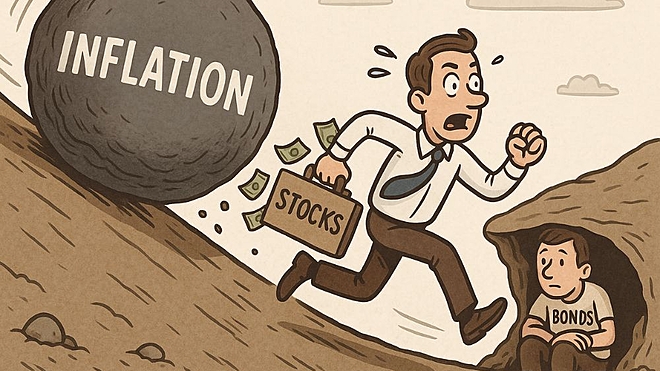
 AI-generated image

By the time Buffett penned his 1977 letter to Berkshire Hathaway shareholders, he had already been managing money for over two decades. But this letter—and the accompanying Fortune article he wrote that same year—hit a different note. Less about what Berkshire had done and more about what investors needed to understand. It was Buffett the educator, not just the capital allocator.
This instalment in our ongoing series on Buffett's letters captures a turning point. It's where he says, almost bluntly: the game has changed, and most people have not noticed. It's also where he begins articulating one of his most enduring ideas—that equities, like bonds, come with a "coupon", and it's not as glamorous as most investors assume.
Let's break it down.
Return on equity: What actually matters
Buffett starts where most corporate leaders stop: record earnings. He is not impressed by companies that grow EPS while quietly piling on equity. A 10 per cent bump in equity producing a 5 per cent bump in earnings? That's compounding, yes but nothing to celebrate.
Instead, he insists on a more telling metric: return on equity (ROE). "Even a dormant savings account will produce steadily rising interest earnings each year," he reminds us. What matters is what the business earns on its net worth, not how much it grows for growth's sake. That single shift in perspective sets the stage for everything else.
Tailwinds, headwinds, and the role of luck
Not all business success is created equal. Some businesses enjoy tailwinds like secular trends, favourable economics, or industry momentum that makes winning easier. Others fight headwinds constantly.
Buffett admits that he has learned this lesson the hard way and more than once. The implication is simple: don't just bet on talent. Bet on talent that is flying with the wind.
Insurance: Commoditised promises, outsized impact
In a rare moment of candour about the core of Berkshire's operations, Buffett strips insurance to its bones: "their only products are promises." There is no patent, no brand moat, no store shelf advantage. Just pricing, judgement, and management skill.
Which is precisely why management matters more in insurance than in many other industries. It's a business with no built-in edge so the edge has to be earned, decision by decision.
The 12 per cent equity coupon: A thought experiment
There is a reason Buffett titled his 1977 Fortune article, 'How Inflation Swindles the Equity Investor.' For all the charm and promise that comes with owning a slice of a business, equities, Buffett argued, are not the inflation hedge they are often claimed to be. In fact, in economic substance, they behave much more like bonds than most investors care to admit.
But how? He made a simple observation. Historically, from the 1950s through the 1970s, American companies were earning around 12 per cent per year on their net worth, i.e., a stable ROE of 12 per cent. Buffett called this an "equity coupon," likening it to a bond's fixed interest. In other words, while stock prices bounce around, the return that businesses make is mostly steady - 12 per cent in this case. And if one were to buy the stock at its book value, one would get a return similar to its ROE.
But here's the catch. Unlike a bond, where you receive fixed payments, a company reinvests a part of the 12 per cent ROE on your behalf. If it reinvests wisely, your wealth grows. If not, your money is stuck in a low-return cycle.
This reinvestment worked well in the 1950s and 60s, when low rates meant that fixed-rate investments (like bonds) only yielded 3-4 per cent, making stocks look much better. But by the 1970s, as inflation and interest rates rose, the "equity coupon" became far less attractive. If investors could now earn 12 per cent from government bonds with zero risk, why take the gamble on stocks?
In essence, Buffett was making a simple point: if inflation is high and interest rates rise, stocks may struggle to outperform safer alternatives.
So, how can this equity coupon be improved? He offers exactly five ways by which ROE can improve but adds that they are nowhere easy to pull off.
Five ways companies can improve their ROE
1. Higher asset turnover: If a business can sell more using the same assets, it generates more income per rupee of capital employed.
However, fixed assets lag in their upward revaluation, and eventually turnover ratios settle back.
2. Cheaper leverage: If a company takes out cheap loans and invests wisely, it can improve returns.
But when inflation is high, borrowing gets expensive, limiting this advantage.
3. Taking more debt: Using more debt (leverage) can multiply profits in good times.
But it also increases risk - if the company struggles, debt becomes a heavy burden.
4. Pay less in taxes: Lower taxes mean higher profits.
But tax policies are unpredictable and mostly beyond the company's control.
5. Increase profit margins: Companies aim to charge higher prices or reduce costs to boost margins, which can improve returns.
However, inflation often pushes costs up faster than companies can raise prices, preventing meaningful margin gains.
The investor's equation
So, what does all this mean for an investor? If inflation is eating into real returns, where do you end up?
Buffett illustrates this with a simple example: If a company earns 12 per cent on book value and trades at book value, you get the full 12 per cent. Pay 1.5 times the book value? Now you earn just 10 per cent. Pay 80 per cent of the book value? You are at 13.5 per cent. The price you pay versus intrinsic value determines your final return. Obvious? Yes. Often ignored? Also yes.
Then comes taxes. After taxes, you have to contend with inflation. Most investors won't even realise what's happened. They will look at rising nominal stock prices and feel richer, never noticing that their purchasing power is quietly bleeding out.
In short, the so-called protection that equities offer against inflation is an illusion—unless bought well below intrinsic value and unless reinvested earnings are truly productive. The equity coupon is real. But it's not magical. It's fixed, and it's vulnerable to taxes, inflation, and investor delusion.
Conclusion
Buffett's 1977 writings are a masterclass in financial realism. Not pessimism, realism. They show a man less interested in selling hope than in understanding constraints. The equity markets were not broken. They were just misunderstood.
More importantly, this letter and article mark the start of something bigger: Buffett's role as a translator between business economics and investor expectations. He was not just managing capital anymore. He was teaching us how to think.
If you want to be a better investor, learn to do the math. Then, ask yourself what's left after taxes, inflation, and friction. That's your real return.
And in most years, it's not as pretty as the headline number.
Also read: Buffett's 1985-86 letters dispel cash flow, book value myths
This article was originally published on September 11, 2024, and last updated on April 03, 2025.
Ask Value Research 
 New episodes every Friday









 New Process Alert
  Seems like you've uploaded a wrong QR code. Please upload the QR code downloaded from MF Central platform.


