





Balanced advantage funds - mutual funds that can change their equity-debt allocation depending on market conditions - have taken diametrically opposite paths at a time when the markets have hit new peaks and valuations look pricey.
Theoretically, these schemes - also known as dynamic asset allocation funds - invest more in equity when their valuations are low and move their money to debt bonds when equity valuations seem high.
This is why investors with a relatively low-risk appetite prefer them. In fact, their popularity has surged in recent times as their pitch is simple: the periodic asset allocation protects you from market volatility.
However, on-ground reality speaks another language, as different funds have different strategies.
Diametrically-opposite direction
While ICICI Prudential Balanced Advantage Fund has limited equity exposure - given that the current market is at elevated levels - Aditya Birla Sun Life Balanced Advantage Fund, Edelweiss Balanced Advantage Fund and Nippon India Balanced Advantage Fund have ignored the playbook to have a higher exposure in the range of 55-70 per cent.
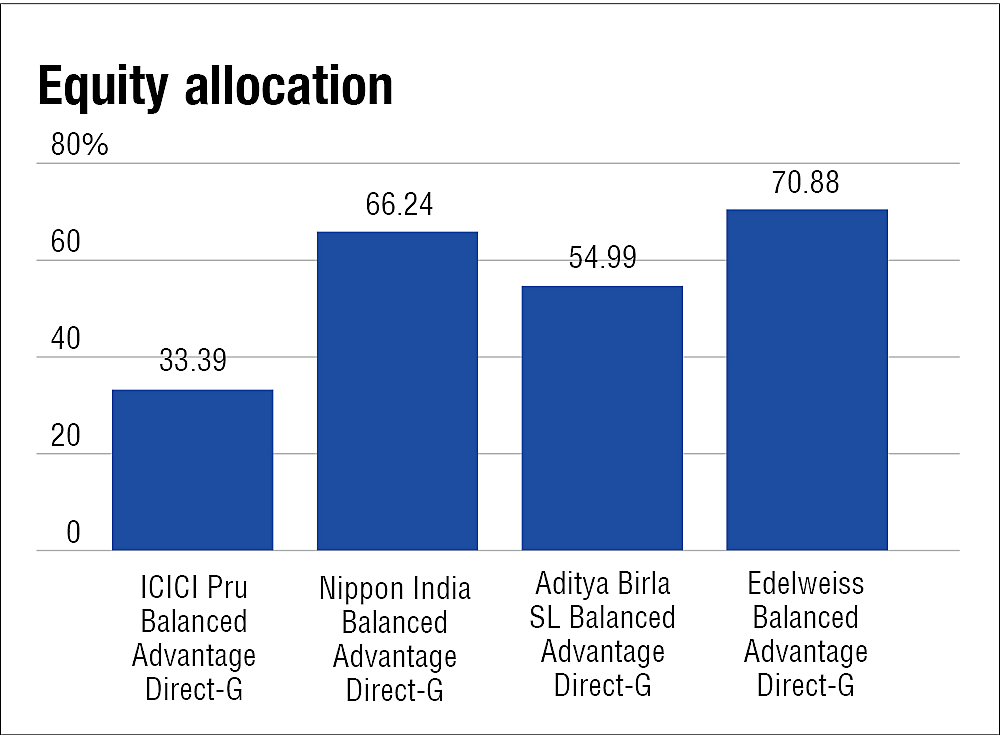
While balanced advantage funds (BAF) are supposed to offer steady returns, their divergent tactics compelled us to dig deeper. We wanted to know if different funds could take different paths to reach the same goal.
Why ICICI Prudential has lower equity exposure
- They are playing by the book.
- They form decisions on the basis of the following:
a) current market conditions (domestic and global)
b) valuation parameters such as price-to-book value, price-to-earnings ratio, among others.
What they told us
S Naren, their chief investment officer, says their decision is based on "the model's suggestion that equity valuations are high".
Why Nippon India has over 60 per cent equity exposure
- They had nearly 66 per cent exposure in equities as of November 2022.
- In addition to using valuation metrics like price-to-earnings ratio, they have three other parameters that influence their decision-making:
- Market momentum
- Trade-weighted dollar
- Global demand indicator
What they said
Ashutosh Bhargava, their head of equity research, confirmed that going by pure valuations model, "the exposure (to equity) in the fund should be around 40 per cent".
"But the other three parameters have been positive, and that is the reason we have our equity exposure to nearly 60 per cent," he said, alluding to the fact that prices of few commodities such as copper have rebounded and the dollar index is down by 8-9 per cent from its peak.
Final thought
Despite the varying tactics, the long-term performance of these funds is on similar lines.
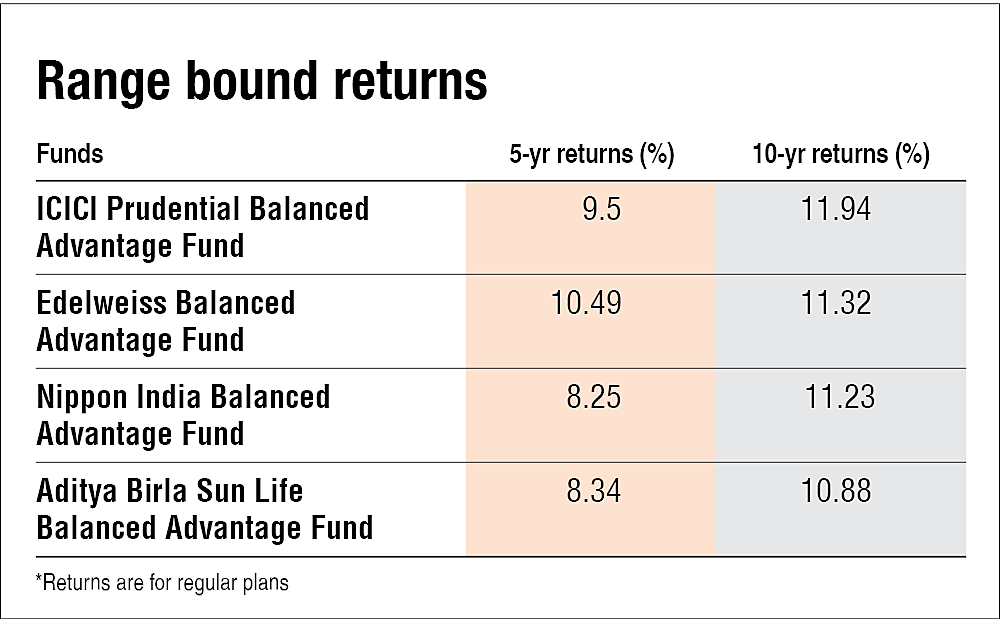
It's clear these funds are simply taking a different route to reach the same destination. At least, that's how the thesis is playing out. If we spot any cracks, we will get back to you.
Ask Value Research 

 New episodes every Friday








 New Process Alert
  Seems like you've uploaded a wrong QR code. Please upload the QR code downloaded from MF Central platform.


