





Markets are inherently volatile - anyone who invests in the market knows this. Still, when corrections happen, even the most seasoned investors tend to fall into the grip of fear. You may be a sensible investor who invested in reasonably good funds or companies and avoided common investment mistakes but the day-to-day downward movement of the Sensex and daily television debates on looming risks can put you on edge, which can be a big impediment for you to stick to your investment path.
To stay the course of your wealth-creation journey, remember the following points.
Sunshine and rainbows are just one side of the coin
Ups and downs are an integral part of the market. Every few years, the market witnesses a correction triggered by various macroeconomic factors. But contrary to the common market emotion of exiting the market, investors should consider such events as a great investment opportunity.
While the market correction generally affects all companies, irrespective of their size, the impact may be different in certain sectors or market segments. But quality companies tend to recover faster, while companies with weak fundamentals or management struggle to recover.
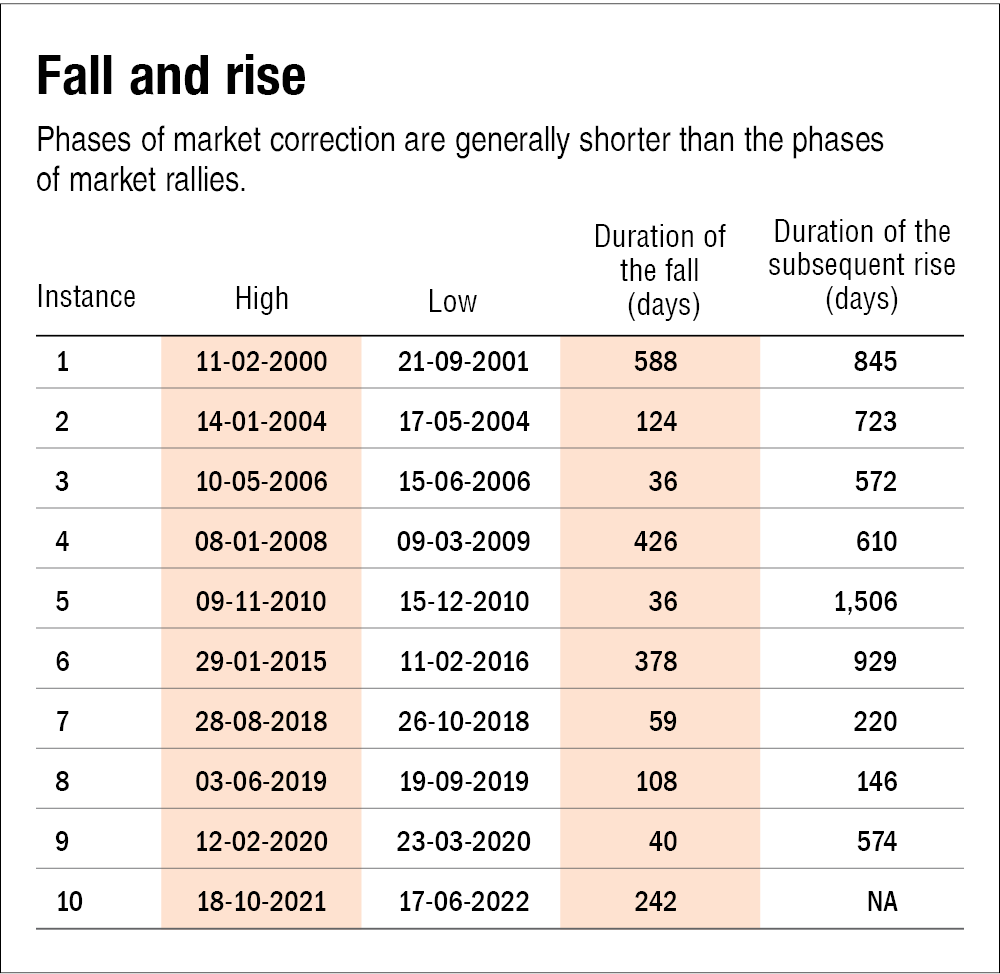
Since 2000, the market has witnessed many instances of corrections because of several reasons. However, what becomes noteworthy is that the correction phases have been generally smaller than the bull phase.
As revealed in the table titled 'Fall and rise', although there may be dark days in one's investment journey, the road ahead need not be only bad. The key to investing is to be patient and disciplined through thick and thin. As Warren Buffett says, "Be fearful when others are greedy and greedy when others are fearful."
Stay put
Stay invested irrespective of the market conditions and that is the only way to make money. While the market may be volatile in the short term and it may be disheartening to see the value of your investments go down, the market tends to reward patient investors (see chart 'The volatility perspective'). Hence, ignore the noise.
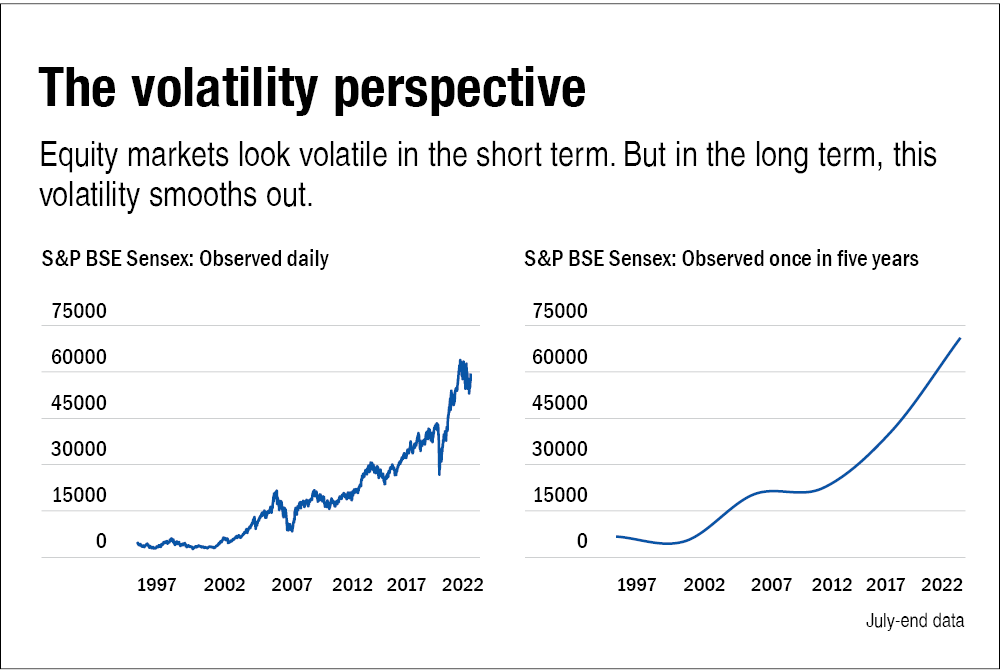
If you are investing in equity, your investment horizon should be at least five years. If your financial goals are five-plus years away, a decline of 1-2 per cent in your portfolio value today or vice-versa will not make much difference to the final corpus by the time you get to your goals. Therefore, obsessively keeping a watch on the NAVs of all your equity funds and fretting over the decline in the investment value over the short term should be avoided.
Continue with your SIPs
It is always advisable to spread your investments across a longer term rather than investing in one go, as it helps in averaging your investment costs. Moreover, continuing your investment during market lows helps you purchase more units. This, in turn, will accelerate your wealth-creation journey in the long term.
Diversify your investments
"Don't put all your eggs in one basket". Diversify your investments across asset classes and fund houses. Different asset classes play different roles in one's portfolio. While the equity allocation helps make use of the bull run in the market and earn good returns, the debt portion of the portfolio is helpful in the downside protection of your portfolio should there be a market fall.
Time and again, Value Research has been emphasising the importance of asset allocation in one's portfolio. The perfect asset-allocation plan for each investor is different and depends on several factors, such as his/her age, investment horizon, the scale of capital, etc. Hence, one should decide one's asset allocation considering various parameters.
Once you have decided on an asset allocation, rebalancing comes into play. Investors should review their asset allocation at periodic intervals, as the market condition changes. Correspondingly, they should sell off a part of the asset class that has gained from its predefined range and invest in the underperforming asset class in order to stick to their original asset-allocation plan.
Invest in quality
In life, you choose nothing but the best for yourself. Investments are no different. While investing, look out for the businesses that have strong fundamentals and growth potential over the long-term horizon. Although such companies are not resilient to volatility, they are better equipped to handle uncertainty. Hence, over the long-term horizon, they tend to reward the investors.
In case you don't have the time or knowledge to research and explore such businesses, then you should opt for equity mutual funds. Here fund managers take care of investing in the best businesses on your behalf.
Don't forget these
- Emergency corpus: Create an emergency corpus equivalent to at least six months of your expenses in a combination of a liquid fund and a sweep-in deposit. It comes in handy during unforeseen circumstances.
- Life insurance: Adequate life cover is a must once you have financial dependents. For this purpose, consider pure term plans only.
- Health insurance: COVID has made many realise the importance of an adequate health cover for all the family members. Apart from the health insurance provided by your employer, you should have one independent policy as well.
This article was originally published on August 17, 2022.
Ask Value Research 

 New episodes every Friday






 New Process Alert
  Seems like you've uploaded a wrong QR code. Please upload the QR code downloaded from MF Central platform.


