





I've been writing this page regularly since 2020, when Value Research Premium was first launched. Every month, I generally talk about some particular advantage that being a member of Value Research Premium gives you. These tend to be widely varying topics like choosing and buying funds, planning your financial goals, tracking your investments, selling them and so on. I've also written about how one should approach difficult periods like when the markets are doing badly and investment values are falling. These issues relate more to one's own attitude. However, it becomes easier to handle them when one has the right tools and information, as Value Research Premium members have access to.
However, a couple of months ago, I started an occasional series of walking my readers through a particular feature to familiarise them completely with what it did and how you would use it. The first such episode was about Portfolio Planner and the second, this time, is on our Portfolio Analysis feature. You can access this by clicking on the 'Portfolio Analysis' link or under the 'Analysis' tab. Like everything else on our website (and indeed all our products), everything is named and described in very obvious and descriptive ways.
Magically easy
Our Portfolio Planner system is meant to suggest new investments that are tailor-made for your financial goals, while Portfolio Analysis does its magic on your existing investments. And how do you tell the system about your existing investments? That's where the magic begins.
As most (but not all) mutual fund investors know, you can obtain your Combined Account Statement (CAS) from the KFintech (earlier called Karvy) or CAMS websites. To import your full mutual fund details into Value Research Online, you can visit 'Upload Investments' and you will be guided through the process of triggering your statement from CAMS and importing it. Our system will analyse the statement and import all your investment details. Now comes the next step, the one you have been waiting for.
Analyse this
All you need to do is to go to the 'Analysis' tab of 'My Investments' and it's all there, instantly ready. To give a full idea of the depth of the analysis, I'll just go through it systematically, step by step, just as it will appear to you on the screen:
Immediate Actionable: These are things that you should fix right away. Our algorithms have identified these as priority actions that you must take. I'll give you a sampler: 37% of your mutual fund investments are not in direct plans. Direct plans have returns that are higher by about 0.5%-1.5% and are therefore more suitable if you manage your investments yourself. see details. 22% of your mutual fund investments are deployed in dividend plans. Due to changes in taxation rules, dividend plans no longer make sense. Consider switching to growth plans. see details. It needs no explanation. The 'see details' gives you the nitty-gritty of the item and what to fix.
Similar issues are flagged about other assets that we track, including NPS, PPF, bonds, gold bonds and others, as we add them.
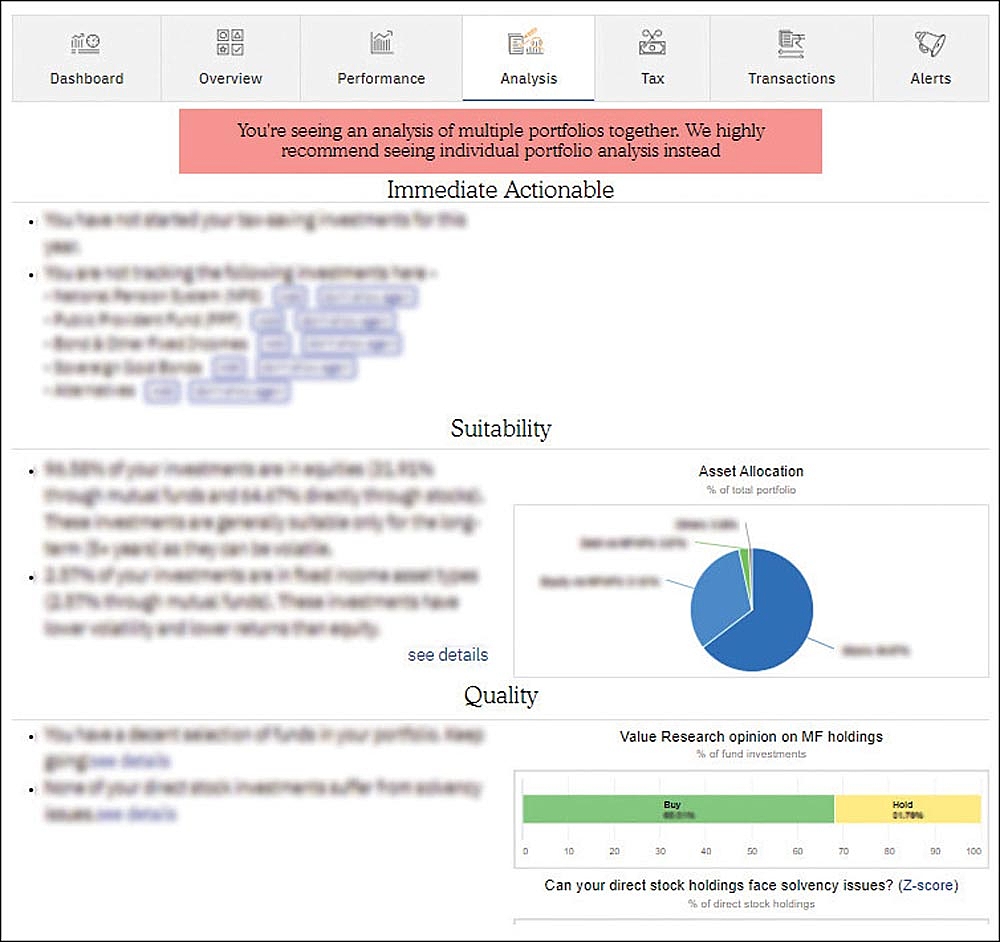
Suitability: That's the next item on the agenda and let's again take a sampler: 79% of your investments are in equities (49% through mutual funds and 30% directly through stocks). These investments are generally suitable only for the long-term (5+ years) as they can be volatile. 17% of your investments are in fixed income asset types (all through mutual funds). These investments have lower volatility and lower returns than equity. 1% of your investments are in sectoral/thematic funds. Value Research does not consider these to be suitable for investing.
Alongside there's a graph to help you visualise the breakup as well as a link to the underlying details. Need I say anything about how useful this is?
Quality: Now things are getting even more interesting. Here's a sample: 48% of your mutual fund investments, which is 92% of your total investments, is invested in funds which we believe are avoidable. Note that not all of them may be inherently bad but we believe that you don't miss out on much by ignoring them. Our selection of Analysts' Choice funds provides a set of good alternatives for every investing need. see details
Clearly, we are not here to beat about the bush and give wishy-washy, vague opinions. I have always said that avoiding the bad is as important as choosing the good.
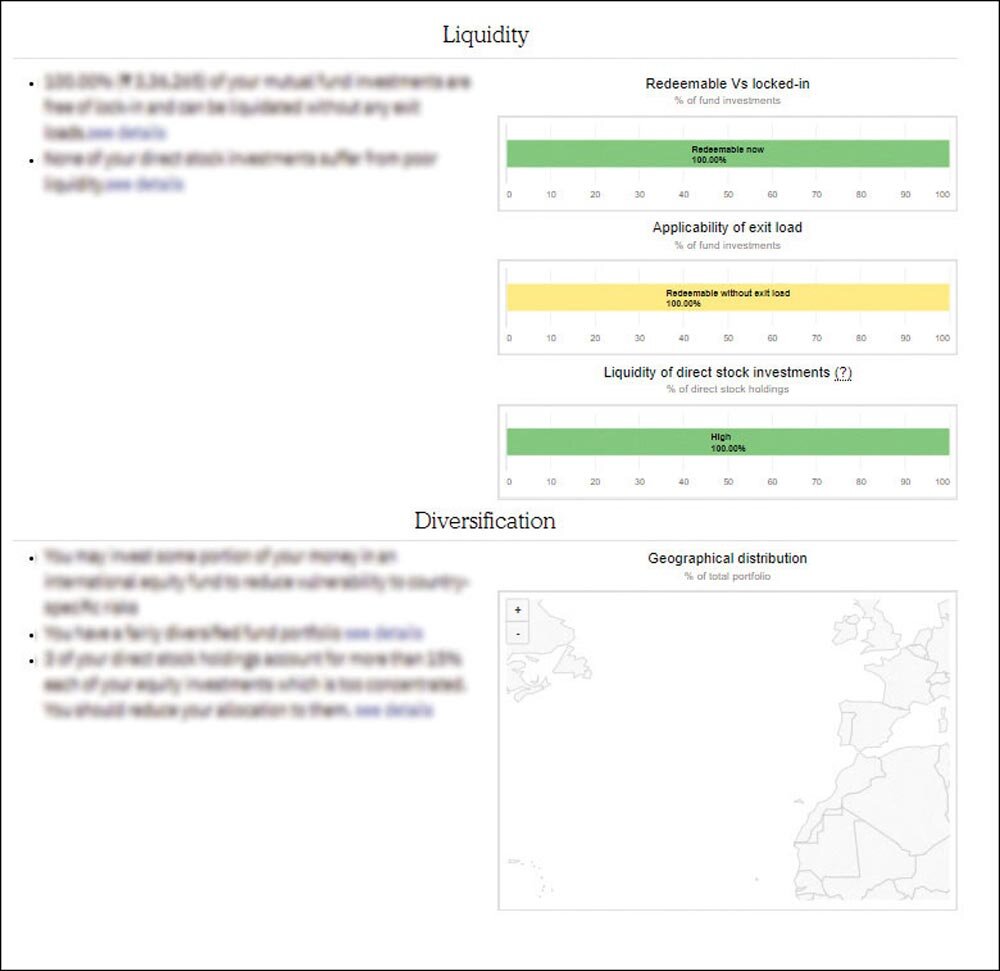
Liquidity: This is not something you always worry about so we do it for you. Here's the sample: 12% of your mutual fund investments are under ELSS lock-in. Of the remaining, 81% can be liquidated without any exit loads. see details. None of your direct stock investments suffers from poor liquidity. see details
When you need money in a hurry, this kind of analysis is worth anything!
Diversification: Value Research members know that there is such a thing as over-diversification and many more mutual fund investors are prone to it than the opposite. Here's a sample of the report we give in this section: You have invested in too many funds, making your portfolio hard to manage. Of these, 11 funds account for less than 5% of each of your fund investments. These small holdings only add to the complexity, not returns. You need to: Reduce the total number of fund holdings and either exit or increase allocation to funds where you have invested less than 5%. see details
1 of your direct stock holding accounts for more than 15% of your equity investments which is too concentrated. You should reduce your allocation to it. see details. You have invested a high amount (54.27% of your total equity investments) in just one sector. You should be more diversified. see details
Nowhere else, no one else
Some people think that Value Research is expensive. A one-year membership costs Rs 5,841, while a three-year one comes with a 30 per cent discount, so it costs only Rs 12,266.
Far from being expensive, I think it's dirt cheap for what it gets you. Look at the sample above. Can you find anyone or anything that can give this kind of analysis and service anywhere close to this price? And remember, Portfolio Analysis is just one small part of the service!
So don't think twice. Head over to Value Research Premium and become a member today.
This article was originally published on July 20, 2022.
Ask Value Research 

 New episodes every Friday



 New Process Alert
  Seems like you've uploaded a wrong QR code. Please upload the QR code downloaded from MF Central platform.


