





Whenever a company sells a product, it is not always in return for cash. Sometimes companies sell goods on credit too to attract customers. This has been a norm across industries throughout the years. The customers who owe the company money from such credit sales are called debtors or the company calls it receivables. The problem arises when the receivables rise or become too high.
Why is it a problem though? A high level of receivables in the balance sheet consistently for years shows that the company is facing difficulties with collecting payments from customers. This will impact the company's cash conversion cycle, which will impact the operating cash flow. If the company continues to be like this then, in no time, it will face a liquidity crunch - a lack of liquid cash or easily convertible assets to meet day-to-day requirements.
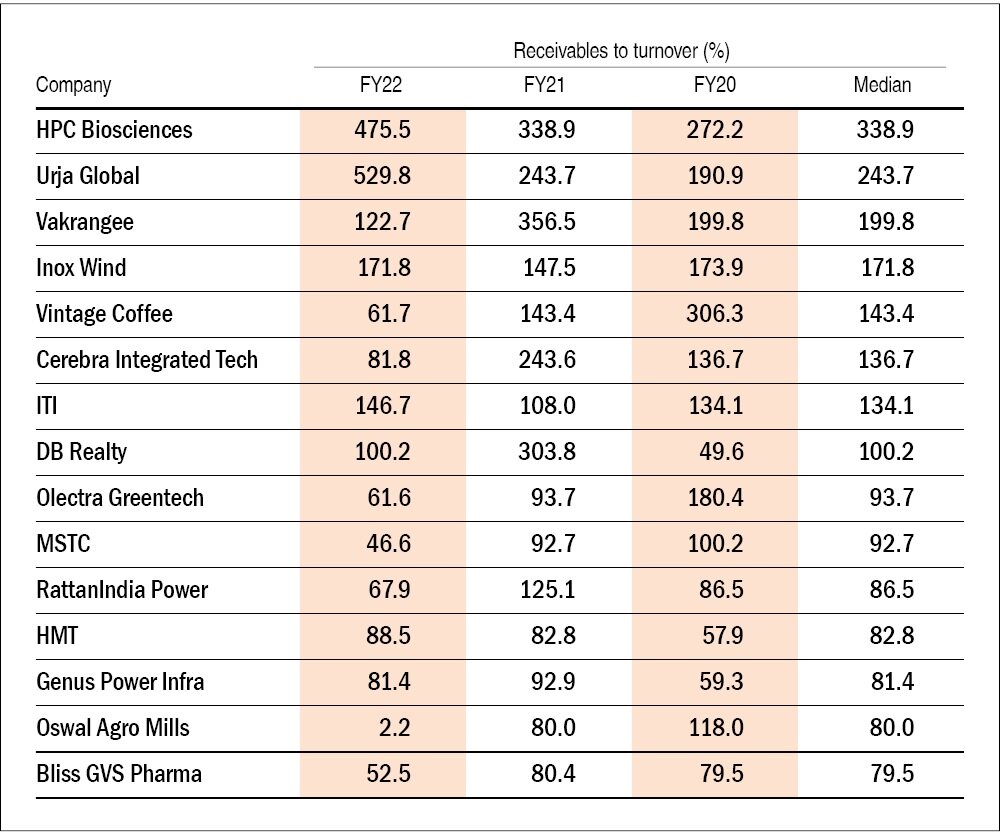
A simple measure to check whether a company has a high amount of receivables on its balance sheet is to compare it with its sales. This is called the receivables to turnover ratio. A higher figure denotes that the company is struggling to collect payments and a lower figure denotes vice-versa. Here is a list of companies with higher receivables compared to their sales. In order to avoid recency bias, we considered the last three years instead of just one year, and to account for outliers, we used a median instead of an average.
This article was originally published on June 27, 2022.
Ask Value Research 
 New episodes every Friday








 New Process Alert
  Seems like you've uploaded a wrong QR code. Please upload the QR code downloaded from MF Central platform.


