


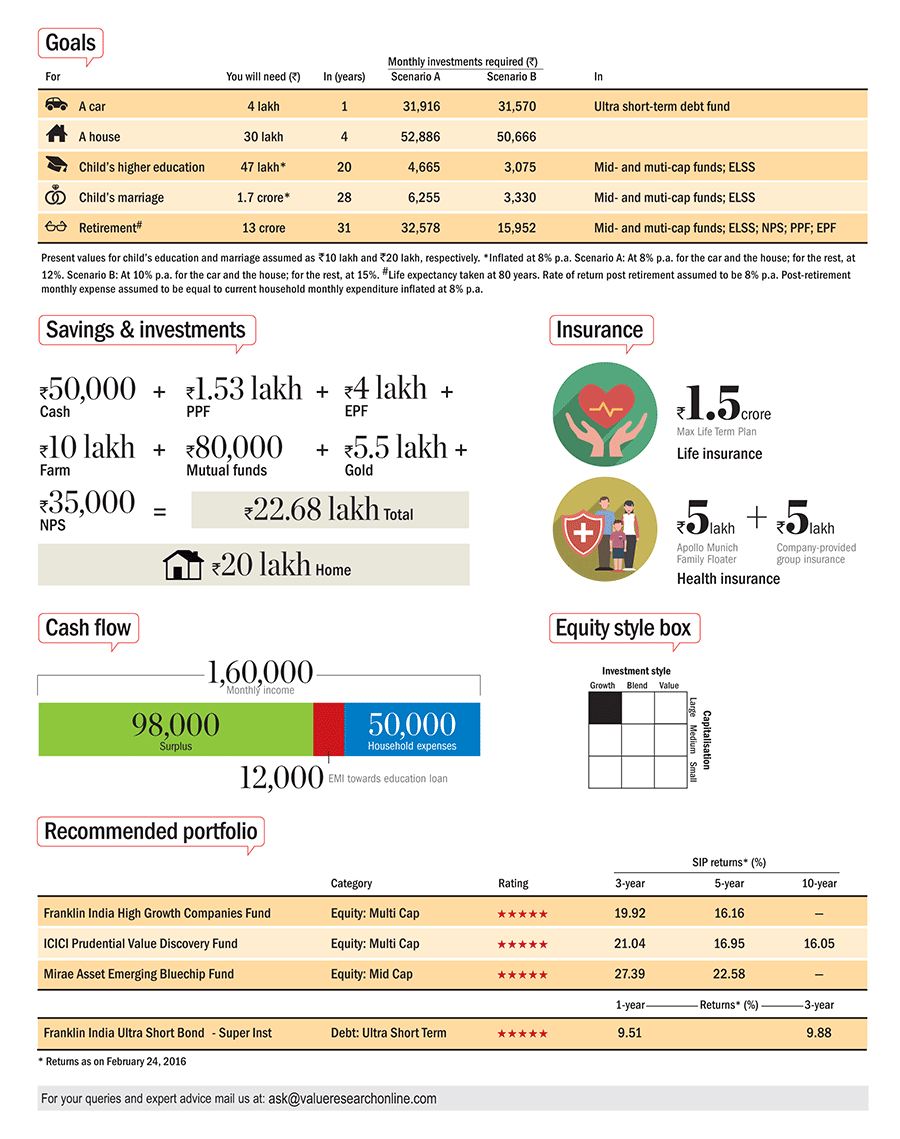
I am 29 years old and got married 18 months ago. My wife is 25 years old. We will be planning a baby after two years. I draw a monthly salary of ₹1,35,000 and wife draws a salary of ₹25,000 per month. Our monthly household expenses are ₹50,000 plus ₹12,000 EMI towards an education loan taken for my wife. For the last six months, I have been investing ₹16,000 in SIPs towards the following equity funds with equal allocation: Axis Long Term Equity, HDFC Balanced Fund, Franklin India High Growth Companies and UTI MNC Fund. So, the total equity-fund corpus as of today is ₹80,000.
Following is the list of assets that I hold:
- NPS: ₹. 35000
- PPF: ₹1,53,000
- EPF: ₹400,000
- Equity funds: ₹80,000
- House: ₹20,00000 (asset value)
- Gold: ₹5,50,000 (asset value)
- Farm: ₹10,00,000 (asset value)
- Cash: ₹50,000
I have the following insurance:
- Life insurance: Max Life Term Plan, sum assured ₹1.5 crore
- Health insurance: Apollo Munich Family Floater, sum assured ₹5,00,000. Company group health insurance, sum assured ₹5,00,000
My fund investments are for my long-term goals of child's education, child's marriage and retirement. PPF, NPS and EPF are to be used to build a retirement corpus. I also want to add one mid/small-cap fund to my portfolio. Could you suggest one?
On the top of this, I have surplus of ₹45,000 to be used for fulfilling the following short-term goals.
- Car (in 12-15 months' time, corpus ₹4 lakh)
- House (four years' time, corpus 30 lakh)
- Emergency fund (for one year, corpus ₹2 lakh)
Could you help me figure out what debt fund I need to use to reach these short-term goals.
- Vishal
What he has (Cash Flow)
- Monthly income of ₹1,60,000
What he wants (Goals)
- Car
- House
- Child's higher education and marriage
What he should do
Emergency fund: Vishal must build an emergency corpus before investing towards his goals. He must keep at least three months' expenses aside for any contingency. He already has ₹50,000 in cash. He needs to increase the emergencyfund to ₹1.5 lakh. He will need a bigger emergency fund once the couple plans for a child.
Health insurance: Vishal has adequate health insurance. He can continue with the same health insurance policy. After the birth of child, Vishal may add the newborn to the same floater policy.
Life insurance: It is praiseworthy that Vishal has kept his insurance simple and bought plain term insurance to cover his life. He is adequately covered. He must continue to pay premiums on time and stay away from insurance-cum-investment policies.
Investments: Vishal has a monthly surplus of ₹98,000. He has two short-term goals: buying a car and a new house. His child's education, marriage and his retirement planning are non-negotiable long-term goals. He may attain all his long-term goals and any one of the short-term goals easily in the given time frame. He needs to either postpone either of the short-term goals or go for a home loan instead of accumulating the entire ₹30 lakh himself for buying a house. If he does not like either of the ideas, he may have to sell his farm for the remaining sum to buy a house.
As to his short-term goal of buying a car in a year, he may put his funds in an ultra short-term fund. All his non-negotiable goals are distant in time. He may invest in mid-cap and multi-cap equity funds for achieving them. Vishal may continue with Axis Long Term Equity and UTI MNC funds. UTI MNC has generated decent returns, but thematic funds cannot diversify beyond the theme. So, he may keep this fund as a small component of his portfolio. He may stop investing in the balanced fund. He may continue with the NPS, the PPF and the EPF for his retirement saving. The monthly investment amounts are based on assumed values. If Vishal feels his goal values are higher, he will need to save more.
This article was originally published on February 25, 2016.
Ask Value Research 

 New episodes every Friday


 New Process Alert
 Seems like you've uploaded a wrong QR code. Please upload the QR code downloaded from MF Central platform.


