




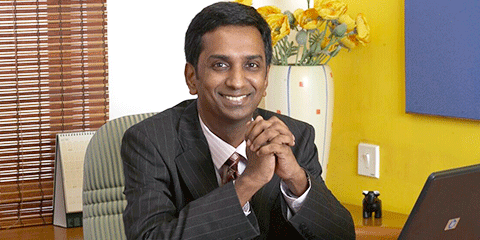
My first attempt to meet up with Anand Radhakrishnan, the cerebral CIO of Franklin Templeton India's equity business, was effectively derailed by the Chennai rains. We had agreed to meet on the fateful day of December 2. After driving halfway to the venue, I found it impossible to motor through the huge waves that had turned the city's centre into Marina Beach. Anand meanwhile received distress calls from home as a nearby river bank was breached.
Next big idea
We met a week later when the sun peeped out. I asked Anand what his most stressful times were during his 20-year stint as an equity investor and fund manager. A high tide in the market, the kind that lifts all boats, is always a challenge, he says. "I've often seen these phases where the markets latch onto a big macro theme and everything along that theme gets re-rated. These are never based on individual companies, their fundamentals or their actual business plans. Such phases put a lot of pressure on managers like me," says Anand who is a hard-core numbers-focused, bottom-up stock-picker.
Anand recounts that this has played out many times in the last 20 years. In 1994-95, when there was an IPO boom, every newly listed stock zoomed to a huge premium. In 1999-2000 there was the technology, media, telecom bubble. "Whoever could latch onto those ideas early was making tons of money. There was no time to question the management, understand the business, etc. We wondered if we were making a mistake at that time. But luckily it did not last very long." When the bubble burst, it was a fantastic year for Anand as the markets were down by 50 per cent and some funds were down by 70-80 per cent, but the funds he managed contained their downside to 30 or 35 per cent.
What these phases taught Anand was that focusing a lot on 'macros' can lead to a disconnect from ground realities. "Anchoring yourself to a company, to the business, to profits, is very, very useful to survive such markets. You may not deliver dramatically superior returns during the bull market, but you will live to tell the story," observes Anand, who has seen managers who played these two waves very aggressively dropping out of the business.
So does he see a dicey macro theme based on 'Modi-fication', reforms, etc., powering the present bull market? Anand says that it looked like so in 2013 but has thankfully fizzled out.
The current situation is that a cyclical recovery is likely, backed by falling inflation, falling interest rates and better governance, he says. But "The recovery is moderate, measured and not something to get too excited about."
Moderate returns
As an interviewer, I've always found Anand to be very patient; he takes a lot of time to explain a complex idea with precision and detail. He launches into why Indian equity investors can no longer take 15-20 per cent returns for granted. "Because India had reasonably good inflation, sales growth for companies was always at 13-14 per cent and profit growth at 14-15 per cent. But now we are in a deflationary situation. That means lower nominal growth. So, if a stock is pricing in 20 per cent growth in earnings based on the past six-seven years, that's very tricky. The next two-three years may be a different story." But to an investor, this shouldn't matter because his real returns, post-inflation would still be healthy.
Will the Pay Commission bonanza boost consumption? Anand thinks that this kind of artificial stimulus cannot last. He gives a simple example. "If a patient has fever, you can give him Crocin to pull down the temperature; but it treats only the symptoms, not the underlying reason. So pay increases will create some demand but can't be a structural driver of the economy. I don't see this playing out in a very excessive manner to support the market," he ends.
Multibagger myth
Most Indian investors love small- and mid-cap stocks more than large caps because they believe that's where they can get their hands on multibaggers. Is that right? No, asserts Anand. "Take any mid-cap fund from ten years ago. Take its portfolio holdings and compare them with today's holdings. You will be surprised at the number of stocks that have gone out of the portfolio. I know the holdings of Franklin India Bluechip Fund from 2004 and if I look at the last ten years, there are many stocks we have held on to continuously. Yes, there are more multibagger opportunities in mid caps or small caps, but you might also lose 90 per cent of your money. Point two is that certain mid-cap or small-cap businesses are niche businesses. They are in uncontested spaces. A clever businessman can exploit it up to a particular scale. But beyond that scale, competitors will rush in and margins will fall. A company can easily go from a ₹10 crore profit to a ₹100 crore profit, but scaling thereafter is not easy."
But aren't some investors doing just this with e-commerce startups? Writing out $20 million cheques and hoping that one or two will become multibaggers? "You can also have 20 lemons. The law of averages does not work over finite times. If there is, show me the study that says so!" he says.
His own money
What about his own money? As someone who is constantly watching trends, is he tempted to switch between asset classes? No, his own portfolio choices are incremental, says Anand. "If at any point of time, I have investable money, I invest in whatever looks good then. So if I don't count the house where I live, I have 60 per cent or so invested in equity, 25 per cent in fixed income, and 10 per cent in property. Five per cent is in liquid funds, which is like emergency money."
While he doesn't rebalance, he does not 'book profits' either. "I have never redeemed from any of my equity funds. I still hold the ELSS fund I subscribed to in my first job in 1995. It is up 30 times or something," says Anand.
Anand regrets not making bigger investments in equity funds in the early part of his career. "Even if your income rises, you are still investing based on your earlier mental framework. If I invested ₹1 lakh in the early part of my career, I was still investing ₹1 lakh when my income rose. That plays a limiting role in getting the right allocation," he muses.
Keeping it liquid
Does he directly buy stocks? No, says Anand, but he owns a legacy portfolio that he bought in his younger days. "It mainly consists of un-sellable stocks because I exited all the good ones and switched that money into funds," he laughs. His direct stock portfolio, which he freely admits is made up of duds, is now a fraction of his net worth.
What are his favourite funds? The bulk of his money is in Franklin Templeton, where he has worked for 11 years. "My largest exposure is in Franklin Bluechip followed by Franklin Prima Plus and Franklin Flexi Cap. Incremental money has also gone into Franklin High Growth Companies Fund."
How does this equity manager approach his fixed-income investments? Post-tax returns are his primary goal. "My debt portfolio is split half and half between tax-free bonds and fixed-income funds. I hold debt funds for more than three years and within funds, I have generally stuck to stable income funds rather than aggressive duration funds."
Does he have an aversion to real estate, as most fund managers have? Anand says that he still lives in the small home that he first bought within the Chennai city. He has a second property on the outskirts but is thinking of selling it. "I don't have any mortgage loans and don't do tax-planning against houses. I like to keep 85 per cent of my portfolio liquid and non-location specific. If I want that money, it can be realised in three days."
Not a 'gut-feel' guy
I know Anand loves to spend hours poring over complicated spreadsheets, so I ask him if he does company meetings to get a gut feel for the management?
"I travel four-five days a month. But I have more preference for desk work than other fund managers, who I know prefer to be on the field. I am not a very qualitative, gut-feel kind of a guy. I mostly go by numbers and logic," he admits.
In fact, he believes that depending too much on management meetings can lead one up the garden path. "I tend to ignore all the signals that the management gives out consciously. I don't want to pick up those signals. They can be doctored. I think stock selection is 70 per cent done on your desk by thinking through the idea on your own. You can verify it in the field for the remaining 30 per cent. You can validate data, you can re-validate it, you can negate it, corroborate it using your meetings outside. But you should have a basic thought process of your own around a business and that happens only when you're sitting and thinking."
Anand has barely changed in the 15-odd years I have known him. How does he remain so lean? He's a long-distance runner and plays badminton. "I try to run three days in a week. On weekdays, I do shorter runs like five-seven km and on weekends ten, 12 or 15 km. I've not yet acquired expensive pastimes like golf," he grins.
Family time keeps him happy. He has two children - a daughter and a son, 12 and 8 years old. He loves to read fiction, particularly the new-age versions of Indian mythology by Indian authors.
He's now reading Indian fiction that takes a compassionate view of mythological villains like Ravana or Duryodhana and presents the story from their points of view. "I always believe that before buying any stock, you also need to know and understand the seller's perspective," quips this analytical stock-picker, who keeps emotions at bay.
Ask Value Research 

 New episodes every Friday

 New Process Alert
  Seems like you've uploaded a wrong QR code. Please upload the QR code downloaded from MF Central platform.


