





The Piotroski F-Score was devised by Joseph Piotroski, a professor of accounting at the University of Chicago. Piotroski believed that financial strength could be determined by using data solely from financial statements. The methodology was first published in 2000. The Score determines the financial strength of a company using nine criteria. For every criterion that is met, the company is given one point. If a criterion is not met, no points are awarded. The points are then added up. A company is rated on a scale of zero to nine, nine being the best. Since the score is based on recent performance, we can say it filters out the 'current' outperformer in terms of profitability and financial improvement over the past performance.
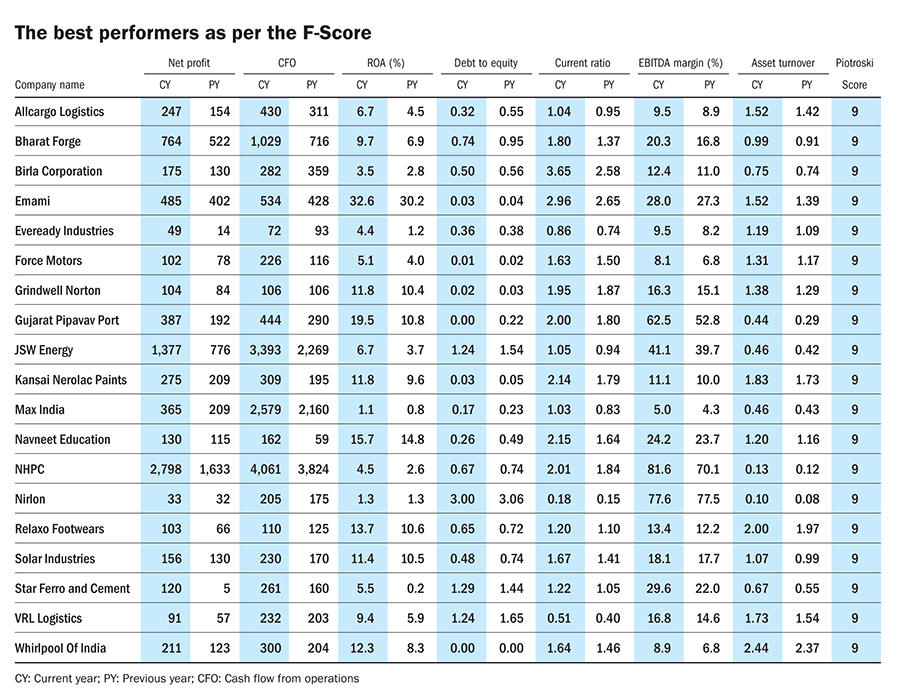
Following are the nine criteria of the F-Score. The first four criteria measure profitability. The next three measure the health of the balance sheet in terms of debt and the number of shares outstanding. The last two factors look at operating efficiency.
- Positive net income in the current year
- Positive operating cash flow in the current year
- Higher return on assets (ROA) in the current year than the ROA in the previous year
- Cash flow from operations greater than net income
- Lower ratio of long-term debt to equity in the current period as compared to the value in the previous year
- Higher current ratio in the current year as compared to the one in the previous year
- No new shares issued during the last year
- Higher gross margin than that in the previous year
- A higher asset-turnover ratio as compared to the one in the previous year
Decoding the F-Score
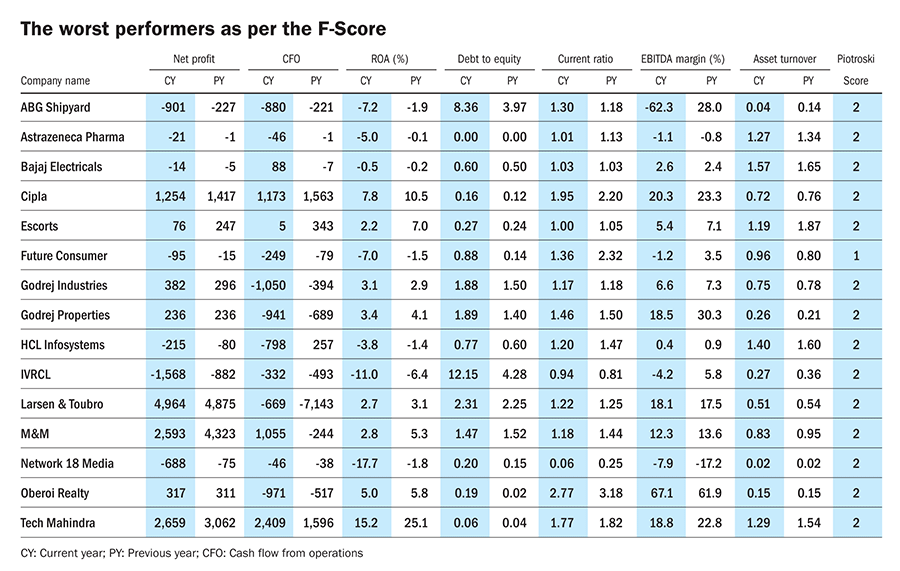
If a company has a score of eight or nine, it is considered strong. If the score adds up to a number between zero and two, the stock is considered weak. Piotroski's April 2000 paper, 'Value Investing: The Use of Historical Financial Statement Information to Separate Winners from Losers', demonstrated that the Piotroski score would have seen a 23 per cent annual return between 1976 and 1996 if the expected winners were bought and expected losers shorted. With any investment system, looking at past results doesn't always means it will work in the future, but having an investment plan is never a bad idea.
Our take
Since the Piotroski F-score is based on recent performance and compares the current-year numbers to those of the previous year and that too on relative basis, it points more towards recent performers. If a company has a low score, that does not necessarily mean that its financial position is weak. But yes, they have not performed in the current year. Therefore, the Piotroski F-Score comes handy to find out the companies which have performed or underperformed recently as compared to their performance in previous year.
Ask Value Research 

 New episodes every Friday


 New Process Alert
  Seems like you've uploaded a wrong QR code. Please upload the QR code downloaded from MF Central platform.


