


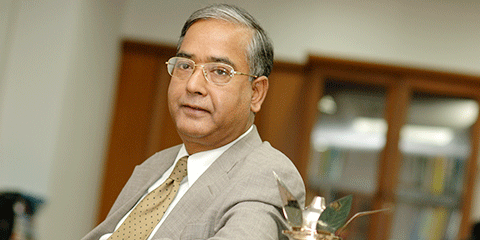
In an exclusive interview for the 13th anniversary issue of Mutual Fund Insight, SEBI Chairman, UK Sinha, talks to Dhirendra Kumar about the regulatory framework governing the mutual fund industry, how technology can change the way people invest and his future plans once his term ends.
The recent report of the committee studying mis-selling has some far-reaching recommendations. The committee says that the regulation should follow function, not form. The products with the same function should have the same costs and commissions, and that the lead regulator should depend on the function of the investment. In a bundled product, the lead regulator for any subpart is to fix the rules. Wouldn't this effectively mean that in insurance products like ULIPs and endowment plans, the SEBI will be the regulator?
This would require a series of legislative changes, which are not very easy to implement. Even in the FSLRC report something on these lines had been recommended - not from the point of view of cost and fees but from a philosophical point of view, of how to run the financial regulatory environment. Coming to cost and fees, I'm in substantial agreement with the committee. When it comes to some details, I have a different view from theirs. One example is their focus on discouraging the trail commission. My belief is that the trail commission is a very good idea. One might question the quantum of the trail commission but the fact is that distributors should be encouraged to make retail investors invest for a long term. This is a premise to which I very substantially subscribe. However, the committee is fundamentally right and I'm happy that this report has already generated a debate in various forums about how to reduce costs. In my interaction with the mutual fund industry, I have personally reiterated this point. They [mutual funds] should be aware of the strong undercurrent against high costs that is coming into the debate and they should take note of it and be prepared. Obviously, this concerns not only asset management but also the insurance industry and others. Going by international standards, there has to be some reduction. In asset management in India, the cost is quite high. We are one of the six countries where it is more than 2 per cent. If we really want to expand the reach of mutual funds, then this has to be reduced.
IRDA seems to have recognised that banks are major perpetrators of mis-selling. Is the SEBI of the same view? Are you also planning any special monitoring of how banks sell products?
We have started, in a very soft way in our circulars and regulations to ensure that AMCs will disclose what percentage of their distribution income is coming by distributing their in-house or allied manufacturing products and how much is for outside. I don't recollect the last numbers but my belief is that in the last three years, that percentage has come down. What has happened after 2009 that banks have become major distributors, followed by national distributors and small IFAs. Since banks' share has gone up, there was a need to focus our energy on what they distribute and how they distribute it. To some extent we have been successful and I'm also happy to report to you that when we discussed these matters with the RBI, it is also in favour of putting reasonable discipline in such matters. Maybe the time has come, or maybe in the near future, we should be getting a little more intensive on this.
In my interaction with some distributors I've gathered that while some of them aspire to be advisors, it is difficult for them because for some customers, it's better to be advisors, while for others they want to be distributors. The regulations stipulate that it is an either-or situation. What is the regulatory thinking on this.
The regulatory thinking is that in the practical sense if it is permitted that the same outfit can function both as an advisor and a distributor, that will not work. The same entity might claim that it is advising some and distributing to others, but in terms of actual conversations that happen between the entity and the client it will be very difficult for anybody to monitor, either during the conversation or post the event. There could be some fudging. So we are very clear that in the same outfit, in the same entity, you cannot have both. We are very clear about that.
The question is: is this model going to be successful. Is it viable? My feeling is that the SEBI needs to be a little more enforcement oriented because the suspicion is that people are still not following the required discipline and they're doing both [advising and distributing].
In the fallout of the JP Morgan- Amtek Auto affair, the SEBI doesn't seem to have a high opinion of credit-rating agencies. Do you think any significant reform is needed in the way these outfits operate or the way they charge or to address the possibility of rating shopping going on?
The SEBI has already started a dialogue with rating agencies, trying to evaluate and question them on their processes. It is a matter of great satisfaction that even before the rest of the world discovered that rating agencies also need to be regulated, India had this regulation as early as 2002. However, the SEBI has doubts about the process being followed.
For example, how come one day a rating agency suddenly decide to suspend a rating? In our view, the suspension of a rating takes place either when there is a commercial dispute between the company and the agency, or the rating agency comes to a finding that they've been wrong in the past and there is going to be a substantial change in the rating of the paper and they want to avoid the embarrassment. So instead of making a substantial downgrade, they just suspend it. This naturally allows that company to go somewhere else and then they get their rating done somewhere else. So we have started this dialogue and we are going to come out with some guidelines in this area. I accept your worry that the process followed by rating agencies needs to be monitored very seriously. Your understanding is correct; this is a genuine worry, and we are working on it. We can't allow this to continue.
In terms of easing internet- and mobile-based investment, mutual funds are still lagging behind. The common platform is no more than a way of pushing around paper forms from investors who go through distributors. Are you planning to push fund houses further, especially in terms of a platform for direct investments?
We are going to push not for a common platform; we are going to push them [fund houses] to take measures how an investor can make investments using technology, without visiting any distributor or any office of the AMC. About two months ago, the SEBI has set up a committee on this under Mr Nandan Nilekani. Three meetings have already taken place; volunteers from Mr Nilekani's team as well as some AMC representatives are also participating. This is an area where a quantum leap is possible and we are working towards it.
On a related issue, KYC continues to be a drag on new fund investors. A new NPS account can now be opened purely online within minutes with an Aadhar-linked bank account. Why isn't this enough for a mutual fund investment?
It is. It is already there. We have allowed that.
...but mutual funds actually mandate physical KYC, when other investments don't.
Their understanding is wrong and we are going to clarify it. The rules framed under the money-laundering law say that the ultimate responsibility is of the intermediary. Therefore, this practice of always going in for an in-person verification has emerged. We are having discussions with them [mutual funds] highlighting that this is not required each and every time, especially for transactions below a certain size. We also want that the bank KYC should be sufficient. We have taken this up with the RBI and I believe that they too are in agreement and they're going to issue a clarification on the matter.
So it will not be mandatory for intermediaries to do an in-person verification if somebody is verified through Aadhar...
The correct way to interpret this is that it will not be compulsory, but if they have any suspicion they can do that. Effectively, for millions of retail customers who are transacting less than ₹one or two lakh, the life will become very simple.
We are coming towards the end of your five years as the sixth SEBI chief. What is your view on what the SEBI has done under your leadership?
That's a very big question. I think I would like to answer this in February, not now.
But what have been the biggest highlights of your term?
I'm not yet in the frame of mind to think of that; maybe a month from my tenure coming to an end I could do so. However, I would point to some of the measures which we took to revive the mutual fund industry, back in 2012. Those measures were not easy to comprehend or implement at that time and there was resistance even within the SEBI and outside to all those changes. We had to take measures to revive the industry. It was not easy but I'm happy that those measures were taken and at the right time. I hope the industry will give some credit to the SEBI too for the current improvement that we are seeing.
Last year you had described a comprehensive system for detecting unauthorised investment schemes that was to be put in place with cooperation of the states. There has also been a spate of actions against entities running such schemes. Is this system now in a satisfactory state?
I think we have covered a lot of ground. What the SEBI had proposed, and that structure has now been accepted by both the RBI and government, is the following. If, in the 700 odd districts of India, people are raising a few lakhs or a few crores in an unauthorised manner, no central agency, whether it is the RBI or the Ministry of Corporate Affairs or the SEBI, can come to grips with it. It would take months or years for the matter to be reported in the press or to be brought to the notice of central agencies.
There is another view that was gaining ground till recently: create one central regulator, give it all the powers so that monitoring of all fund raising and deposits should be with one central agency. I said to the government that if you want this agency to be really functional and effective, you will have to give them a staff strength not in thousands but in lakhs.
So my solution is that the primary responsibility of this should be with the state governments. Through two successive judgements of the Supreme Court, it has been clarified that state governments are perfectly within their right to enact a local legislation for unauthorised money collection. Maharashtra and Tamil Nadu were pioneers and now about 20 or 22 states have enacted such laws. The way these function is that the district magistrate and a deputy collector under the district magistrate are authorised by the state government to take necessary measures. For example, they can attach the property, they can sell the property, they can place the person behind bars. The amended act of Odissa has provided that those taking deposits have to have registration with the district magistrate.
This is the first stage. The second is that there should be a very effective coordination between the central government and the state government. And the RBI and the SEBI have now created a mechanism for state-level coordination committee. They have to meet once in a quarter with central government agencies like RBI, SEBI, MCA, all of whom are members. Cases are discussed there-that this complaint has come or that who is going to handle that etc. Then it is passed on to one of them. It has to be reported in the next meeting what action has been taken. Or, someone can come back and say this is not my issue, this is an MCA issue or this is a SEBI issue and someone else can take it over.
The third part is investor education. Massive investor education is required. If these three things happen, I think this menace will be substantially controlled. And when I'm saying all this, I'm also encouraged by the feedback I'm getting from international experiences. Nowhere in the world, the securities market regulator is responsible for tackling Ponzi schemes. It is state regulators.
And doing very basic things which have to be curbed at the outset?
Yes. Since the SEBI Act was amended in 2014, we have been able to take a lot of actions. We have passed orders in more than 225 cases. In the amended Act we also have now got the power of recovery. So, we have started attachment and recovery proceedings. I think we have actually recovered ₹26 crore and attached about ₹2,000 crore.
Is there any important thing that you think has not yet been undone or should have been done very aggressively?
I'm surprised that there is a feeling in certain sections, in media and also outside media, that the SEBI's role is also to curb black money. This is a very dangerous thing to say because there are people who are paid by the government, who are appointed by the government to collect revenue and stop generation of black money. They can outsource their work to the SEBI. Unfortu-nately, some people feel that way.
It is true that there have been a number of areas where we have worked and detected things, which also involved avoidance of tax or evasion of tax, but the SEBI cannot be held responsible for the tax-collection part. It is something incidental to our inquiries in areas concerning the securities market. But I can't be responsible for tax evasion. There is a primary agency for that purpose.
Three years ago, one of the major ways to manipulate in the markets or to dupe investors was through the primary market. There were agents whose job was to call promoters, hold out the promise of a certain price on listing and provide an exit to such people. In the process, the small investors who invested in those IPOs suffered. The SEBI has been able to curb that.
We have been able to do so because we brought in a lot of restrictions on the IPO side and a lot of responsibilities for merchant bankers. Investment bankers have been given very clear-cut directives, even to the extent that they have to disclose in every IPO document what has been the track record of the IPOs they have brought in the last two years. Till 2013, if you look at issues brought out between 2010 and 2013, more than two-third were continuously selling below the issue price. We have been able to curb that - one, by these measures and, second, by introducing the call option to the pre-open market on the opening day. That has been one substantial reform. Most other countries have not even thought of it. And India has been able to do that. Now one outcome of that is while the IPO manipulation has been checked, it has also checked the evasion of tax because only black money was being passed. Anybody who was doing all this, the operator, was receiving money in the black - all illegitimate activities. The unfortunate part is nobody is giving us the credit that the action we took on our part has also helped in curbing black money.
We've also cracked down on malpractices in secondary market transactions. There was a widespread incidence of client codes being modified. This was the so-called fat-finger issue, where they claimed to have typed in some other client code. Thousands of client-code modifications used to take place. We suspected that these were being done to provide benefits to certain sets of people and we have curbed these. We have penalised those brokers very heavily. Now one end result of that is that the black money part is going away. We don't get credit for this?
The latest thing is that we found that over the last two-three years, certain scrips have gone up by many times the relevant index. We identified those companies, surveyed and then investigated them. This was a long and thorough investigation where we needed to know who the brokers were who had frequently traded, who the clients were, who the investors involved were, the nexus amongst them, the money flow, etc. This means looking into hundreds of accounts, thousands of bank transactions over a prolonged period of time across various banks. This took time, but we did it and then we informed the revenue authorities that this is what we have discovered. We have taken action and according to the data that we had at that time, more than 7,000 crore worth of tax was evaded. But the unfortunate part is that some section of media is saying that the SEBI has failed in tax recovery. The SEBI has not been created for that purpose.
Are you planning to hang up your boots post February or should we expect yet another innings in a new role?
We'll talk about that in February.
This interview appeared in the November 2015 Issue of Mutual Fund Insight.
Ask Value Research 

 New episodes every Friday


 New Process Alert
 Seems like you've uploaded a wrong QR code. Please upload the QR code downloaded from MF Central platform.


