


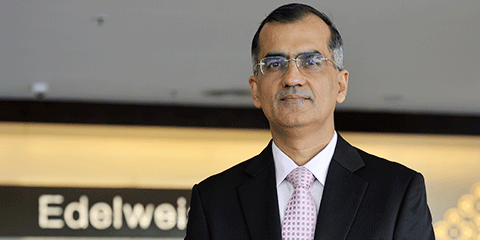
Our ability to focus on our core, which is equity as an asset class, is our biggest strength. Our range of unique products in the low-volatility equity segment, leading to the creation of a distinct investment category, accentuate and reflect that strength. Another significant strength is our entrepreneurial mindset, which enables us to be decisive and fleet-footed and helps keep our costs under control. This has enabled us to persist in our strategic growth initiatives.
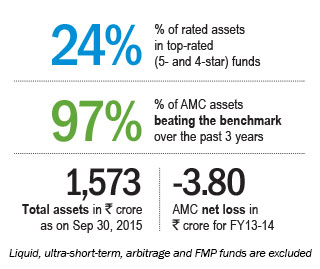 One of the weaknesses we see is the conventional mindset of investors in terms of warming up to the low-volatility space, despite it's obvious benefits. Consistent performance and clarity of communication are the two imperatives which are helping us mitigate this issue.
Challenges
Clearly, the industry's incessant focus on AUM rather than quality of AUM will continue to cause consternation. As a consequence, sales of fixed-income funds to large investors will keep happening, which in turn will lead to suboptimal TERs to manage returns as also undue credit risks.
The other challenge is frequent changes in taxation. We should give time to the industry to adjust to changes in taxation, both at an investor and at a distributor level. There is too much emotional energy being sapped in handling this issue rather than growing the business.
From a global investment perspective, global volatility and the wherewithal to sustain huge global flows - in and out - are going to be the biggest challenge. From a local perspective, I see a challenge in the way the industry handles its fixed-income portfolios. The average ticket size in fixed-income funds is very steep due to significant investments from large-ticket investors. Redemption management will be an issue which will keep the industry on the edge.
Competition
There is enough competition with commoditised products and most old AMCs with vintage have them. However, there is not enough diversity, except from younger AMCs, which is a prerequisite for market expansion. Worldwide, a lower net-worth threshold is a crucible for professionals backing their investment ideas and convictions, which in turn expands the cache of investors.
Retail reach
If one has to go by history, most new products trickle down the affluence curve over a period of time. It is a natural process and gets accelerated with better execution and higher distributor interest. It has already begun at our end. We therefore have explicit distributor engagement targets for the sales team, which will lead to a higher retail participation.
This article was originally published on November 18, 2015.
Ask Value Research 

 New episodes every Friday


 New Process Alert
 Seems like you've uploaded a wrong QR code. Please upload the QR code downloaded from MF Central platform.


