


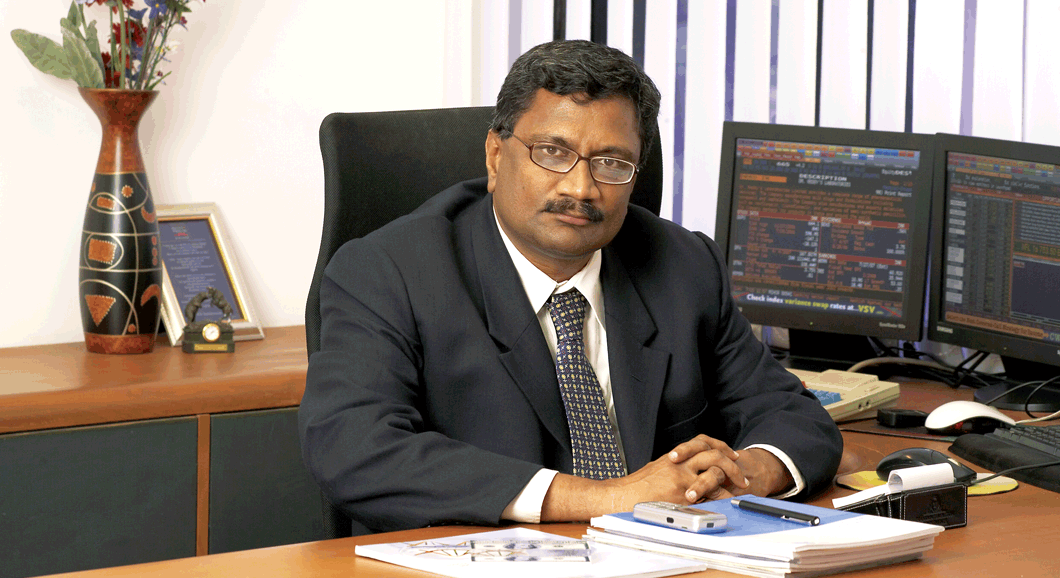
After a two decade career in one of the oldest private sector AMCs, KN Sivasubramanian- CIO, Franklin Templeton Investments calls it a quit. In this candid conversation, he shares his future plans and reminisces of the times gone by
Why retire so early?
I have spent quite a bit of time in the industry, and it's an industry in which I got into by accident. But, I learned to love it over the past 20 years. I had decided to quit sometime back, when I touched 50. I turned 50 sometime ago, and I wanted to start focusing on other things in life. So, from a personal standpoint, there are other priorities and I wanted to take some time off to focus on those things.
What will you do now? What will you focus on?
I am taking a break from the corporate world. The intention is to spend more time with my family, I have parents who are quite old and so far I have not spent enough time with them and that is something I want to immediately focus on. Post that, I am yet to make up my mind. I don't have anything concrete in mind, but I am moving out of investment management. I loved what I did, but I think it's time for me to look at other things.
These days there are a lot of professionals leaving to join politics. No such plans?
No, no. There are no such plans.
What is the biggest thing that distinguishes your approach from other fund houses? Looking back over the past 20 years and knowing others, how do you distinguish yourself from other people managing money here?
Frankly, I think it's difficult for me to answer on behalf of others, but from my standpoint, I would like to mention two things. One, while I strayed into the business by accident, it was something of a passion and also because of the kind of people who have worked with me, Sukumar, Anoop Bhaskar and others; all these people brought a certain passion for equity investing and that sort of rubbed off onto me. Over the years, I think I have done my job to the best of my abilities with passion. The second thing I would like to point is patience, that is something I would like to stress. Our approach has always been a team-based approach, it's not based on any individual. The company has been patient with us. We try to be patient when it comes to investments and also when it comes to opportunities. So these two things are something that characterise my stay here over the last 20 years.
At any stage you got deeply value oriented in terms of buying things at a discount? Or cheap stocks which are completely out of favour, those kind of situations?
I have personally also bought into some of these contrarian stocks. One big theme which we played was the oil marketing companies (OMCs) which has been a disaster over the last 10 years, and there was a point in time when we were massively overweight on OMCs. A decade ago they looked like great value. And the jury is still out on that, we have moved towards market based pricing or else the story would have been different. I think post the change of government in 2004, it was put on the backburner, the move towards market based pricing sort of impacted the entire sector. Slowly we seem to be moving back towards market linked pricing; major component of the subsidy the government pays out. If we manage to move towards market based pricing, I think there is a big rejig possible for the entire OMC sector.
Now I have this question which is rightful of asking any fund manager; do you think the bull run of 2004 to 2007, can it be repeated in the foreseeable future?
My view is that all asset classes go through cycles. There are times when an asset class is totally disregarded and times when things get overdone, and that is what happened in 2004-07. Whether such a run will be seen again is very difficult to comment. This time around I think it will be more nuanced and people will pay attention to fundamentals. But of course, there are always new players and obviously new ways to be learned. But I am clear in my mind that equity today probably presents the best opportunity among asset classes in India.
The fundamental problems of the Indian economy appear a lot more intractable than they used to. Do you agree?
We are intractable, but at the same time, I think there are simple solutions which if put in place, can overcome these problems. I think the last five years have been spent in trying to ensure that there is better need for the solution of growth which we have seen in the economy. My view personally is that you need to have a stronger balance sheet before you can start attempting redistribution of wealth. We need policies which will enable entrepreneurship and capitalism to work before we start looking at redistribution because the first and foremost aim should be to create more jobs, rather than trying to redistribute a pie which is quite small right now. The government has to earn more revenue before they think in terms of trying to benefit one class of people over the other.
I have always thought of asset management as talent oriented, or instinct oriented as well to a great extent. In the new school of thought, there is reasonable process orientation which is creeping into fund management. Which side do you fall in?
I am more on the process side. Of course, experience does help. There are various studies that have tried to examine whether investing is all skill or luck, and the best thing which can be said is that, you follow a process, you try and improve the probability of being right. Chess, for example, it's all skill. If I play Magnus Carlsen, I will probably lose 100 out of 100 times. Whereas, as far as the stock market is concerned, a total rookie in the market can pick a stock which can be a 10-bagger or 20-30-bagger. But one single strike cannot prove whether you are good or bad. You are good only if you make thousands of picks and majority of them turn out to be right. And for such a thing to happen, you need to be more process oriented, and try to cut out all the probabilities of a loss and improve the probability of your being right. Obviously, there is definitely an element of luck as well. And to ensure that the luck fits into the skill part, you need to be process oriented and process orientation can improve the probability of success.
I know a lot of your successes, but in the early years, what was the silliest thing you did?
Lot of silly things frankly. The whole industry was new. And not just us, I think other portfolio managers also made mistakes. I think initially the focus was on the arbitrage available on the IPO investments, which most of us played. Clearly, we weren't on the job. Very few outfits had people with necessary experience, so most of us were new and as a consequence we made a lot of mistakes. The key thing that we did not understand was that the business success depends on the management of the company and the kind of business space they are in. So even if you have the best management, if the space they are in is not great, it's something even the best management cannot turn around. So those are things which we were not attained to in the initial stages. As a result, we invested in quite a few sectors which in hindsight, we shouldn't have. So, we look at all the so-called frontline sectors of the day. We were taken in by the promise of great returns, but over the years, we learned to focus more on the business potentials, the cash flows, and the quality of management.
But even Infosys at that stage would have been something like an aqua culture, with which you went right.
Like I mentioned, the process will help you beat out some of the mistakes you made, but it will not ensure that you avoid all mistakes. So it is not a question of avoiding mistakes as such, because mistakes also teach us a lot. And the key thing to do is get out of mistakes early, don't make big mistakes and once you've made a mistake, get out of the mistake early and realign it with other businesses which have more potential. So the question that arises is, if it's a new industry how do you know it's going to be a good industry going forward? The same can be said for private banks as well. As we go along, we need to constantly keep reassessing the business potential and seeing whether you are in the right or you're missing something. So that constant thinking about that business potential and thinking whether you're on the right track or there is something you need to focus on.
How difficult will it be to not to come to office and look at investments, be with a smart set of people, talking about companies and the routine you've been used to?
Yeah, that would be the difficult part, switching off from the markets is going to be difficult. But at the same time, I am somebody who loves to read a lot, my eyes are also not that healthy, so it will help me to stop looking at screens. Frankly, even for the people in the markets, I think we need to spend more time reflecting on issues impacting businesses and companies, rather than watching the ticker throughout the day.
Ask Value Research 

 New episodes every Friday


 New Process Alert
 Seems like you've uploaded a wrong QR code. Please upload the QR code downloaded from MF Central platform.


