


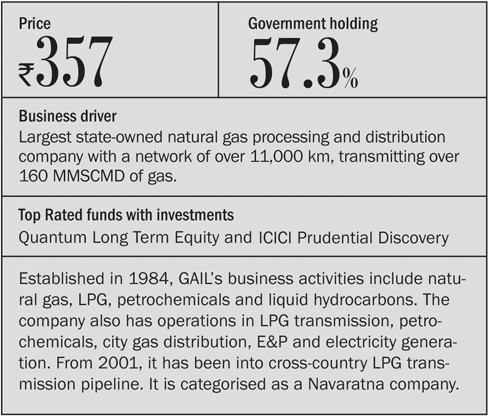
GAIL undertakes exploration, production, processing, transmission and distribution of natural gas. The company operates a natural gas pipeline network of about 11,000 km and a LPG pipeline network of about 2,038 km. It transmits more than 160 MMSCMD of gas through its pipelines and also produces liquid hydrocarbons such as propane and pentane. GAIL has a market share of more than 70 per cent in both gas transmission and marketing.
Strengths
The government patronage extends beyond finance to more importantly in government approvals. GAIL is very likely to remain the key player in the transmission of gas across the country for many years to come. Gas transmission is the primary income generator for the company, accounting for over half of its total earnings.
Currently, GAIL's subsidy burden is capped at Rs 1,400 crore for FY14. With the company slated to pay market price for natural gas, it is very likely that GAIL will not be required to pay any subsidy from FY15 onwards. Further, the company has plans to invest Rs 30,000 crore on capacity expansion in the next four years. The expansion will result in a transmission capacity increasing to over 15,000 km by FY15. GAIL is also commissioning a new LNG terminal in Dabhol; expected to come online in the coming months.
Further, the recent government directive allows gas companies to fix their own marketing margins to all consumers barring those on urea manufacturing units and LPG plants. This is a huge positive for GAIL as the earlier worries of capping of marketing margins had put the earnings for gas marketing companies like GAIL in a lumber.
A bigger business for GAIL is turning out to be gas trading. This line of business now brings in a quarter of the company's Ebit with margins of 4 per cent. This is of importance, given the demand for gas outstripping supply, resulting in gas imports and sale which can significantly boost earnings.
To secure natural gas supply, GAIL has entered a long-term LNG supply agreement for 2.5 MMTPA with Gazprom Marketing and Trading, Singapore. It also entered into a long-term liquefaction tolling capacity agreement for 2.3 MMTPA of LNG with Dominion Resources Inc. of the US.
Further, the increasing LPG prices, currency depreciation by around 10 per cent and the Rs 1,400 crore subsidy relief, according to Antique Stock Broking, could result in EPS to rise by as much as 52-57 per cent during the second half of the current financial.

Concerns
While ONGC and Oil India stand to gain from the gas price hike from $4.2/mmbtu to $8.4/mmbtu, GAIL stands to be negatively impacted as it uses ONGC's gas feed for its LPG and petrochem sales. While the price hike aims to align domestic gas to market prices, GAIL's cost of procurement will double.
Gas transmission volumes are not increasing. With KG D6 not overcoming its problems, volumes for GAIL have remained stagnant for many quarters now.
GAIL imports LNG to counter the low gas production by ONGC and D6. However, imported LNG is not cheap and costs about $13/mmbtu compared to the current $4.2/mmbtu for KG gas. Higher cost of input gas is likely to trouble GAIL in the near term.

Valuation
GAIL trades at 9.5 times its earnings, which is about 30 per cent cheaper than its five year median valuation. While the company's transmission segment could remain down for some time, GAIL's trading business could drive earnings up if it sustains the current momentum.
No expected subsidy sharing after FY14 and the government's latest decision to allow GAIL to fix its own marketing margins should help the company. But this is a long term play. Buy only with a horizon of five years or more.
This article was originally published on February 26, 2014.
Ask Value Research 

 New episodes every Friday


 New Process Alert
 Seems like you've uploaded a wrong QR code. Please upload the QR code downloaded from MF Central platform.


