




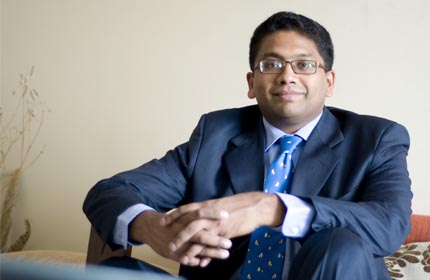
The gloomy market conditions in the past three years have not deterred the performance of funds managed and overseen by Vetri Subramaniam, Chief Investment Officer (CIO), Religare Invesco Mutual Fund. He discusses the state of the Indian economy and the markets and explains the investment strategy adopted by him that has helped the performance of many of the Religare Invesco funds.
What's you view on the durability of the market momentum seen of late?
Instead of momentum, we prefer to view the market through the lens of valuation. In 2008 the valuations were close to historical highs and then in 2009 the valuations went down to lows. However, from 2010 market has been trading in a much tighter valuation band--capped by the historical average valuations at the upside and at a 15-20 per cent discount to average valuations at the lower side. Every time the reasons are slightly different for why the market is moving within this valuation range.
The defining feature of this period is that largely domestic investors have been absent from the market and the predominant source of flows has been from foreigners. What we are seeing is cycles of 'risk-on risk-off' behaviour on the part of global investors. Sometimes it is correlated to local events and data, but more often it is correlated to global events. So issues such as Europe sovereign debt, Fed tapering, etc, are the sort of macro issues which are driving fund flows very aggressively into all asset classes across the world. And that is what seems to be causing these sharp up and down moves at various point of time. I think in India from the point of view of economy not much is happening and we have been in a gradual deceleration for almost three years. There are no signs of this deceleration ending. Some of the issues the economy is experiencing will get addressed by passage of time, so one needs to be patient on that front. The economy needs policy traction, improved corporate financial health, competitiveness and a revival of the investment cycle.
If you look at recent high which we saw few weeks ago, we had gone up to just marginally above long term valuations for Sensex which is about 17.5 times. Sustaining and climbing above that mark will require lot more confidence in terms of the local economy, growth rates and earnings recovery. As of now we are still not able to see earnings recovery. There has, however, been some stabilisation of earnings growth prospects of FY2014. But if you break it down in the earnings, growth has stabilised because export growth oriented companies have seen upgrades even as most others have seen downgrades. So on average it looks like things have improved, but numbers suggest that it is more related to these translations benefits in the short term rather than any increase in momentum in the economy.
What's your approach in managing the various equity funds like Religare Invesco Business Leaders, Religare Invesco Equity and Religare Invesco Growth? Do they differ or do you differentiate among them?
We have well written internal mandate for each of the fund which distinguishes our fund management approach towards the funds. So in Business Leaders fund, it's a complete large cap fund, we don't take any sectoral risks (in line with the benchmark weights). The essential focus of this fund is to generate alpha by stock picking rather than taking sectoral or asset allocation calls. We don't churn the portfolio, we take call on companies that are leaders in that particular sector or industry and than we are happy to stay invested through market cycles.
On the other hand, the Religare Invesco Equity has a complete different approach. It is an extremely focused portfolio. By mandate we can invest between 15-30 companies, but we tend to run it in with about 20 companies, we also take more aggressive sector allocations in this fund. Further, in this fund we also take asset allocation positions which can be either through cash or index hedges. In that sense this fund tries to create alpha by combining stock picking, sectoral allocation and asset allocation. It has done quite well for us over the last four years because this is the kind of market and volatility that works very well for this style. Our internal analysis shows that asset allocation has played a significant role in creating alpha for this fund. Such product is typically for investors who want their fund managers to manage the volatility and use asset allocation to generate Alpha.
Religare Invesco Growth Fund is a core, diversified equity fund and we try to control risks in the portfolio from all the possible directions. We take measured sector risk and maintain a balance between growth and value. We also keep the portfolio balanced between large-cap and mid-caps by aligning it with the benchmark. For us this is an 'all weather' fund and we try and generate steady alpha for investors over the benchmark.
How different is Religare Invesco Contra fund from other diversified equity funds?
The key to this fund is its willingness to be early to take on risk. It has a strong value focus and we try and look at companies where the value is very attractive irrespective of the fact that in the short term things might be challenging. This fund is very well positioned to benefit from an economic recovery as the market gains confidence. The fund's value focus will enable it to benefit as and when the economy revives and these companies will benefit not just from earnings growth but also from PE re-rating. It is a strategy which has struggled in the last two years because the economy has been going through turbulent phase. But we still think this is good portfolio for someone who is willing to take risks and has a value oriented mindset.
What's your approach while managing Religare Invesco Tax Plan, is it different other equity funds?
We run this scheme with a very simple mindset--we can remain patient (as money is locked in for three years) and can also benefit from growth opportunities by investing in young companies. The fund is equally balanced between large-caps and mid-caps and it takes our best large-cap and mid-cap ideas. The portfolio always stays well diversified.
How do stocks make inroads in your portfolio?
We maintain what we call our 'internal universe' which fluctuates between 280-300 companies. We arrive at this numbers by adding companies from Bombay Stock Exchange (BSE) 200, CNX Midcap Index and stocks from other indices like PSU, Infrastructure and Banking which are benchmarks for our thematic or sector funds. This total comes to around 280, while remaining 10-20 companies are completely bottom-up ideas which might be suggested by the analysts.
This universe is tracked by our internal team--an analyst covers a sector or multiple sectors. Even fund managers have sectoral responsibility, so they might cover one sector as an analyst in addition to managing a fund. We then use our internal stock categorisation system, in which we evaluate each company through a bottom-up approach. We look at the business in which the company operates, its growth prospects, financial and operational metrics. If the company passes through these filters and meets certain characteristics they get 'categorised'. So when we say, companies are categorised, it means that they are approved for investments. So out of nearly 300 companies, currently we have about 140 odd companies categorised.
What kind of stocks never enter your portfolio?
As a fund house we follow a strict bottom-up approach and as I described earlier, stocks that are not 'categorised' don't enter our portfolio. It doesn't matter if that particular company is in the index of not, if it doesn't meet our criteria we don't even think of buying it. Companies whose Return on Equity (RoEs) are consistently much below industry average and also below economic threshold don't make it through our system. So companies which don't meet this kind of criteria typically don't enter the portfolio. In the past 2-3 years we have been extremely cautious on companies where we think there is problem in terms of ability to service debt.
Your funds have done very well of late. What has been the key performance driver?
Our investment approach is very disciplined. We have strong internal process driven by in-house analysts. I think consistent performance has kicked into our longer term portfolio performance. In the last five years we have different market conditions: depressive and euphoric and also a more boring trading range market, since 2010. But what has really worked for us is that we have maintained to provide consistent returns across our funds. The other crucial part is the our focus on high quality companies with healthy RoEs and Return on Capital Employed (RoCEs) has worked to our advantage. The market has been biased towards quality companies and that has benefited our portfolio.
Has Invesco brought about any change in fund management?
Invesco has a federal approach towards investment management. Every investment centre has its own set of investment processes and is governed by that. There is no change in the way we manage the funds after Invesco partnered with us. However, Invesco being one of the leading asset managers globally, their risk management and performance measurement is standardised across the world. Now we report all the numbers back into standardised formats that Invesco uses to measure risks and performances. This has improved the quality of our risk management process. But, there is no change in the investment process.
Ask Value Research 

 New episodes every Friday

 New Process Alert
  Seems like you've uploaded a wrong QR code. Please upload the QR code downloaded from MF Central platform.


