




 Aprajita Anushree/AI-Generated Image
Summary: A broad market index asks which companies are large enough to deserve weight. A factor index asks which characteristics deserve weight instead. An active factor fund asks both questions and adds a third that the index never considers.
Every index carries a judgement about what deserves weight. In the Nifty 500, market capitalisation supplies most of that judgement. A company that becomes larger commands more capital, irrespective of whether the rise reflects stronger fundamentals or simply a richer market price. The index provides broad coverage while leaving a separate question unresolved: which characteristics deserve more capital?
A broad universe is only the starting point
Factor rules begin at that question. From the same Nifty 500 universe, a different rulebook can produce a portfolio whose behaviour diverges sharply from the parent index. A momentum rule may favour persistent relative strength, whereas quality rules can remove financially weaker companies. Value changes the entry criterion by asking whether the price leaves enough room for the fundamentals. Low-volatility rules pursue a different risk profile.
The table ‘Factor rules changed the long-term return profile’ resists a league-table reading. Momentum rewarded investors more at the median while demanding greater tolerance when conditions turned. Low volatility protected weak periods more effectively.
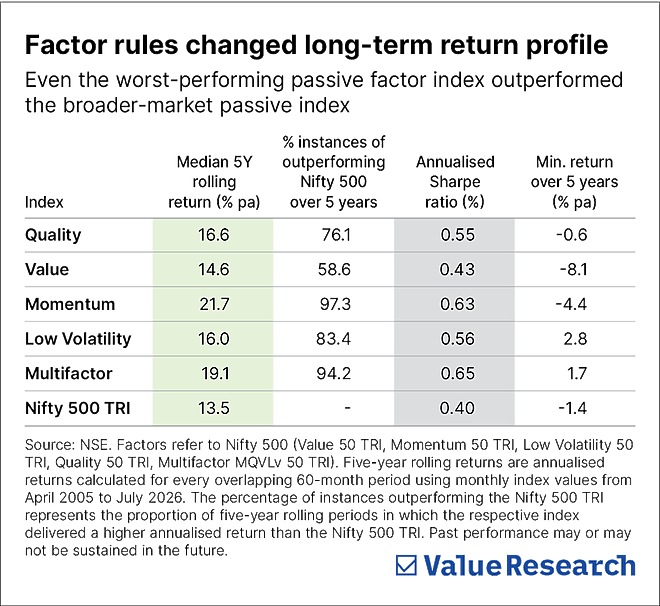
Factor rules therefore change the distribution of outcomes within the same market, which makes the relevant question whether the resulting trade-off suits the role that the strategy must play in a portfolio.
Rule-based investing also moves judgement earlier in the process. Researchers define the factor before trading begins and decide when the portfolio will rebalance. Discipline follows when the strategy continues to obey those tested rules through uncomfortable markets.
Market capitalisation does much of the work in a broad index. A passive factor index shifts some authority to a published rulebook. Once an investor chooses that index, the index’s methodology continues to determine which stocks qualify until the provider revises the rules.
The real difference lies in how the rules work
A broad-market index largely accepts the portfolio created by the index methodology. A passive factor index makes a more deliberate choice: it tracks an index built to favour a specified factor. The investor therefore accepts both the factor view and the index provider’s method of expressing it.
An active factor fund has another layer available. Other rules can determine which companies are eligible before the factor is applied, or govern how the resulting portfolio takes risk. This gives the process more room to distinguish between a stock that scores well on a factor and one that the model considers suitable to own.
That distinction is central to NJ’s approach. The process starts from a broad universe and applies a baseline quality filter before the chosen factor enters the picture. For the momentum strategy, companies that fail the prescribed forensic and governance tests are removed. Similarly, stocks displaying high volatility are screened out. Factors like momentum and value then operate within the remaining universe.
That sequence matters. A stock cannot enter merely because its price has risen strongly or it is trading at a reasonable discount. It must first survive the conditions that the investment process places around the factor.
Such freedom carries its own risk. Each additional rule rests on a research judgement and can fail to improve the portfolio. An active factor fund therefore deserves no automatic presumption of superiority over a passive factor index. The extra rules have to justify themselves through the outcomes they produce over time.
Whatever floats your boat
Broad-market indices remain useful because they give investors extensive market exposure through a simple rulebook. Factor indices make a further choice about which characteristics should receive more weight. Active factor funds can subject those characteristics to additional tests before capital is committed.

Each step places more responsibility on the rules behind the portfolio. That raises the standard by which the strategy should be judged. A useful rule must have a sound rationale and survive market conditions that do not flatter it. Over time, the relevant question is whether those additional rules earn their place.
Nirmay Choksi is the Executive Director - Research at NJ Asset Management Private Limited and the views expressed above are his own.
Also read: From signal to selection
Ask Value Research 

 New episodes every Friday












 New Process Alert
  Seems like you've uploaded a wrong QR code. Please upload the QR code downloaded from MF Central platform.


