 Widely read:




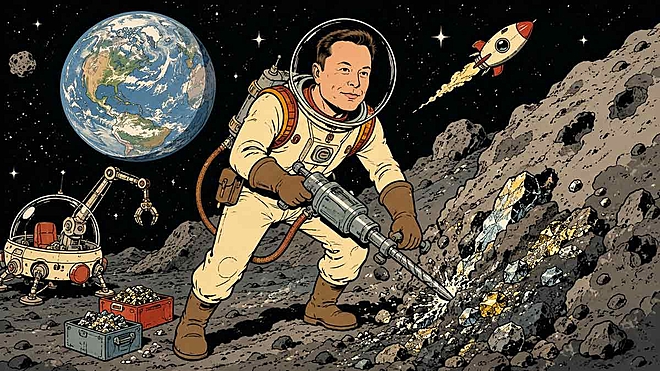 Anand Kumar/AI-Generated Image


Summary: The standard advice in this column is to switch off the news. Then a conversation about asteroid mining, space-based manufacturing and the end of heavy industry on Earth made that advice harder to follow than usual.
Readers of this column know my standard advice: switch off the news.
I have written on many occasions that the day's headlines are no friend to your portfolio, that the urgent thing on your screen tonight will look like nothing in a year, and that the investor who reacts to every news development is usually the one who fares the worst. I stand by all of it. So, it is a little awkward to admit that a few weeks ago, I came across something I could not wave away and want to tell you about, even though it has little to do with your money.
The occasion was the stock market listing of Elon Musk's SpaceX, which arrived this month at a price that made him, on paper, the world's first trillionaire. The press has been full of the number, and serious people have argued, persuasively, that the company is worth a great deal less than the market is paying. They are probably right, and I have nothing to add to the valuation. But that argument is the small game. The thing that stopped me was the large one, and it came not from the financial pages but from a conversation with a friend.
He is a lifelong science fiction devotee and an unabashed admirer of Musk, the sort who was reading Robert Heinlein at an age when the rest of us were reading the sports pages. Over the course of an evening, he laid out where he believes this road eventually leads, and I have not been able to put it down since.
It begins with mining the asteroids. Here, he told me something I have not stopped thinking about. Every mine for heavy metals on Earth, every source of gold and nickel and iron we have ever dug, is really the site of an ancient asteroid strike, a small fragment of which happened to bury itself here long ago. The metals were never ours to begin with. They fell. And out in space, where they came from, the same materials exist in quantities that make the richest mine on Earth look like a rounding error.
From there, the logic builds one step at a time. Once you are drawing raw materials from the rocks up there, it makes little sense to haul them all the way down a gravity well to Earth. So the next step is to manufacture in space, where, closer to the sun, energy is effectively free and endless. And since most of what we build exists only so that we can build other things with it, the conclusion becomes hard to resist: keep the entire industrial chain in orbit, and let only the finished articles come down to us.
The end of the story is the part that has stayed with me. If heavy industry can be carried on more cheaply off the planet than on it, then Earth need no longer be the place where we make things. It can go back to being the place where we grow things and where we live, with the mines and the furnaces and the smoke lifted clean off it, and only the finished goods descending quietly from above. That, my friend says, is the destination this whole enterprise is actually travelling towards.
I do not quite know what to do with this. My entire working life has been spent puncturing grand visions, because in savings and investments, a grand vision is usually the wrapping on a poor product, and the moment something sounds too grand, I reach for my wallet to check it is still there. People have promised us the future for a very long time. Flying cars and Moon holidays were always a decade away, and the safe bet on any such prophecy is that it is too early, too expensive, or simply wrong. And yet, I could not file this conversation under noise, the way I file almost everything else, and that is unusual enough to be worth sharing with you.
Let me be plain that this is not a column about what to do with your money. I am not suggesting you buy this share or any other, and I would be wary of anyone who used a vision of this sort to sell you something, because that is exactly how visions are usually put to work. My reason for writing is different. Every so often, it is worth setting the portfolio aside and remembering how small a thing it is against what may be coming. We argue about the new tax regime and the right number of mutual funds, rightly, because those shape the next few years. But if even a fraction of what my friend described comes to pass, we are looking at a change in ordinary life larger than the industrial revolution, which remade everything our great-great-grandparents had taken to be permanent.
None of us can see that far ahead, and the people pricing the share today cannot see it either, no matter what their models tell them. The honest position, in front of a future this large, is not confidence but a kind of cheerful humility. So, my advice, for once, has nothing to do with your savings. Keep ignoring the news, because it still will not help your portfolio tonight. But once in a while, lift your eyes from the statement of account and wonder what your grandchildren might come to think of as perfectly ordinary. I cannot tell you whether my friend is a prophet or a dreamer. I can only say that I am not sure he is wrong.
This column was published in Mint on July 5, 2026
Ask Value Research 
 New episodes every Friday






 New Process Alert
  Seems like you've uploaded a wrong QR code. Please upload the QR code downloaded from MF Central platform.


