




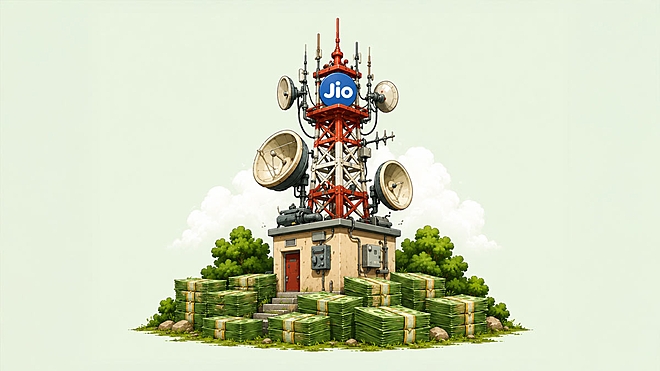
 Aman Singhal/AI-Generated Image

Summary: Not one of Jio's big-name backers is selling a single share. The money the public puts in goes to the company. That unusual structure changes the question an investor needs to answer before the price band is even set.
The most telling detail about Jio's IPO is not the size. It is who is not selling.
Reliance is holding every share it owns. So are Meta, Google and the sovereign wealth funds that bought in years ago. Not one of Jio's big-name backers is cashing out. The money the public puts in will not reach any of them. A large part of it is earmarked for paying down debt.
That is an unusual structure for a listing of this scale. And it matters because it changes the question an investor needs to answer. This is not a story about early backers taking profits. It is a story about a company asking the public to fund the next chapter and to decide, before the price band is set, whether that chapter belongs to a phone company or a technology platform.
The gap between those two answers is enormous. And it is the whole investment.
Every rupee goes to the company. Most of it to pay down debt
Jio Platforms filed its draft red herring prospectus (DRHP) with SEBI on June 19, 2026. Here is the offer in brief.
| Feature | Detail |
|---|---|
| Filed | June 19, 2026 |
| Estimated size | Rs 30,000 to 35,000 crore |
| Type | 100% fresh issue, up to 27 crore shares at face value Rs 10 |
| Largest use of proceeds | Rs 27,500 crore to repay subsidiary debt |
The size remains an estimate. The price band is fixed only after SEBI reviews the filing.
A listing built to repay, not to enrich
Two features of the structure carry most of the meaning.
The first is that this is a fresh issue, not an Offer for Sale. In an Offer for Sale, existing owners sell their shares and the company receives nothing. In a fresh issue, new shares are created and the proceeds land in the company's own account. Jio picked the second route, so the public's money funds the business rather than its early investors.
The second is where that money goes. The single biggest use is not artificial intelligence or any new venture. It is debt. Jio intends to spend up to Rs 27,500 crore repaying borrowings at its telecom arm, Reliance Jio Infocomm, including foreign-currency loans taken to build the network. And the clean-up was already underway before the IPO filed.
| Net debt (Reliance Jio Infocomm) | Amount |
|---|---|
| FY24 | Rs 48,440 crore |
| FY25 | Rs 45,273 crore |
| FY26 | Rs 27,579 crore |
Read together, the IPO looks less like a growth raise and more like a financial spring-clean. Lighter debt means smaller interest bills and more room to spend on the expensive next phase, large-scale data centres and AI infrastructure, without borrowing even more.
Revenue up 34% in two years. Margins holding
The draft prospectus sets out three years of restated consolidated accounts. They describe a large, fast-growing and genuinely profitable business.
| Particulars (Rs crore) | FY24 | FY25 | FY26 |
|---|---|---|---|
| Revenue from operations | 1,09,558 | 1,28,218 | 1,46,885 |
| Net profit | 21,423 | 26,109 | 30,049 |
Revenue from operations has risen from about Rs 1.10 lakh crore to nearly Rs 1.47 lakh crore in two years. Net profit has grown every year, reaching Rs 30,049 crore in FY26, a net margin of roughly 20 per cent.
77% of revenue is still telecom. The price depends on whether that matters
Close to 77 per cent of Jio's revenue still comes from traditional telecom: mobile plans, JioFiber home broadband and enterprise connectivity. The newer digital lines—streaming, cloud—earn money, but they are modest beside the telecom core.
This is the company's central tension. Telecom can be hugely profitable at scale, but the stock market seldom pays up for it. Investors tend to treat network operators like utilities—businesses that swallow capital, must keep buying costly spectrum and never stop upgrading. Even the strongest telecom names rarely command the multiples that software and technology companies attract.
That is why Jio's leadership wants the market to see a technology company. Spending is flowing toward AI infrastructure, cloud computing, enterprise software, data centres and connected devices. The logic is that the network brings the customer in, and the real money comes from everything sold to that customer afterward.
Airtel is the natural comparison, and it is a sharp one. Jio went for sheer reach and low prices to accumulate hundreds of millions of users. Airtel courted higher-value customers, pushed up revenue per user and kept spending disciplined. The result is that Airtel generates stronger profitability from a smaller base.
| Metric | Jio | Bharti Airtel |
|---|---|---|
| Mobile broadband market share | 50% | 35% |
| Subscribers | 52.4 crore | 66.6 crore |
| ARPU, Q4 FY26 | Rs 214 | Rs 257 |
India has no AI champion. Jio wants to be the answer
The BSE Sensex has fallen about 9 per cent in 2026 and dropped from the world's fifth-largest market to seventh, passed by Taiwan and South Korea as global money chased AI chipmakers. In the market's shorthand, India has become an "anti-AI" bet, a country with no headline AI champions.
Into that gap steps Jio, presenting itself as something close to India's AI answer: a builder of data centres and digital infrastructure at national scale. Its filing, a day after NSE lodged its own DRHP, suggests the IPO freeze is starting to lift as geopolitical tensions ease. At the Reliance AGM, Mukesh Ambani cast the listing as proof that India can create technology companies of global scale. Whether the market buys that framing is the entire contest.
Telecom or tech. That one call is the whole investment
The question for a retail investor is not whether Jio can keep adding mobile users. That phase is largely done. The question is whether it can grow into India's leading digital-infrastructure business and be valued by the market on those terms. If it manages that, the Airtel comparison fades and the benchmark shifts toward global technology companies. The valuation arithmetic changes completely.
Until then, be precise about what is on offer. These shares are not a claim on what Jio is today, a business still roughly three-quarters telecom. They are a wager on what it intends to become. The IPO funds that attempt and clears the debt that might have slowed it.
Wait for the price band. Study what the filings reveal about the digital and AI businesses actually scaling. Then choose your lens. Telecom or technology.
A wager this size deserves more than a headline. Value Research Stock Advisor studies the business behind the buzz—the financials, the competitive position, the risks and whether the price makes sense once the narrative is set aside. When the price band arrives, you will want a framework, not just a feeling.
Ask Value Research 
 New episodes every Friday











 New Process Alert
  Seems like you've uploaded a wrong QR code. Please upload the QR code downloaded from MF Central platform.


