




Which schemes are eligible for direct plans?
* All open-ended equity funds except exchange traded funds (ETF) and plans that have been discontinued for further subscriptions
* New FMP fund offers and capital-protection schemes launched since January 1, 2013
* Interval schemes commencing during the transaction period immediately succeeding January 1, 2013
What are the ways to invest in a direct plan?
You can invest in a direct plan in following ways:
* Register with the fund house's online portal and invest through it
* Submit your application at the fund house's branch in person or by post
* Approach the Asset Management Company's office in person or by post
* Submit your application to the registrars of the fund house, which are CAMS and Karvy
Will my existing investments in the regular plan, made directly with the AMC without a distributor, be transferred automatically in the direct plan?
No. This will not happen automatically. You need to send an application to the AMC to shift the investments you made before January 1, 2013 to the direct plan. However, SIPs and STPs registered before January 1, 2013 without a distributor code, will automatically be processed under the direct plan from January 1, 2013.
I have an investment in the existing (regular) plan which is not routed through any distributor. Will the future dividend reinvestments take place automatically in the direct plan?
No. Dividend reinvestments will take place in the existing (regular) plan even when the investment is not routed through the distributor.
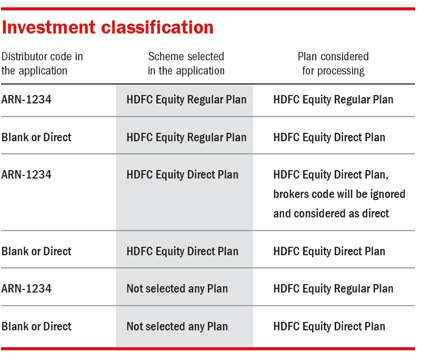
How are my investments classified if I invest with or without distributor code?
To illustrate the different scenarios, we have illustrated how your investment will be classified (See: Investment classification).
Why has Value Research not started to rate direct plans?
Value Research rates equity funds, which have a minimum three-year history, which in the case of debt funds is 18 months. Direct plans are derived from regular plans, they have the same portfolio. However, these plans will have higher returns because they do not incur any commission or distribution expense, which is applicable in case of regular schemes. It can be safely assumed that the rating of a fund in the direct plan of a scheme will be the same or better compared to the regular plan in the same fund.
When the portfolio is the same for direct and regular plans of a scheme, shouldn't the dividend be declared at the same rate for both the plans?
First, mutual funds are not obliged to pay dividends. The dividend distribution depends on the availability of the surplus with fund scheme to distribute. Direct plan and regular plan may have the same portfolio but at the same time have different NAVs due to the difference in expense ratio of the two plans, resulting in the returns being different for them.
As per Sebi regulation, mutual funds can only give dividend from the realised gains. As direct plans were launched only from January 1, 2013, there is a possibility of these schemes having no or less surplus to distribute. It could be for this reason that the fund scheme does not declare dividends under the direct plan compared to the regular plan or declares lesser dividend under the direct plan.
Ask Value Research 
 New episodes every Friday

 New Process Alert
  Seems like you've uploaded a wrong QR code. Please upload the QR code downloaded from MF Central platform.


