




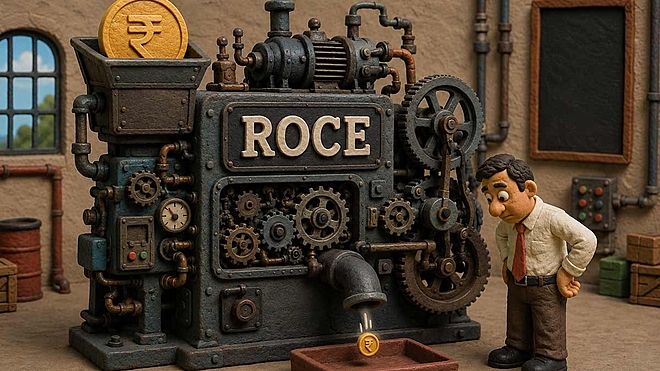
 Anand Kumar/AI-Generated Image

Summary: Fast-growing profits. Rapidly rising sales. Yet the ROCE has been quietly declining. We look at three such companies and how our screen helps us catch the gap between headline growth and actual capacity efficiency.
You found three companies growing at over 30 per cent a year. Sales up. Profits up. Everything looks like it is working.
Then you notice one more number. Return on capital employed, or t he return a business earns on every rupee it puts to work, has been falling across all three. Not slightly. Sharply.
That is the question this screen is designed to ask: What happened to capital efficiency while growth was being delivered?
Growth with a falling return profile
Companies with strong sales and profit growth, but declining return on capital employed
| Company | Annual sales growth (%) | Annual profit growth (%) | Latest ROCE (%) | FY23 ROCE (%) | Change in ROCE in three years (%) | Stock Rating |
|---|---|---|---|---|---|---|
| Netweb Technologies India | 69.9 | 63.7 | 37.5 | 66.4 | −43.5 | 3 |
| KPI Green Energy | 61.2 | 66.9 | 13.8 | 29.7 | −53.6 | 4 |
| Zaggle Prepaid Ocean Services | 51.1 | 80.4 | 13.5 | 25.4 | −46.8 | 3 |
| Sales and profit growth figures are for FY23 to FY26. ROCE, or return on capital employed, is the profit a business generates relative to the capital it uses. | ||||||
A falling return on capital is not automatically a verdict. A company building capacity before revenues arrive, or funding large orders before customer cash clears, can show ROCE compression for perfectly good reasons. The compression may be temporary. It may be the price of building something larger.
But it does change the question you should be asking. A company growing fast with stable or rising ROCE is compounding efficiently. A company growing fast with falling ROCE needs a second look: Is today's capital building tomorrow's earnings, or just funding weaker-quality growth?
Netweb Technologies
Netweb is not a software company. It designs, manufactures and deploys high-performance computing systems, AI infrastructure, private cloud solutions and enterprise workstations. The distinction matters.
Its ROCE has not fallen because it is building factories. In FY26, net fixed assets were only Rs 59 crore, and the company turned those assets over 33 times in the year. The pressure is elsewhere.
Net current assets rose from Rs 302 crore in March 2025 to Rs 581 crore in March 2026. Inventory days moved from 53 to 86. The cash-conversion cycle, the time between spending money and collecting it, stretched from 73 to 84 days. Borrowings rose to Rs 272 crore, though Netweb remained net cash overall.
The cause is the shift in business mix. AI systems made up 43 per cent of FY26 revenue. This included executing a Rs 559 crore strategic order. Large AI and graphics-processing-unit orders require expensive components, extended inventory planning and upfront capital, all before customer payments arrive.
Promoter holding has also come down, from 75.5 per cent around listing to 67 per cent in March 2026, partly through reported block deals. Worth watching.
At 37.5 per cent, Netweb's ROCE is still strong by most standards. The real test is whether the AI-led business can keep margins healthy while bringing inventory, receivables and borrowings back under control.
KPI Green Energy
KPI Green's appearance here was almost predictable. Renewable energy is capital-intensive by design.
The company has been scaling across solar, wind, hybrid, independent power producer and battery energy storage projects. FY26 total income rose 56 per cent to Rs 2,742 crore. Profit after tax rose 57 per cent to Rs 509 crore. Earnings before interest, tax, depreciation and amortisation rose 73 per cent to Rs 1,006 crore.
Strong numbers. The issue is what sits behind them.
Fixed assets more than doubled, from Rs 2,524 crore in FY25 to Rs 5,427 crore in FY26. Total assets went from Rs 4,792 crore to Rs 9,882 crore. The business is expanding, but the capital base is expanding faster. Operating cash flow improved to Rs 424 crore. But investing cash outflow was Rs 4,071 crore, funded largely by Rs 3,642 crore of financing.
KPI Green's independent power producer portfolio stood at 2.57 gigawatt-peak, of which 0.96 GWp was generating power and 1.61 GWp was still under construction. Land bank and transmission capacity have expanded sharply too.
Promoter holding has slid from 54.8 per cent in March 2023 to 49.5 per cent by March 2026, partly from a Rs 1,000 crore qualified institutional placement in August 2024, where new shares were issued to raise capital. Promoter pledge stood at 44.7 per cent of promoter shares in March 2026. That figure deserves close attention.
This is not a low-capital compounding story. It is a build-out story. The test is whether the new renewable assets, once they come online, earn enough to lift ROCE meaningfully.
Zaggle
Zaggle's situation is different from the other two.
There are no power plants being built. No large inventory build. The ROCE decline here reflects something harder to see: business mix, accounting presentation, product investment and acquisitions.
A large share of Zaggle's reported revenue comes from its Propel platform, where points are recorded on a gross basis under Indian accounting standards. Depreciation and amortisation rose sharply, driven by capitalised technology and product development costs. Part of the capital base is going into building the platform, not into physical assets.
The company has also acquired Greenedge Enterprises and Rivpe Technology, rebranded as Zagg.Money. These broaden the product ecosystem. They also add integration complexity and capital requirements.
Zaggle's growth is real. But the ROCE decline means the critical question has shifted: are the product investments actually improving what users are willing to pay for, or just adding scale? Cash profit after tax looks healthy. How cleanly that converts to operating cash flow will matter more once the full FY26 annual report is available.
What the screen is actually telling you
Three companies. Three different explanations for the same pattern.
Netweb's decline is largely a working-capital story: big orders, long cycles, capital tied up before cash arrives. KPI Green's is straightforwardly capex-led, with heavy infrastructure spending ahead of revenues. Zaggle's reflects technology capitalisation, acquisitions and how revenue is counted.
None of this is automatically bad. Falling ROCE during a genuine investment phase can be the cost of building something worth owning later. But if growth keeps demanding more capital without better cash conversion, eventually, the headline numbers are telling you less than they appear to.
The growth is real. The question is what it is actually worth.
Want to track how these companies perform as their capital cycles play out?
Value Research Stock Advisor gives you independent analysis, quality ratings and portfolio guidance — built for investors who want to understand what they own, not just what is moving.
Subscribe to Stock Advisor today
Ask Value Research 

 New episodes every Friday










 New Process Alert
  Seems like you've uploaded a wrong QR code. Please upload the QR code downloaded from MF Central platform.


