




 Illustration: Anand Kumar
Summary: Constantly checking your portfolio can lead to emotional decisions and poor returns. A disciplined asset allocation with predefined rebalancing rules acts like a thermostat, helping you buy low, sell high and stay calm through market volatility.
It was 3 AM when Rahul checked his portfolio for the seventh time that day. The Indian markets had closed hours ago, but the US markets were open, and his tech-heavy portfolio was down another 2 per cent. He had already moved 15 per cent to cash that afternoon.
Should he move more? By morning, he had changed his mind multiple times.
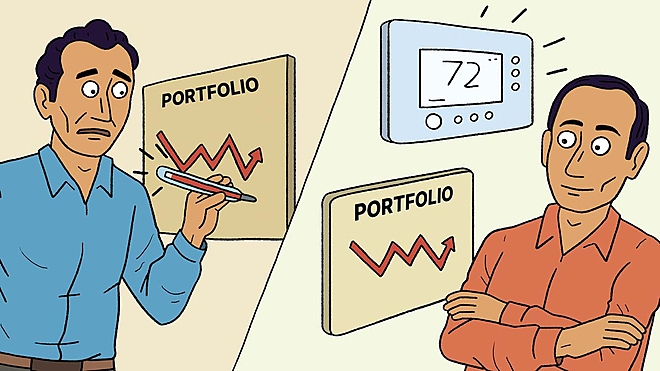
A few weeks later, those same holdings had recovered. But Rahul’s portfolio lagged; he had locked in losses and missed the rebound. His problem wasn’t that he was measuring his portfolio’s temperature. It was that he had no thermostat.
The thermometer trap
How many times last week did you check your portfolio? If you are like most investors, probably more often than you would admit. We have become obsessed with taking our portfolio’s temperature, tracking daily swings, refreshing apps, watching every tick.
But here’s the paradox: the more you measure, the worse you tend to perform.
Constant monitoring creates an illusion of control. Each check feels responsible. In reality, it exposes us to noise. Daily swings are mostly meaningless, yet our brains treat every dip as danger and every spike as opportunity. Loss aversion kicks in. FOMO follows.
That is why the average equity investor underperforms the market, not because they pick terrible funds, but because they buy when markets feel safe and sell when fear takes over. A study by Axis Mutual Fund found that from 2003-2022, the average investor underperformed the average equity fund by over 5.3 per cent annually. Consider March 2020. The Nifty plunged more than 30 per cent in a month. Every login felt like a psychological assault. Many investors sold simply because doing nothing felt unbearable. The temperature reading was too frightening to ignore.
But those who exited near the bottom missed what came next, one of the sharpest recoveries in market history. By December 2020, the Nifty hit new highs. By March of next year, it stood at around 15,300.
The thermometer told them the temperature. It didn’t tell them what to do about it.
The thermostat solution
Think about your home’s air conditioner. You don’t walk around with a thermometer checking every room hourly, manually adjusting the temperature each time you feel a little hot. You set a thermostat to keep the ideal temperature between 20 and 22 degrees.
Your portfolio needs the same thing: a thermostat, not a thermometer.
A portfolio thermostat has three components:
A target allocation: The desired temperature range. That might be 60 per cent equity, 30 per cent debt, 10 per cent commodities for an investor, depending on their risk appetite.
Rebalancing bands: An acceptable deviation before action is needed to bring your portfolio back to target. Say, equity markets rallied, and the 60 per cent target became 65 per cent. It would be prudent to rebalance halfway back to tthe arget to be in proximity to the desired allocation.
Automatic triggers: Rules that execute without emotion. When equity drifts outside its band, you rebalance back to the above desired allocation. No panic, no prediction made, just simple math.
When discipline beats prediction
Here’s the mathematical beauty of a thermostat: rebalancing forces you to do what every investor knows they should do but rarely end up doing – buy low and sell high. Not because you are smart and know how to time the market, but because you are systematic. The thermostat helps remove ego and emotion from the equation. It doesn’t require you to be right about the future, a fallacy that most investors don’t understand. But it helps me be disciplined about the present.
A good example would be the small-cap rally in 2023. The Nifty Small Cap 250 index rallied over 47 per cent that year, followed by 26 per cent in 2024. Retail investors piled in, and many portfolios shifted from their original allocation if they didn’t rebalance. Those without systematic rebalancing were now sitting on unintended concentrated small-cap bets, exposed to the extreme swings in volatility in the asset class.
A thermostat approach would have trimmed small caps as they exceeded a predefined limit, booking profits, and reallocating those to underweight sections of the portfolio. This would have helped contain concentration risk in the portfolio and hence helped them save capital when small caps eventually underperformed, as they did in 2025.
The psychology behind the thermostat solution
The thermostat isn’t just about better returns, though the evidence is there that you get them. It’s about peace of mind. It’s about going to bed without checking your portfolio at midnight. It’s about staying invested through volatility because you trust your system more than your emotions.
Rebalancing removes decision fatigue. The rules are already set in advance. It eliminates timing anxiety, as you need to be correct twice when timing the market–when to sell and then when to buy, or vice versa. Rebalancing creates accountability as it becomes hard to deviate from your own predetermined rules. It helps shift your focus from daily noise to long-term happiness. It helps shade your portfolio from emotional biases. The thermostat doesn’t fight these biases; it just makes them irrelevant in the long run.
Do you have a thermometer or thermostat?
If you checked your portfolio yesterday and today, felt a flutter of anxiety at the numbers you saw, and wondered if you should do something, then you definitely have a thermometer.
On the other hand, if you have target allocations, rebalancing bands and rules you follow regardless of market fluctuations, you have a thermostat.
If you fall into the former, the good news is that you can set up your thermostat this weekend. It’s a DIY approach–define your allocation, set your bands and commit to quarterly reviews to adjust it. Once you do, you’ll wonder why you spent so much time obsessing over your portfolio’s temperature. Because in the end, investing isn’t about reading the temperature perfectly. It’s about setting the thermostat wisely and then letting math do what it was designed to do.
Ranjit Bhatia is Head – Alternate Product Strategy at WhiteOak Capital Asset Management Ltd
Ask Value Research 

 New episodes every Friday











 New Process Alert
  Seems like you've uploaded a wrong QR code. Please upload the QR code downloaded from MF Central platform.


