




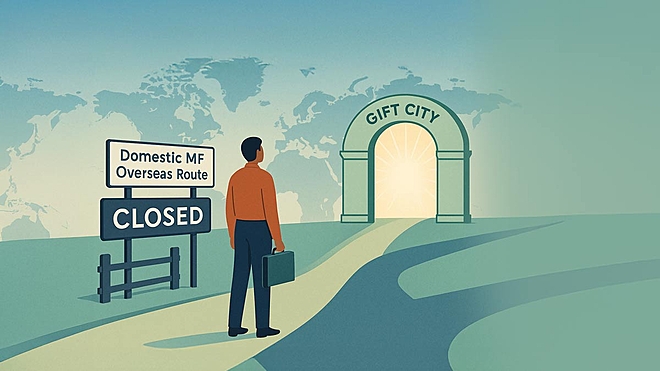
Summary: International funds haven’t welcomed new money in years, but the demand never went away. This story looks at the structural limits behind the freeze and what fresh options are emerging for long-term investors.
Summary: International funds haven’t welcomed new money in years, but the demand never went away. This story looks at the structural limits behind the freeze and what fresh options are emerging for long-term investors. For nearly three years now, investors keen to begin a fresh SIP in an international fund have been greeted by the same dispiriting notice: ‘Temporarily closed for subscriptions’. What makes this stasis stranger is that enthusiasm for global funds has only increased. Assets in international schemes have swelled from a little over Rs 2,000 crore a decade ago to nearly Rs 60,000 crore today. The chart titled ‘Global ambitions, local limits’ slopes steadily upward, with a noticeable acceleration after 2020. And yet, the companion columns, tracking the number of schemes, flatlines after 2023. From the high-20s to about 60 schemes, and then nothing. Essentially, the appetite kept growing, but the supply simply stopped. That’s because while investor enthusiasm kept rising, the regulatory ceiling did not. How the old overseas route broke Earlier, you bought an Indian mutual fund whose mandate allowed it to invest abroad, directly in foreign shares or via overseas funds and exchange-traded funds (ETFs). At the same time, SEBI, the markets regulator, kept an eye on the industry-wide exposure with a set of aggregate limits: $7 billion for mutual funds and another $1 billion for ETFs, plus a cap per each fund house. As long as those ceilings were not touched, no one worried. Then came the post-Covid bull run. The S&P 500 and other global themes looked irresistible. Indian investors discovered US index funds, China funds, global flexi-caps and anything with “FAANG” in the presentation. Flows surged. Unfortunately, amid the enthusiasm, the limit was breached. Once the industry aggregate was effectively used up, SEBI blocked fresh investments. New launches were shelved. Existing funds stopped accepting new waves of money or accepted money sporadically. Creations of new units in global ETFs were halted, so listed units were now trading at a premium. While the door was not closed on existing investors and portfolios could still be managed, the ‘Welcome’ sign for new money came down. The only other option left was the Liberalised Remittance Scheme (LRS). But this route was plagued with complex forms and annual tax reporting, which are ingredients to kill investors’ animal spirits. Why global investing deserves a slot at all After all, Indian equities have treated investors rather well over the years. The familiar argument

 New episodes every Friday











 New Process Alert
  Seems like you've uploaded a wrong QR code. Please upload the QR code downloaded from MF Central platform.


