





The roar of India’s automobiles has drowned out almost every other sound in the market this year. Fuelled by a burst of electric vehicle (EV) launches, a slew of government incentives and a revival in consumer confidence, the Nifty Auto Total Return Index (TRI) has surged 16.7 per cent so far (as of September 30, 2025), outpacing Transportation at 15 per cent and Financials at 12.7 per cent. Even the broader benchmarks have stalled in comparison. The Nifty 50 is up just 5.7 per cent, while the Nifty 500 has added a mere 2.9 per cent.
For investors, this turbocharged run poses a familiar dilemma: is the auto index a highway to high returns, or a pothole-ridden road that could slow down your wealth-building journey?
What exactly is the Nifty Auto Index?
Unlike broader benchmarks such as the Nifty 50, which represent India Inc. in miniature, the Nifty Auto Index is a more specialised machine. It tracks up to 15 listed companies from the automobile ecosystem, across four-wheelers, two- and three-wheelers, auto ancillaries and tyre makers.
The index is free-float market-cap weighted, which is a technical way of saying that the largest and most traded companies steer the performance. Unsurprisingly, it’s a bit of a heavyweight contest. Just three names, Mahindra & Mahindra, Maruti Suzuki and Tata Motors, account for more than half the index, and the top five together make up over 68 per cent.

In other words, when these giants accelerate, the entire index roars ahead. But when they tap the brakes, the whole engine sputters. The Nifty Auto, for all its torque, remains a narrow vehicle, one that runs smoothly only as long as its leaders keep the wheels turning.
A closer look at performance
For all its recent glory, the Nifty Auto Total Return Index (TRI) has not always cruised smoothly. Over the medium term, say on a three-year rolling-return basis, the ride has included more than a few bumps. Between 2017 and 2022, the index trailed the broader Nifty 500 TRI by an average annualised margin of over 10 per cent.
It roared back after 2023. Since then, the index has found fresh momentum, consistently outperforming the market across time frames. On a three-year annualised basis, it now leads the broader market by more than 13 per cent a year.
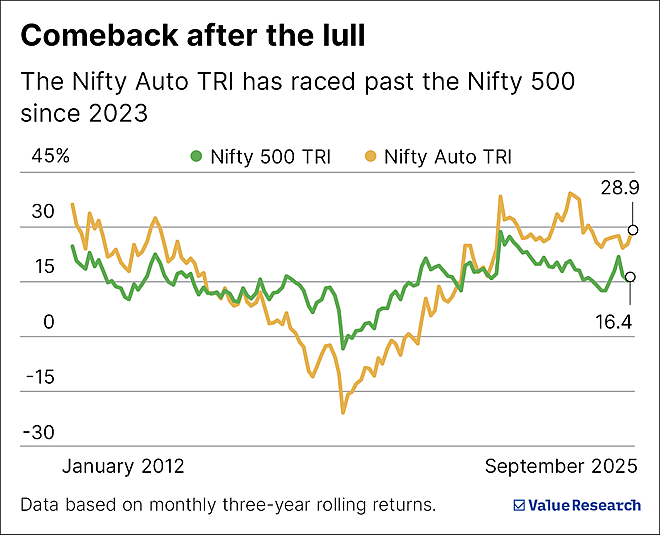
Yet, a wider lens tells a more reassuring story. For long-term investors, the Nifty Auto TRI has been a solid wealth creator. Between January 2010 and September 2025, the index has grown over one-and-a-half times faster than the overall market. India’s rising incomes, sustained consumption demand and the early rumblings of the electric vehicle revolution have all helped fuel this performance.

However, such impressive growth has not come without turbulence.
The other side of performance
The less flattering side of the story emerged between December 2017 and April 2020, when the Nifty Auto Index endured its steepest decline, plunging 61 per cent. In comparison, the broader Nifty 500’s sharpest fall came during the Covid pandemic, when it dropped 37.6 per cent.
This wasn’t a one-off event, either. In five of the six biggest market corrections over the past 15 years, auto stocks have fallen harder than the broader market. The numbers below make it clear.

Volatility metrics tell a similar story. The Nifty Auto Index has a standard deviation of 21.2 per cent, compared with 16.4 per cent for the Nifty 500. In simpler terms, investing in this sector comes with sharper swings.
So yes, while the Nifty Auto Index can amplify gains during rallies, it is equally capable of magnifying losses during downturns.
Our take
The Nifty Auto TRI is like a performance car, thrilling when the road is smooth, but tricky to handle when it rains. It’s dominated by a few giants, moves in cycles and can experience sharp drawdowns during downturns.
Its long-term record is impressive, too, and 2025’s rally adds more shine. But that doesn’t make it a core holding. For most investors, it is best left alone. However, those who wish to get a piece of the action can treat it as a tactical satellite holding, something you add for a potential boost, not the foundation of your portfolio.
This article was originally published on October 27, 2025.
Ask Value Research 












 New Process Alert
  Seems like you've uploaded a wrong QR code. Please upload the QR code downloaded from MF Central platform.


