




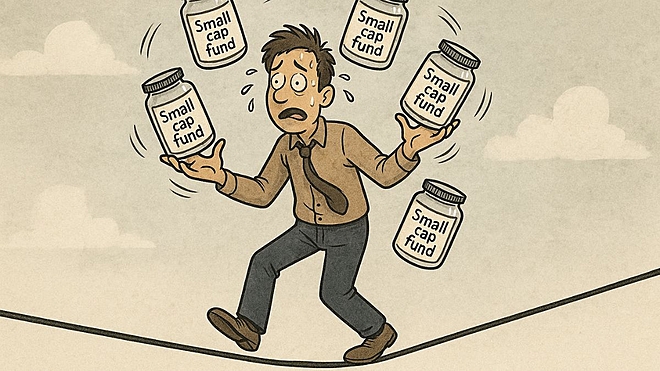
 Aditya Roy/AI-Generated Image
Summary: Small-cap funds have dazzled investors with stellar returns, drawing massive inflows and tempting many to collect multiple funds. But does owning more really mean earning more? Our analysis finds that while small-cap funds have low portfolio overlap, adding extra funds barely improves returns. So, let’s find out how many small-cap funds you should ideally own?
The past five years have been nothing short of spectacular for equities, especially more so for small-cap funds. As of October 15, 2025, their annualised five-year trailing return stands at a 28.2 per cent, the highest among all non-sectoral categories.
Naturally, such sizzling numbers have pulled investors in droves. AMFI data shows that over the past five years, small-cap funds have attracted a massive Rs 1.4 lakh crore in net inflows, behind only sectoral/thematic and flexi-cap funds.
Riding on this wave of enthusiasm, many investors have found themselves collecting small-cap funds like trophies, adding one after another in the hope that more funds mean more returns. That logic deserves scrutiny. Does adding more small-cap funds actually improve performance, or does it simply multiply noise?
Low overlap: The appeal of owning many funds
One of the key reasons we suggest avoiding multiple funds from the same category is that it can lead to overlap among them. In simple terms, higher overlap means different funds may end up owning many of the same stocks, defeating the purpose of diversification.
But does this hold true for small-cap funds as well? Let’s find out. The table below shows the average and maximum overlap between two funds across large-, mid-, and small-cap categories.
Small-caps show low overlap
Average and maximum overlap among small-cap funds is much lower than in large- and mid-cap categories
| Category | Average overlap (%) | Maximum overlap (%) |
|---|---|---|
| Large-cap | 44.4 | 72.4 |
| Mid-cap | 24.6 | 57.4 |
| Small-cap | 13.1 | 39.4 |
| Data as September 30, 2025. Average overlap has been calculated by comparing each fund’s portfolio with every other fund in the category. The average of all such pairwise overlaps represents the category’s average overlap. | ||
As the above table shows, both average and maximum overlap between two funds is much lower for small-cap funds compared with large-caps, and slightly lower than mid-caps. So, overlap among funds is not a big issue for this category.
The reason for this difference lies in their investment mandates. Large-cap funds are required to invest at least 80 per cent of their corpus in large-cap stocks — those ranked 1 to 100 by market capitalisation — leaving only 20 per cent for mid- and small-cap names. Small-cap funds, on the other hand, must invest at least 65 per cent in small-cap stocks (companies ranked 251 and beyond), with the remaining 35 per cent allowed in large- and mid-caps. This gives them a much wider hunting ground, offering greater flexibility and resulting in lower overlap among funds.
Does this mean you can just load up your portfolio with small-cap funds since overlap is low?
When diversification turns into duplication
Take the top five small-cap funds, for example. Each of them, on its own, holds between 13 and 87 stocks that are also part of the Nifty Smallcap 250 index. That doesn’t sound too bad. But when you combine all five portfolios, they overlap with 145 stocks from the same index — that’s more than half of it.
In other words, holding multiple small-cap funds starts resembling the index itself. Basically, you start with conviction; you end with replication.
The performance test: Does more mean better?
To check if adding more small-cap funds improves returns, we picked the five best-rated small-cap funds at the end of each year from 2012. We then assumed an investor started their SIP at the start of the following year and calculated the SIP returns over seven years. For SIPs starting in 2019 and 2020, we looked at six-year and five-year returns instead.
To see how holding more funds affects returns, we compared SIP results for investors who spread their money across five, four, three, two, or just the single best-rated fund.
The following table summarises the result:
Does holding more small-cap funds improve returns?
7-year SIP returns (%) indicate minimal gains from holding more than two funds
| Number of top-rated funds held | 2013 | 2014 | 2015 | 2016 | 2017 | 2018 | 2019* | 2020* |
|---|---|---|---|---|---|---|---|---|
| 5 funds | 11.3 | 12.2 | 22.9 | 20 | 25.8 | 28.3 | 31.7 | 33.3 |
| 4 funds | 11.1 | 12 | 22 | 19.7 | 25.8 | 27.5 | 32 | 34 |
| 3 funds | 11.6 | 11.2 | 22.2 | 20.2 | 24.4 | 27.4 | 32.2 | 34.3 |
| 2 funds | 11.3 | 11.7 | 22.4 | 20 | 24.7 | 26.5 | 34.5 | 32.4 |
| 1 fund | 9.2 | 11.4 | 18.7 | 16.5 | 24.5 | 25.4 | 33.4 | 28.2 |
| *For SIPs started in 2019 and 2020, 6-year and 5-year returns are considered respectively. Top-rated funds as of year-end were used, with SIPs starting at the beginning of the following year. Portfolio returns are averages for holdings with more than one fund. | ||||||||
The trend is hard to miss: piling on more funds doesn’t really move the needle. Beyond the top two, the extra baggage hardly pays off. For instance, holding all five top-rated funds on average beat the two-fund portfolio by a meagre 0.3 percentage points. That’s a whole lot of effort (and clutter) for barely any reward.
What you should do
For most investors, two carefully chosen small-cap funds are plenty. Adding more just creates overlap and portfolio clutter, without meaningful gains.
Keep small-caps as a limited slice of your equity pie, with the rest in steadier, diversified categories like flexi-caps. Remember, small-caps can deliver exciting growth—but they can also swing wildly. In the 2008 crash, the Nifty 100 TRI fell 61 per cent, while the Nifty Small-cap 250 TRI plunged an eye-watering 76 per cent. Not going too far back, during the recent market correction from late September 2024 to early March 2025, large-caps lost 17 per cent, while small-caps shed over a quarter of their value.
And small-caps aren’t quick to bounce back. Whenever the Nifty Small-cap 250 TRI fell more than 15 per cent from its peak, it took around 13 months to recover, compared with just 9 months for large-caps. The lesson is clear: going all-in on small-cap funds can be risky. A balanced approach—mixing high-risk, high-reward small-caps with steadier options like flexi-caps, which are largely dominated by large-caps—can help you ride out the storms while still capturing growth.
Therefore, the real secret to building wealth here isn’t in holding more funds, it’s in holding them long enough to ride out the bumps.
Safety first, growth always
Good investing isn’t just about chasing returns; it’s about building a foundation strong enough to handle surprises. That means having the right funds, in the right proportion, with no clutter.
With Value Research Fund Advisor, you’ll know exactly which funds deserve space in your portfolio, and which ones are just dead weight. We help you streamline, rebalance and grow, so your wealth shines brighter every year.
Ask Value Research 

 New episodes every Friday






 New Process Alert
  Seems like you've uploaded a wrong QR code. Please upload the QR code downloaded from MF Central platform.


