




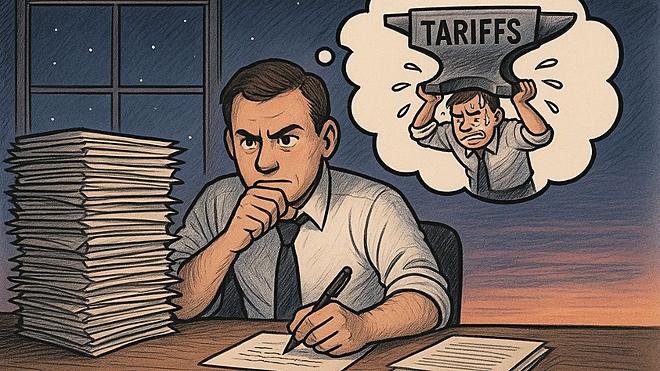
 Aditya Roy/AI-Generated Image


Ronald Reagan used to tell a joke about life in the Soviet Union, where chronic shortages meant citizens faced absurdly long waits for basic goods. In this story, a man finally saves enough money to buy a car. He goes through the bureaucratic process, pays his money up front and is told by the clerk to return in exactly 10 years to collect his vehicle.
"Should I come back in the morning or afternoon?" the man asks.
The clerk looks puzzled. "10 years from now – what possible difference could it make?"
"Well," the man replies, "the plumber is scheduled to come that morning."
Suggested read: Investing, fast and slow
The joke captures something essential about life under unpredictable systems. Even when delays stretch across decades, people still need to plan around them. They still need to coordinate their lives, make arrangements and think ahead. The 10-year wait isn't the real problem – it's the inability to plan rationally around it that corrodes everything else.
This Soviet-era joke feels remarkably relevant today as we watch American policy create similar planning paralysis across the globe. The recent announcement that H-1 B visa applications will now cost employers $100,000 – a roughly 2,000 per cent increase from previous fees – is just the latest example of how sudden policy shifts force businesses and individuals into impossible planning scenarios.
Suggested read: The story is unchanged
Consider the position of an Indian technology professional currently working abroad. Should they rush back to America before the new rules take effect? Should they delay their return for a few years? What about their spouse's career, their children's education, or their parents' healthcare needs? These aren't abstract policy questions – they're deeply personal decisions that affect millions of families, who now find themselves trapped between unpredictable rules and unchangeable life circumstances.
The same planning paralysis affects businesses trying to navigate America's increasingly erratic trade policy. In recent months, tariffs have been announced, then delayed, modified and sometimes reversed. Companies are expected to make long-term investment decisions – such as building factories, signing supplier contracts and hiring employees – without knowing what the trade rules will look like in the next quarter, let alone the year after. The Singapore Trade Minister joked in a public forum that customs tariffs changed three times over the time that it takes a container ship to sail from Singapore to San Francisco.
When a company is uncertain about whether its supply chain will face 10 per cent tariffs or 50 per cent tariffs, it cannot rationally decide where to build its next facility or which suppliers to contract with. The most expensive outcome isn't necessarily the highest tariff – it's the inability to plan around any consistent framework at all.
Suggested read: The rising tide
For Indian investors watching these developments, the lessons extend far beyond American immigration and trade policy. The same principle applies to any investment environment where rules change unpredictably. The most insidious aspect of such unpredictability is how it changes behaviour long after specific policies might be reversed. Businesses that suddenly face rule changes have begun building much larger safety margins into their planning. They delay investments, diversify suppliers, and generally become more conservative in their approach to growth. Individuals facing visa uncertainty don't just delay their travel plans – they reconsider career paths, educational investments, and family decisions that might have seemed straightforward under predictable rules.
This behavioural change often persists even when policies stabilise. Companies that spent years navigating unpredictable trade rules don't immediately resume aggressive expansion when clarity returns. Families that experienced visa uncertainty don't quickly forget the stress of not knowing whether they could return home or bring relatives to visit. The psychological impact of unpredictability creates its own economic drag, extending far beyond the direct costs of any particular policy.
When people can't plan rationally, they plan conservatively. And when everyone plans conservatively simultaneously, investors, and indeed entire economies, begin moving like Soviet car factories – slowly, cautiously, and with far less efficiency than their potential would suggest. An environment where equity investors convert to fixed income and companies sit on cash rather than expand aggressively becomes a vicious circle. All Indians above a certain age have experienced this first-hand.
Want to learn how to spot resilient businesses?
Tariffs and policy swings pose serious risks to businesses everywhere. But a handful of excellent companies will not only survive this test – they will thrive. These are businesses with the rare ability to adapt to policy changes.
Spotting them isn’t that straightforward. It takes a deep understanding of how a business runs. That’s exactly what our book Money, Markets, and Mistakes delivers. Drawing on decades of insights from industry veteran Dhirendra Kumar, this book equips you with the mindset needed to spot these winners and hold onto them for the long run.
Also read: Survival of the fittest
Ask Value Research 

 New episodes every Friday











 New Process Alert
  Seems like you've uploaded a wrong QR code. Please upload the QR code downloaded from MF Central platform.


