




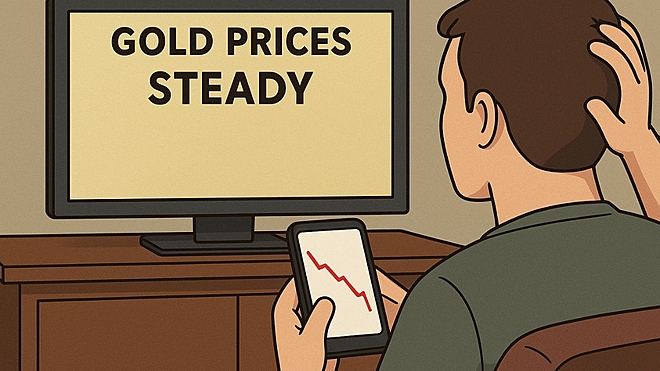
 Aditya Roy/AI-Generated Image
Summary: When gold prices are running flat, it would be natural to assume that gold funds would always reflect that steadiness. However, on August 18th, fund NAVs fell by a certain margin. In this article, we explore the reasons behind this discrepancy in the asset price and fund NAVs.
On August 18, 2025, one of our readers wrote in with a puzzle: “When gold prices remained flat, how could my Axis Gold Fund and Nippon Silver ETF FoF fall by 0.35 per cent and 0.7 per cent, respectively? Are fund houses calculating gains and losses in some sophisticated way to cheat investors?”
It’s a fair question. Anyone tracking the day’s headlines would have seen gold and silver described as “steady.” Yet fund NAVs told a different story. The explanation lies not in deception but in the mechanics of how bullion funds are valued.
How NAVs are really set
A fund’s NAV is not a running ticker. It is struck once a day, after the close of business, using a published rulebook.
- Benchmark: NAVs are pegged to the London Bullion Market Association (LBMA) AM fix in dollars, not the intraday Indian quotes scrolling across your screen. The LBMA fix is the official global benchmark price for gold and silver, set twice a day (AM and PM) in London by major banks. It acts like a worldwide reference point for valuing bullion.
- Conversion: That dollar price is translated into rupees at the prevailing exchange rate, with customs duty and transport premia added.
- Backing: The ETFs themselves hold physical bullion (gold bars of 995 purity, silver of 999) kept in SEBI-registered custodians’ vaults, insured and audited.
So yes, your money is backed by real metal.
Why “flat” can mean “down”
Three forces can move NAVs even when the local spot price looks unchanged:
- Currency swings: On August 18, the rupee weakened against the dollar. Since bullion is dollar-priced, that alone cuts NAV.
- Benchmark timing: The LBMA fix that day was softer than the domestic intraday price you may have seen.
- Costs and tracking error: Custody fees, GST, and the mechanics of a fund-of-fund introduce small daily drags.
Result: the NAV fell while “headline” gold looked steady.
What this means for you
For an investor, the message is straightforward:
- Don’t read too much into daily NAV moves. They reflect global benchmarks and currencies, not the last trade in your local market.
- No sleight of hand is involved. These are SEBI-regulated valuation norms, audited and disclosed daily.
- Over time, NAVs will track the metal. The noise of currency shifts and costs evens out; the trend follows bullion.
Bottom line
A bullion fund is a long-term bet on gold or silver. The NAV may not line up with the day’s headlines, but it faithfully follows the rulebook. Flat is never really flat, and that’s no cause for alarm.
This article was originally published on August 19, 2025.
Ask Value Research 










 New Process Alert
  Seems like you've uploaded a wrong QR code. Please upload the QR code downloaded from MF Central platform.


