




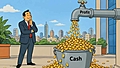
 AI-generated image
Summary: Some of India’s biggest corporate collapses - Jaypee, ABG, Videocon, didn’t happen overnight. The signs were always there: poor cash flow, shady accounting, mounting debt, and bizarre business pivots. In this story, we decode the simple but powerful red flags that can help you steer clear of such disasters. If you want to stop guessing and start spotting trouble early, this is a must-read.
In June 2017, the Reserve Bank of India sent banks a list of 12 companies—India’s largest loan defaulters at the time. Together, they accounted for nearly 25 per cent of the country’s bad loans. This list would later be chronicled in journalist N. Sundaresha Subramanian’s book The Dirty Dozen, which laid bare the rise and ruin of corporate giants such as Lanco Infratech, Amtek Auto, Jaypee Infratech and ABG Shipyard.
These weren’t isolated failures. Most of these companies had over-leveraged balance sheets, misused borrowed capital, relied heavily on political connections, reported questionable financials, and often diversified into unrelated sectors under the guise of expansion. In hindsight, the warning signs were obvious—but widely ignored.
We’re not going to revisit these companies in detail—there’s little point in repeating the same story. Instead, we analysed each of these failures and identified a set of common threads. If recognised early, these patterns can help you steer clear of such disasters well before the market catches on.
We’ve divided this feature into two parts: the first covers the quantitative red flags, and the second looks at qualitative factors that are just as critical.
Quantitative signs
1.CFO to EBITDA of less than 60 per cent
A low CFO to EBITDA ratio indicates that a company is inefficient in converting its accounting profits into actual cash flow. This could be due to delayed collections from customers, high inventory levels, or, in more serious cases, fictitious sales. When companies consistently fail to convert reported earnings into cash, they often face working capital stress, forcing them to borrow just to manage daily operations. Over time, this can lead to rising debt and potential financial distress. Here are some companies with a history of poor cash conversion. While not every case signals trouble, a sustained CFO to EBITDA ratio below 60 per cent is a red flag worth watching.
Where's the cash going?
Companies with consistently weak cash conversion in the last decade
| Company | Stock Rating | FY16-20* | FY17-21* | FY18-22* | FY19-23* | FY20-24* |
|---|---|---|---|---|---|---|
| Bharat Heavy Electricals | ★☆☆☆☆ | 46 | 36 | 37 | 46 | 35 |
| Patanjali Foods | ★★★☆☆ | -11 | -18 | -27 | -52 | -737 |
| KEI Industries | ★★★☆☆ | 54 | 46 | 51 | 56 | 48 |
| Pfizer | ★★★★★ | 59 | 56 | 58 | 54 | 57 |
| Kirloskar Oil Engines | ★☆☆☆☆ | 32 | 23 | -50 | -87 | -90 |
| Gravita India | ★★★☆☆ | 46 | 46 | 35 | 59 | 39 |
| Zee Entertainment | ★★★☆☆ | 27 | 35 | 30 | 28 | 44 |
| HFCL | ★☆☆☆☆ | 33 | 37 | 33 | 29 | 25 |
| CCL Products (India) | ★★★☆☆ | 55 | 52 | 50 | 47 | 36 |
| Avanti Feeds | ★★★★★ | 50 | 56 | 35 | 48 | 51 |
| PC Jeweller | ★★★☆☆ | -21 | -21 | -103 | -180 | -45 |
| *CFO to EBITDA (in %) CFO / EBITDA less than 60% on cumulative basis Market cap more than Rs 10,000 crore Excluding BFSI and realty companies |
||||||
2.Accounts receivable to sales more than 25 per cent
One reason a company may struggle to convert revenue into cash is delayed payments from customers. This can point to two possibilities. First, the company may be offering liberal credit terms—often a strategy used by smaller players in a competitive industry to attract and retain customers. Second, and more concerning, it could indicate fictitious sales meant to inflate reported revenue.
In both cases, the result is the same: a build-up in receivables and a potential working capital crunch. To assess whether this is a red flag, it’s important to compare receivables not just historically, but also against industry benchmarks to understand what’s typical.
Here are some companies that currently show elevated levels of receivables.
Receivables piling up?
Companies with elevated level of receivables as compared to their revenue
| Company | Stock Rating | 5Y Sales growth (%) | 5Y Accounts receivable growth (%) | Receivable to sales FY25 (%) | Receivable as a % of total assets (FY25) |
|---|---|---|---|---|---|
| Biocon | ★★☆☆☆ | 19 | 35 | 36 | 12 |
| Caplin Point | ★★★★☆ | 18 | 23 | 33 | 22 |
| Gujarat Fluorochemicals | ★★☆☆☆ | 13 | 16 | 25 | 15 |
| IRCTC | ★★★★☆ | 16 | 17 | 37 | 43 |
| Laurus Labs | ★★★☆☆ | 14 | 20 | 36 | 35 |
| NMDC | ★★★★★ | 15 | 28 | 32 | 25 |
| PTC Industries | ★☆☆☆☆ | 13 | 27 | 47 | 10 |
| Swan Energy | ★☆☆☆☆ | 71 | 90 | 27 | 12 |
| Tata Elxsi | ★★★★☆ | 18 | 20 | 26 | 32 |
| Vinati Organics | ★★★★☆ | 17 | 24 | 26 | 21 |
| Zen Technologies | ★★★☆☆ | 46 | 55 | 42 | 23 |
| ZF Commercial | ★★★☆☆ | 15 | 25 | 29 | 34 |
| BSE 500 companies excluding BFSI with annual sales growth more than 10% FY25 receivable to sales ratio more than 25% FY20-25 annual receivable growth more than sales growth |
|||||
3.Weak inventory turnover
Inventory turnover indicates how many times a company sells and replaces its inventory over a given period. While a lower ratio can sometimes suggest that the company is building up inventory in anticipation of stronger future sales, it may also point to weakening demand—where the company is unable to sell goods as quickly as before.
In such cases, with cash tied up in unsold inventory, the company may once again need to rely on short-term debt to meet its day-to-day operational needs.
4.Contingent liabilities more than 25 per cent of net worth
Contingent liabilities are potential obligations that may arise in the future—such as pending lawsuits, tax disputes or guarantees. If these liabilities exceed 25 per cent of a company’s net worth, they signal hidden risks that could significantly impact profitability or even threaten solvency.
While they don’t appear in the main financial statements, contingent liabilities can cause serious damage if they materialise. Here are some companies with notably high levels of contingent liabilities.
Hidden risks, visible red flags
Companies where contingent liabilities are piling up
| Company | Stock Rating | FY22 | FY23 | FY24 |
|---|---|---|---|---|
| Bharat Heavy Electricals | ★☆☆☆☆ | 25 | 30 | 33 |
| FSN E-Commerce | ★★☆☆☆ | 27 | 47 | 65 |
| KIOCL | ★☆☆☆☆ | 36 | 39 | 42 |
| NLC India | ★★☆☆☆ | 61 | 76 | 84 |
| Data Patterns | ★★★☆☆ | 27 | 31 | 38 |
| Jindal Saw | ★★★☆☆ | 34 | 41 | 43 |
| BSE 500 companies excluding BFSI Contingent liabilities as a % of net worth more than 25% in the base year (FY22); increasing trend in the next two years |
||||
5.Loans and advances to employees or related parties of more than 5 per cent of net worth
This raises serious governance concerns. It may indicate fund diversion, opaque transactions, or excessive promoter influence. In several past defaults, such advances were used as a means to quietly siphon money out of the business—often to the detriment of minority shareholders.
Qualitative signs
Quantitative indicators, no matter how effective, are essentially lagging in nature. While qualitative factors are also somewhat backward-looking, spotting and scrutinising them early can help uncover red flags sooner. Here are some important warning signs to watch out for:
1.Unrelated diversification
At first glance, this may appear to be a normal business expansion strategy. But in many cases, it signals a company chasing trends—sometimes merely to attract market attention, with little strategic logic behind it. In other instances, it reflects a desperate attempt to discover new growth avenues when the core business stagnates.
Take Videocon, for example. The company had an excellent track record in its core consumer appliances business. But things began to unravel when it ventured into unrelated segments such as oil & gas, DTH, and telecom. By 2019, Videocon had become one of India’s biggest defaulters, with a debt burden of Rs 45,405 crore. At the time of liquidation, shareholders faced a staggering 96 per cent haircut.
2.Churn in top management
Whether it’s the CEO, CFO or even independent directors, frequent changes in top management can be a red flag. It often suggests internal turmoil or deeper governance issues. Constant leadership churn can also lead to erratic shifts in strategy and operations—disruptions that eventually show up in the company’s financial performance.
It also helps to look at the broader employee attrition rate. High turnover across the organisation may point to a poor work culture or strained relationships between management and staff—both of which can affect long-term sustainability.
3.Promoter pledging
Investors often favour companies with high promoter holding, as it signals strong skin in the game—the idea being that promoters will act in the company’s best interest because their own wealth is tied to it.
But what happens when promoters start selling their stake or repeatedly pledging it? That alignment of interest begins to fade. A rising level of promoter pledging or a steadily declining stake should raise concerns. These are clear signs that promoter commitment may be weakening—and that risks for other shareholders could be increasing.
4.Auditor’s reports
While an auditor’s opinion is the first thing investors should check in an annual report, other sections—such as Key Audit Matters—deserve equal attention. A qualified or adverse audit opinion can indicate underlying issues in the company’s financial reporting, or worse, raise questions about its ability to continue as a going concern.
Before you go
The first rule of investing is simple: don’t lose money. And more often than not, that means avoiding the avoidable. The warning signs we’ve outlined aren’t just red flags—they are the most fundamental filters any company must pass before it even merits deeper analysis.
It doesn’t matter how compelling the story sounds, how strong the sector is, or how impressive the growth numbers appear. If a company fails on these basic parameters, you’re not looking at a hidden gem—you’re looking at a ticking time bomb. Smart investing isn’t just about spotting winners. It’s about sidestepping disasters.
At Value Research Stock Advisor, we do this groundwork for you by evaluating every stock across quality, growth and valuation, with red flag detection built into our framework. So you can invest with clarity and avoid surprises.
Also read: Why over 90 per cent of stock market participants lose money
This article was originally published on July 26, 2025.
Ask Value Research 
 New episodes every Friday










 New Process Alert
  Seems like you've uploaded a wrong QR code. Please upload the QR code downloaded from MF Central platform.


