




 Aditya Roy/AI-Generated Image
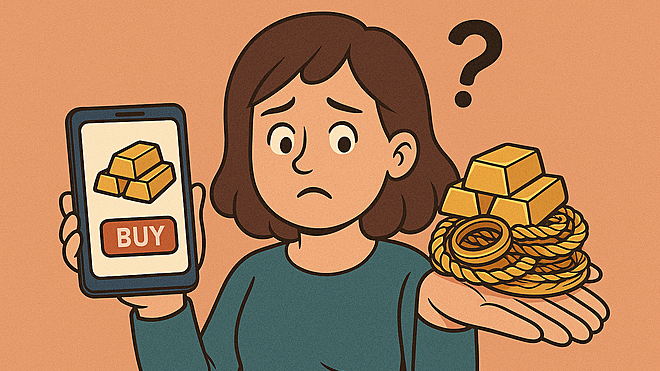
Gold has been shining for a while, growing a tick over 28 per cent annually in the last three years — but is buying gold jewellery really the smartest way to ride the rally? A 21-year-old investor’s dilemma sparked a deeper look at why Indians still confuse gold jewellery with gold investing. Let’s find out why.
A 21-year-old engineering student on social media aired his dilemma, which is surprisingly common in Indian households. He had just earned a Rs 2 lakh stipend and was eager to invest it. But there was a twist. His mother was urging him to convert the entire amount into 20 grams of gold jewellery from a trusted local jeweller who promised “minimal cuts”.
No major financial goal. No urgent expenses. Just a suggestion rooted in tradition. “Is this a good time to buy gold?” he asked.
That one question unlocks a much bigger one: why are Indians so besotted with gold? And more importantly, why do so many of us confuse gold jewellery with investing?
Why can gold jewellery be a mistake?
For generations, Indian families have treated gold jewellery not just as adornment, but as a store of value. Weddings, festivals, even savings plans — gold plays a starring role. And with prices touching record highs in recent years, this “ancient wisdom” seems vindicated.
But let’s be clear: buying jewellery is not the same as investing in gold.
- When you buy gold jewellery, you're not just paying for the gold, you're paying for a whole lot more. First, there are making charges, which typically range from 10 to 30 per cent of the gold value. Designer pieces or intricate craftsmanship can push this even higher. Next, many jewellers include wastage charges, a vague cost justified as the loss incurred during making, often bundled silently with making charges.
- Then comes GST: you pay 3 per cent on the gold value.
- Put together, this means that for every Rs 1 lakh you spend on gold jewellery, as much as Rs 20,000–30,000 goes into non-gold costs. And if you try to sell the jewellery later, you're unlikely to recover these extras, making it a poor choice for anyone expecting solid investment returns.
Why? Because jewellers don’t pay for the emotional markup — only the meltable gold. Add purity issues (especially with older or un-hallmarked pieces), and the effective return on jewellery can be much lower.
All this means that while gold as a commodity may go up, the jewellery you own can become a wealth drainer.
So, how to invest in gold smartly
1. Sovereign Gold Bonds (SGBs)
For long-term investors, SGBs have been the gold standard, and for good reason. These government-backed bonds offer a 2.5 per cent annual interest, and if held for the full eight-year term, no capital gains tax. Plus, there's no worry about purity or storage.
But here’s the catch: fresh SGB issuances are currently paused, and most existing ones trade at premium prices or suffer from poor liquidity. That makes them difficult to access or buy at a reasonable cost today, a dealbreaker for many.
2. Gold ETFs
Gold exchange-traded funds are perhaps the most cost-efficient way to invest in gold today, especially for those already familiar with stock markets.
They directly track domestic gold prices, are SEBI-regulated, and can be bought or sold through your demat account at market prices. Most ETFs charge an expense ratio in the 0.31 to 0.73 per cent range, among the lowest in the gold investment universe.
They offer daily liquidity, NAV tracking and are ideal for lump-sum investors or those who want to ride gold trends with more flexibility.
Check ETF tracking error
That said, don’t just look at expense ratios. Tracking error — the deviation between the ETF’s returns and actual gold prices — is equally crucial. Lower the tracking error, better the fund’s ability to mimic gold. High tracking errors can result in underperformance, even in a rising gold market.
Check ETF liquidity
Even the best ETF can disappoint if it lacks liquidity. Low volumes can lead to wide bid-ask spreads — meaning you might have to sell at a discount. This is especially important in volatile markets or during quick exits.
Unfortunately, liquidity data isn’t always easy to find. You may need to check exchange websites or drill into daily volumes manually.
3. Gold FoFs (Fund of Funds)
If investing in ETFs sounds like a time-consuming affair, consider Gold FoFs. These are mutual funds that invest in gold ETFs. The big benefit? No demat account needed. You can invest via SIPs, redeem units online and manage them like any other mutual fund.
However, Gold FoFs charge their own expense ratio on top of the ETF’s fee. So, if you're cost-sensitive, this is something to watch out for.
Want to invest in the best gold FoF or ETFs?
Don’t worry — our analysts at Value Research Fund Advisor already do that legwork for you. We've curated a shortlist of eight Gold ETFs and FoFs.
Finally, is this a good time to buy gold?
Short answer: if you're buying jewellery, it’s never the “right time” from an investment standpoint. You’re paying 10–30 per cent extra upfront and giving up returns the moment you walk out of the shop.
But if you’re investing in gold as part of your long-term asset allocation, discipline matters more than timing. Because the yellow metal has historically gone through highs, lows and plateaus over the years.
This means you should treat gold as a hedge, not a primary growth engine. Ideally, it should form 5–10 per cent of your total portfolio.
Also read: Gold gone cold: The 0 return periods no one is talking about
This article was originally published on July 16, 2025.
Ask Value Research 
 New episodes every Friday




 New Process Alert
  Seems like you've uploaded a wrong QR code. Please upload the QR code downloaded from MF Central platform.


