




 Aditya Roy/AI-Generated Image
Two funds, same returns — which one’s better? For most investors, the answer isn’t obvious. But there’s one metric that can help you look under the hood: the Information Ratio (IR). This simple yet powerful measure can reveal whether your fund is actually adding value — or just getting lucky. Read on to see why this is the one number smart investors always check before saying yes to a new SIP.
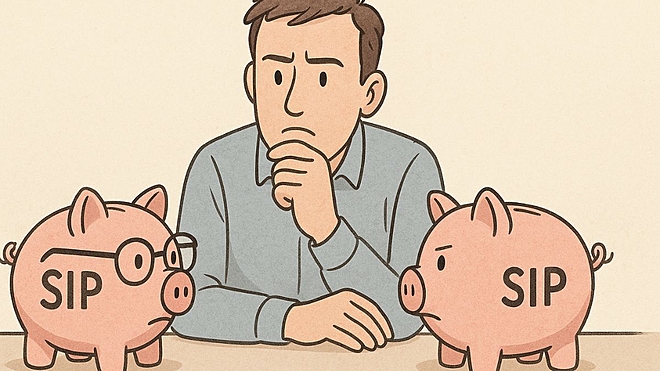
Meet Priya. She’s about to start a Rs 10,000 SIP in a large-cap fund. After researching on Value Research, she shortlists two funds — both have delivered around 14 per cent returns over the last five years.
On the surface, they look nearly identical. But dig a little deeper, and one has an Information Ratio (IR) of 0.95, while the other sits at 0.42.
So, what does that mean? And why should Priya care about Information Ratio?
What is Information Ratio
The Information Ratio (IR) helps you understand how consistently a fund beats its benchmark after adjusting for risk.
In plain English, here’s what it captures:
- Skill of the fund manager in generating excess returns (also known as alpha)
- Consistency of performance
- Volatility of the excess returns
A higher IR means more reliable performance with fewer wild swings.
A good IR is generally 0.5 or above. A score above 1 is considered excellent.
A simple analogy
Think of two cricket players who both scored 600 runs in a season.
- Player A scored a century in two matches but got out for 10 or less in the others.
- Player B consistently scored 50+ across matches.
Both hit 600 — but only one is dependable. That’s what the Information Ratio tells you. It measures how those returns were earned.
How it’s different from Sharpe ratio
You might ask — isn’t this like the Sharpe Ratio?
Not quite. Because Sharpe ratio looks at total risk taken by the fund, while Information Ratio looks at extra risk taken to beat the benchmark.
So, if you’re choosing between two similar funds and want to know which one is consistently beating the index, look at the Information Ratio.
Why Information Ratio can be important
With so many funds bunched close in terms of 1-, 3-, and 5-year returns, IR helps separate the consistent performers from the flashy ones. It’s especially useful when:
- You’re choosing between similar-return funds
- You want to identify fund manager skill
- You’re investing in actively managed funds (vs index funds)
What you should do
Before you invest in a fund, look beyond just past returns. Check the Information Ratio in the risk measures section on Value Research. Especially for large-cap, flexi-cap and mid-cap funds, where consistency is king.
After all, it's not just about how much return a fund generates — it's about how reliably it does that.
Want to discover high-IR, high-confidence funds?
At Value Research Fund Advisor, we don’t just show you data — we help you take action.
Whether you're building a fresh portfolio or reviewing old SIPs, our expert-curated goal-based fund recommendations help you find funds that are not just good — but consistent.
Join Fund Advisor today and see how we help you invest smarter, with insight — not instinct.
This article was originally published on July 14, 2025.
Ask Value Research 
 New episodes every Friday






 New Process Alert
  Seems like you've uploaded a wrong QR code. Please upload the QR code downloaded from MF Central platform.


