 Widely read:


 Aditya Roy/AI-Generated Image

“I bought the ETF at Rs 206, but the NAV says Rs 202. Why the mismatch?”
If you’ve asked this question, you’re not alone. Welcome to the world of ETFs, where the price you pay — and what your investment is actually worth — aren’t always the same.
This dual-price phenomenon is one of the most overlooked aspects of ETFs. And it has real implications for your returns.
The two faces of an ETF
Every exchange-traded fund has two prices — the NAV (net asset value) and the market price.
NAV reflects the value of the ETF’s holdings and is calculated after market hours. The market price is what you pay on the stock exchange, and it fluctuates in real time.
Ideally, these two prices should match. But in the real world, they often don’t.
What exactly is the NAV?
NAV is the per-unit value of the ETF’s underlying portfolio — the stocks or bonds it holds.
For example, if a Nifty 50 ETF holds Rs 100 crore worth of stocks and has one crore units, its NAV is Rs 100.
But unlike mutual funds, you don’t buy ETFs from the fund house at NAV. ETFs trade like stocks, and what you actually pay is the market price.
So, what is the market price?
This is the price you see on the exchange — and the one you pay. It changes constantly based on demand, supply and investor sentiment.
The market price can be higher or lower than the NAV. And that difference matters.
The premium–discount trap
Sometimes, ETFs don't trade exactly at their underlying value. They might be a bit more expensive (trading at a premium) or slightly cheaper (discount).
Premiums and discounts are typically tiny when the ETF is actively traded — like those tracking large, popular indices such as the Nifty and the Sensex. But when the ETF is based on a niche theme, holds international stocks or doesn’t see much buying and selling during the day, the gap between NAV and price can get wider.
That’s why it’s worth checking the premium or discount before buying an ETF — especially if you're looking at international or thematic funds. Even a few percentage points can make a difference to your returns.
Why this affects your returns
Let’s say you invest Rs 1 lakh in an ETF trading at a 3 per cent premium. Even if the NAV rises 10 per cent, your return would be 7 per cent because you overpaid at entry.
Similarly, exiting at a discount can hurt your returns, especially in volatile markets, where fewer buyers mean you may have to sell to the first one available, even at a lower price.
How to avoid overpaying
Before buying an ETF, compare the market price with the latest NAV. If the market price is more than 1 to 1.5 per cent higher, that’s a sign of a premium. You can:
- Wait for the premium to come down
- Use a limit order instead of buying at market price
- Choose another ETF tracking the same index
Also, check the iNAV (indicative NAV), which is a near real-time estimate of the ETF’s fair value based on live prices of the underlying assets. Many AMCs publish this during market hours.
If the market price is far above the iNAV, you’re likely paying too much. The iNAV acts as your intraday benchmark to avoid overpaying.
The bottom line
NAV tells you what your ETF is worth. Market price tells you what you’re paying.
And iNAV helps you judge whether the price is fair right now. Check all three before you buy. Because in the ETF world, the cost of not knowing can quietly shrink your returns.
An investor education and awareness initiative of Nippon India Mutual Fund.
Helpful Information for Mutual Fund Investors: All Mutual Fund investors have to go through a one-time KYC (know your Customer) process. Investors should deal only with registered mutual funds, to be verified on SEBI website under 'Intermediaries/Market Infrastructure Institutions'. For redressal of your complaints, you may please visit www.scores.gov.in. For more info on KYC, change in various details and redressal of complaints, visit mf.nipponindiaim.com/InvestorEducation/what-to-know-when-investing.
Mutual fund investments are subject to market risks, read all scheme related documents carefully.
Also read: How are exchange-traded funds (ETFs) taxed?
This article was originally published on July 07, 2025.
Disclaimer: This content is for information only and should not be considered investment advice or a recommendation.
For grievances: [email protected]
Ask Value Research 
 New episodes every Friday










 New Process Alert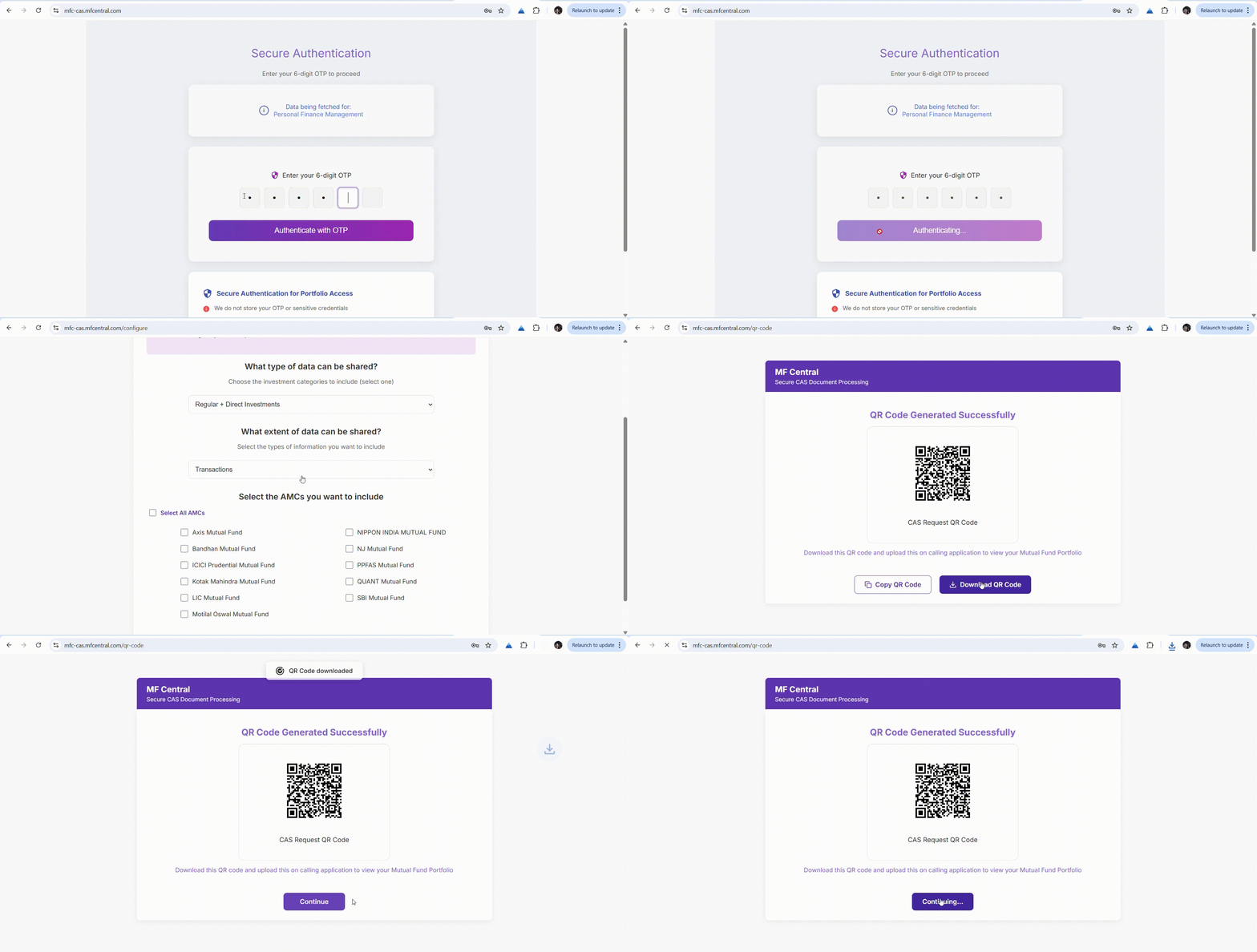
 Seems like you've uploaded a wrong QR code. Please upload the QR code downloaded from MF Central platform.


