 Widely read:




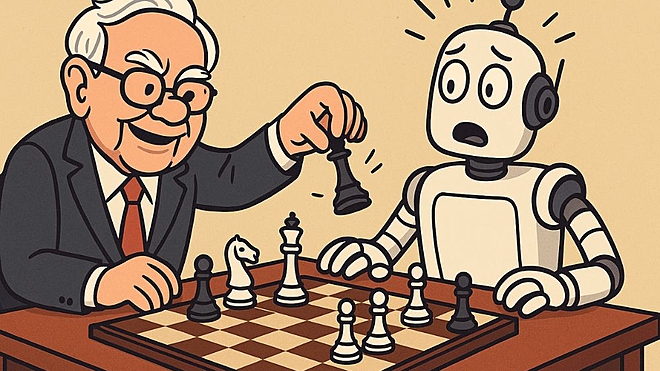 AI-generated image
In September 1998, the most powerful names on Wall Street were huddled inside a stuffy boardroom at the New York Federal Reserve. Not to bail out a country, not to stabilise a currency, but to rescue a single hedge fund: Long-Term Capital Management (LTCM).
The irony? This fund was supposed to be bulletproof. It had two Nobel laureates, a host of PhDs and some of the smartest minds in finance. But as Roger Lowenstein documents in his riveting book When Genius Failed, even these geniuses couldn’t outsmart the markets.
This isn’t just a tale of hubris. It’s a wake-up call for anyone who thinks investing is just about being smart. Because as LTCM proved: sometimes, intelligence can be the biggest risk of all.
The rise of brilliance
Back in 1994, John Meriwether, a celebrated bond trader from Salomon Brothers, decided to build something extraordinary. He wasn’t assembling just any investment team—he brought together a group of finance’s biggest brains. We’re talking PhDs in physics, mathematics and economics. Two of his partners, Robert Merton and Myron Scholes, were Nobel Prize winners. It felt like assembling an Avengers of Wall Street.
With this dream team in place, Meriwether hit the fundraising circuit. And the results were staggering. LTCM, his new hedge fund, raised $1.25 billion in a flash. European banks, Ivy League universities and heavyweight CEOs lined up to invest. Why? Not because they deeply understood the fund’s strategy, but because the team behind it was dripping with intellectual firepower and prestige.
As journalist Roger Lowenstein points out in When Genius Failed, most of these investors didn’t fully grasp how LTCM actually made money. But they didn’t feel the need to—they trusted the reputations, not the model. In their eyes, this was a low-risk bet on brilliance.
The flaw in their brilliance
Their model was built on quantitative arbitrage. These were complex strategies that exploited tiny pricing inefficiencies in global markets. It all looked flawless on paper. And for the first few years, it worked. From 1994 to 1997, LTCM posted annual returns exceeding 40 per cent, with minimal volatility. It attracted over $100 billion in borrowed capital, becoming a Wall Street darling.
But here’s the catch: LTCM wasn’t just smart — it was highly leveraged. Since the price gaps LTCM was exploiting were razor-thin, to make any real money, they had to place huge bets. That meant borrowing. A lot.
For every dollar of investor money, LTCM borrowed about $30. And on top of that, they entered into derivative contracts with over $1 trillion in exposure. All of this worked perfectly—until 1998, when the misstep arrived.
The fall of genius
The trigger? A seemingly remote event: Russia defaulted on its sovereign debt. This was not something LTCM’s elegant models had accounted for. As markets panicked, the uncorrelated assets LTCM had bet on all moved in the same direction — down.
Within weeks, the fund’s capital shrank from $4.7 billion to under $500 million. Its web of derivative contracts — over $1 trillion in exposure — now threatened the entire global financial system.
The New York Fed had no choice but to call in the CEOs of every major bank — Goldman Sachs, Morgan Stanley, J.P. Morgan, Merrill Lynch and more — to coordinate a bailout. Eventually, 14 banks pooled in $3.6 billion to stop LTCM from collapsing. But the damage had been done. Genius had failed.
What we can learn
At first glance, LTCM’s story feels like an institutional disaster. But its lessons apply to every investor, even those investing via SIPs in mutual funds.
Here’s what it teaches us:
1. Being smart is not enough
LTCM’s team were academic titans. But the markets aren’t equations on a whiteboard. They’re driven by human emotion, fear, greed — and chaos. Smart investors should know what they don’t know.
2. Leverage magnifies everything
Leverage can boost gains. But it amplifies risk even more. Many investors chase returns with credit card EMIs, loans or F&O trades. That’s a dangerous game — just ask LTCM.
Even renowned investor Warren Buffett, known as the Oracle of Omaha, once said in a TV interview: “It is crazy to borrow money on securities. One should invest within one's means.”
3. Black swans always exist
LTCM failed because it didn’t prepare for unlikely, extreme events — what Nassim Taleb later called black swans.
4. Arrogance is expensive
LTCM refused to disclose strategies. It shunned partners. It believed it was too smart to fail. Confidence is good, but when it becomes arrogance, it blinds you to risk.
5. Markets are humbling
If the smartest fund in the world can nearly crash the global system, so can overconfidence in our own investing.
To sum up, When Genius Failed is more than a cautionary tale. It’s a reminder that successful investing isn’t about flashy degrees or complex spreadsheets. It’s about discipline, diversification and humility.
If you’re building wealth for the long term:
- Don’t chase clever-sounding strategies
- Don’t rely on predictions or precision
- Stick to time-tested mutual funds
- Diversify your asset mix (equity, debt, gold)
- Most importantly: Stay grounded
Also read: Did you know even ₹50 lakh+ earners are struggling to save?
This article was originally published on June 25, 2025.
Ask Value Research 
 New episodes every Friday





 New Process Alert
  Seems like you've uploaded a wrong QR code. Please upload the QR code downloaded from MF Central platform.


