 Widely read:


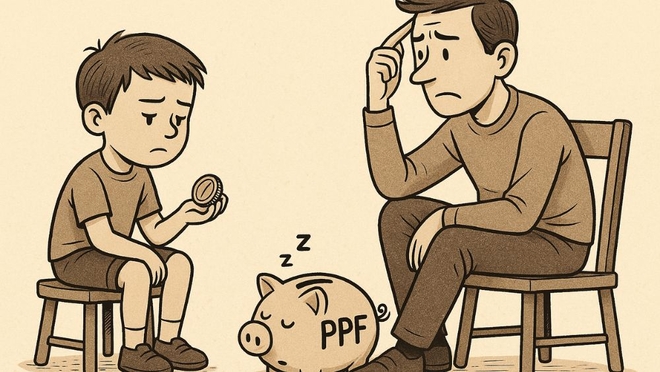 AI-generated image

When it comes to safe, long-term saving options for children, the Public Provident Fund (PPF) often tops the list for Indian parents. It's government-backed, tax-free and has a 15-year tenure, making it seem tailor-made for funding a child's future goals. But while opening a PPF in a minor's name sounds straightforward, the rules can trip you up if you're not careful.
Here's a complete guide, starting with the most basic question.
PPF interest rate for minors
The interest rate on a PPF account held in a minor's name is exactly the same as a regular PPF account. There's no preferential or differential rate.
As of Q1 FY26 (April to June 2025), the interest rate stands at 7.1 per cent per annum. The government notifies this rate every quarter, and it applies uniformly across all PPF accounts, minor (under 18) or adult.
Who can open a PPF account for a minor?
Only a parent or legal guardian can open a PPF account for a minor. A person can hold:
- One PPF account in their own name, and
- One PPF account in the name of a minor child (as a guardian)
If both parents are alive, only one of them can open the PPF account for the minor. Each minor is allowed only one PPF account under the rules.
PPF limitation
The annual investment limit in PPF is Rs 1.5 lakh per financial year. This limit is combined across the guardian's own account and the minor's account.
So if you already contribute Rs 1.5 lakh to your own PPF, you cannot invest additional money into your child's PPF without violating the rules.
What about tax benefits?
Only the guardian who contributes to the minor's PPF account is eligible for a tax deduction, and only under the old tax regime.
Under Section 80C of the Income Tax Act, you can claim up to Rs 1.5 lakh as a deduction from your taxable income, which can include contributions to your own PPF and that of your minor child, combined. The interest earned and maturity proceeds are fully tax-free.
But if you've opted for the new tax regime, you don't get any deduction for PPF contributions, whether for yourself or your child.
What happens when the child turns 18?
Once the minor turns 18, the PPF account legally becomes theirs.
- The child must provide proof of age and identity to have the account transferred in their name.
- The guardian's control ends, and your then-adult child can operate the account independently.
- A fresh nomination may also be required at this point.
Should you open a PPF account for your child?
That depends on your goals and how you plan to save for them.
PPF is ideal if your focus is capital safety and tax-free returns over a long horizon. It's especially useful for debt allocation in a broader financial plan. But here's the thing: PPF returns, while safe, are modest. Over the past several years, they've hovered around 7 to 8 per cent annually.
Now consider this: if you're investing with a 15-year horizon, equity investments - such as mutual funds - have historically delivered far better returns over such time frames, albeit with higher short-term volatility. An average flexi-cap fund has returned over 13 per cent in the last 15 years. Meaning, anyone investing Rs 1.5 lakh every year at the end of March over the last 15 years, would by now have accumulated Rs 76.5 lakh, if invested in an average flexi-cap fund as against Rs 43.7 lakh in the case of PPF.
So, while opening a PPF account for a child may feel like the "safe" choice, it may not be the most rewarding one if your goal is to build a large corpus for higher education or future expenses. In that case, you may be better off investing in a hybrid strategy—a mix of equity mutual funds and safer debt instruments like PPF.
Also read: Is it possible for a minor child to have multiple PPF accounts?
This article was originally published on May 16, 2025.
Disclaimer: This content is for information only and should not be considered investment advice or a recommendation.
For grievances: [email protected]
Ask Value Research 
 New episodes every Friday










 New Process Alert
 Seems like you've uploaded a wrong QR code. Please upload the QR code downloaded from MF Central platform.


