




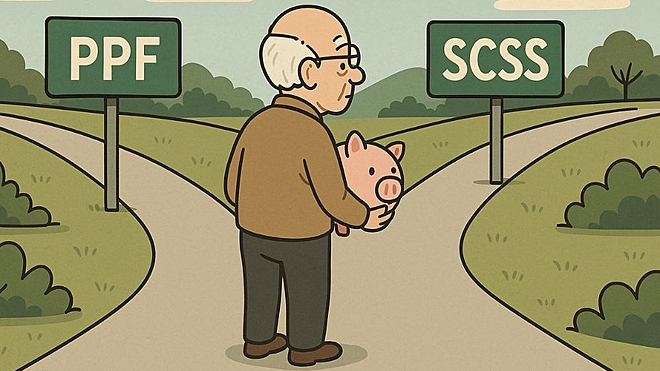
 AI-generated image
It's a familiar crossroads for many retirees.
For years, you've diligently invested in the Public Provident Fund (PPF) — a favourite among Indian savers for its tax-free returns, sovereign guarantee, and reliable compounding. Now that your account has matured, you're sitting on a substantial sum and a common dilemma: Should you extend your PPF for another five years or withdraw the money and move it to the Senior Citizen Savings Scheme (SCSS), which is currently offering an attractive 8.2 per cent?
At first glance, the answer might seem obvious. SCSS offers a higher return. But there's more to this decision than just the headline number.
What happens after PPF maturity?
A matured PPF account doesn't have to be closed. You can extend it in blocks of five years — with or without fresh contributions. Many opt for extension without contributions. In this mode:
- Your existing balance continues to earn interest at the prevailing PPF rate, currently 7.1 per cent.
- You are allowed one withdrawal every financial year.
- And best of all, the interest remains completely tax-free.
This makes the extended PPF a useful tool even in retirement — combining capital preservation, tax-free growth and limited liquidity.
SCSS: Higher interest, but taxable
The SCSS, designed specifically for senior citizens, offers regular quarterly payouts and a high interest rate of 8.2 per cent, which gets locked in for five years at the time of investment.
But there's a catch: the interest earned is fully taxable.
If you're in the 30 per cent tax slab, your post-tax return from SCSS drops to roughly 5.7 per cent. Even in the 20 per cent slab, the effective return is around 6.5 per cent — lower than PPF's 7.1 per cent, which is entirely tax-free.
So, for those in higher tax brackets, SCSS may not be as rewarding as it first appears.
When SCSS makes sense: No taxable income
Here's where it gets interesting. Under the new tax regime, individuals can now earn up to Rs 12 lakh a year tax-free, thanks to the enhanced rebate.
So if you fall in this category — for instance, a retiree with no significant taxable income — then SCSS becomes a very attractive option. In such cases, you're not losing anything to tax, and you get regular income with a guaranteed 8.2 per cent return.
Even better, you can invest up to Rs 30 lakh in SCSS, and as a couple, up to Rs 60 lakh, making it a powerful income source in retirement.
What about regular income needs?
SCSS offers quarterly payouts, which many retirees find useful for managing household expenses.
PPF doesn't offer fixed payouts. But if extended without contributions, you can withdraw once a year. You can use the same for your household expenditure. Alternatively, the amount can be moved to a liquid mutual fund, and from there, you can set up a Systematic Withdrawal Plan (SWP) for monthly income.
It's not as seamless and convenient as SCSS, but it gives you more control, flexibility, and potential tax savings.
Rate certainty vs floating returns
Another key difference: SCSS locks in the interest rate for five years at the time of investment. If you invest today, your 8.2 per cent is protected, regardless of future rate cuts.
PPF, on the other hand, has a floating rate that's revised every quarter by the government. The current rate of 7.1 per cent is attractive, but it could drop in future if interest rates decline further, which most experts predict it will in the coming months. As such, the PPF rates will also see a dip.
What you should do
The decision between PPF and SCSS is not just about which one pays more. It's about what you actually take home after tax, how much flexibility you want and how steady your income needs to be.
- If your income is not taxable, SCSS becomes a compelling option because it offers regular, predictable payouts and the comfort of a locked-in rate.
- If you're in a higher tax bracket, PPF is likely to serve you better. Despite a lower interest rate, its tax-free returns give it an edge.
- If you have a large corpus accumulated in PPF, extending it and using a combination of both SCSS and PPF can be a smart move. It can help you keep your surplus safe while earning tax-free returns, making it a highly efficient fixed-income tool.
That said, do not ignore the importance of equities in your portfolio. Even after retirement, one must allocate at least one-third of their portfolio to earn inflation-adjusted income.
Also read: Is the PPF interest rate fixed for 15 years?
This article was originally published on April 14, 2025.
Ask Value Research 

 New episodes every Friday











 New Process Alert
  Seems like you've uploaded a wrong QR code. Please upload the QR code downloaded from MF Central platform.


