




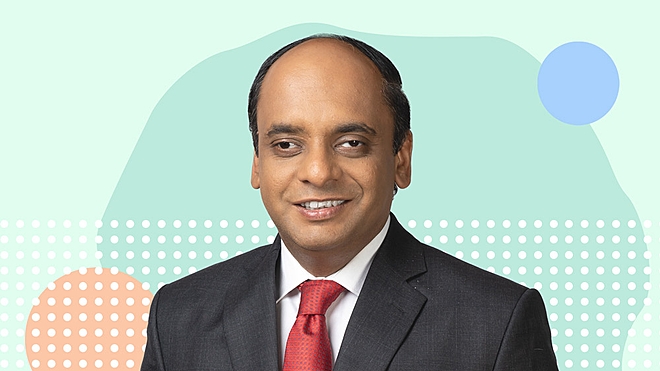

With over a decade on the sell side before moving to fund management, Harshad Borawake brings nearly 20 years of professional experience. The Head of Research at Mirae Asset Investment Managers (India) currently oversees four hybrid schemes with assets worth approximately Rs 13,600 crore.
Despite recent challenges in Mirae's flagship equity funds, Borawake remains committed to the firm's quality-focused approach. "We don't invest in a company where ROCE is in single digits," he emphasises, explaining why Mirae missed some of the PSU rally that benefited competitors. In this interview, Borawake discusses the recent market correction, his GARP investment philosophy and the steps being taken to improve fund performance. Below is the edited transcript of our discussion.
You've worked on both the sell side and as a fund manager. How have these roles shaped your investment approach?
I have been on the sell side for more than 10 years, and it was more about in-depth research in a few sectors that I was tracking. It was also important to articulate the views to the clients and help them gain insights into a particular company or sector. But most importantly, the insights led to some actionable buying or selling decisions.
However, I think on the buy side, as a fund manager, it's different, and here, it's more about taking a bird's-eye view. We have to look across the sectors and not just one sector. It's more like joining the dots and trying to assess what's in the price. For example, when commodity prices rise, it benefits producers but negatively affects users. So, let's say that right now, the interest rates might go down; it might be negative for a few banks in the short term and positive for NBFCs (non-banking financial corporations). So, on the buy side, it's more about multiple factors one needs to look at.
Therefore, to answer your question, the sell side was more in-depth, and the buy side is more about looking at multiple things across the portfolios.
How would you describe your investment philosophy, and how has it evolved with changing market conditions?
I started my career during the Global Financial Crisis; later on, we had the QE (quantitative easing) and Covid-19 crisis. Throughout these years, I have learned the importance of monitoring macro and global developments. But investing is all about the company you invest in, whether it can grow reasonably over the years, what moats it has and what kind of return on capital employed (ROCE) it can generate. From my experience, cash flow generation is more critical than macroeconomic factors.
I focus more on ROCE, which should be at least 15 per cent pre-tax, and the management quality has to be impeccable. To the greatest extent possible, I will try to assess the value of the company on a DCF basis. I am okay with buying up to a reasonable price and not at any price. This investment philosophy is also called growth at a reasonable price (GARP).
So over the years, the key lesson learned is to not give too much importance to the near-term factors or sentiments. However, focus more on the company you are investing in, and as long as you are comfortable with its valuation and outlook, I think you should be fine.
Over the past couple of years, several flagship Mirae equity funds, including Large & Midcap, ELSS and Midcap, have faced challenges, with many ranking in the third and fourth quartiles in 2024. What have been the key hurdles? How do you plan to steer these funds back to their winning ways?
I believe that the nature of the market has changed significantly over the last two or three years. Let's start with what has worked and what hasn't.
So what has worked in the market is the public sector names; within that, stocks of sectors like defence and railways did very well. Before rising, PSU stocks didn't do much for 8-10 years for various reasons. So, if you look at our investment framework, we don't invest in a company where ROCE is in single digits. At Mirae, I think we missed a few of the PSU names, which did well, and some of our peers had those names. We did not change our strategy after the rally. We are sticking to our fundamentals and looking to invest only in quality names.
So, if you look at the hybrid portfolio I manage, things are getting normal after the three- and six-month periods. Over the last few quarters, I believe the markets have also normalised. So, ranking will take time, but we've seen some improvement in recent months. On the other hand, 2-3 stocks we purchased have underperformed. Obviously, we believe that it's more of a transitional setback, and we will eventually bounce back.
After the recent market correction, do you see Indian equities as more attractive, or is there room for further downside?
Markets have corrected depending on which indices you look at. Let's say the key indices have fallen by 12 to 15 per cent, but stock-level corrections are steeper wherever there was a froth.
For instance, the sectors we overlooked, such as defence, have experienced corrections ranging from 30 to 40 per cent. But even after such corrections, they are not cheap, but much better than six months ago. So, if you look at the Nifty 50, it is available at less than 17 times one-year forward earnings. It is less than the 10-year average, but at the same time, mid and small caps still trade at a premium to long-term averages. I think markets have not really become attractive but are in much better shape than they were six months ago. Within the large caps, it makes a lot of sense from the medium-term perspective.
Secondly, encouraging signs are emerging from the rural sector. The markets corrected because there was an urban consumption slowdown, government capex got stalled due to the elections, and obviously, we have also seen foreign investors selling and geopolitical issues.
I think domestic factors should hopefully be addressed. The government made significant tax concessions on the consumption side in the recent Budget, so it is essential to address the issue of urban slowdown. What was absent in the last few years was private capex. Hopefully, we will see private capex returning over the next two to three quarters. That should again lead to markets doing well from the earnings perspective.
Do you see more pain in the mid- and the small-cap segment?
A large part of the froth has gone away. But does it make mid- and small-cap baskets attractive? I think the answer is no at a basket level, and now it is more stock-specific.
In the last few years, most of the stocks did well. The market's breadth was impressive, but we now need to gradually return to the fundamentals and focus on the specifics of each stock. Investing now only makes sense to look in a company if they have a strong return on capital employed (ROCE), a decent balance sheet and reasonable valuations. I think blanket or basket investing may not work in mid and small caps, and it will be more of a bottom-up stock-picking.
With foreign portfolio investor outflows and weaker earnings, what could drive a market recovery?
In the Budget, there was a visible change from the government. It did listen to the pain on the ground, which led to the consumption being prioritised over capex. These changes will take time and not happen overnight, and the consumption weakness on the urban side, which we have seen in the last two quarters, should make some comeback in the following quarters.
One of the issues on the urban side was the impact of inflation, more so on the masses side. So, over the next two to three quarters, we believe that the impact of inflation should moderate, partly also due to base effect. Secondly, if you look at the breadth of the corporates, there are pockets like retail, QSR in consumption, metals and pharma companies; their earnings growth is excellent. These are some of the multiple sectors that are driving the earnings growth. If you look at banking, the credit growth has come down but is still in the double digits. So, from the market's perspective, I believe there should be some time correction, which could happen. But as and when the earnings catch-up happens, we should again see markets doing well.
To put it in context, the market returns in the last 3-4 years were also quite phenomenal. Thus, we also have to keep that in mind when we see the 10-12 per cent correction, and from that angle, I think it's a more healthy and much-needed correction.
Mirae Asset Aggressive Hybrid Fund initially had a strong lead over its peers and benchmark. However, its margin of outperformance has gradually declined, as seen in its five-year rolling returns. What factors have contributed to this dip in performance?
The last three years were favourable for the markets, particularly for the mid and small caps. From the sector's perspective, industrial names and defence also did quite well.
At Mirae, by choice, we have our portfolios biased towards large caps, and from that context, there was underperformance when mid and small caps did well. When looking at the last three to nine months, funds have been performing very well. We are moving from quartile three to quartile two in the last three to nine-month period.
What steps are you taking to improve the Mirae Asset Aggressive Hybrid Fund performance going forward?
We observed that when we did our attribution analysis, it was not because we didn't have the stocks that had done well. But all the allocations and the weights assigned to them made all the difference.
For example, we could have higher weights where we had high conviction. Over the past year, we have implemented corrective measures and increased weights in areas where we have strong convictions, and the benefits have been evident in the last three to nine-month period. Therefore, our stock selection process remains unchanged. But we have slightly modified and allocated higher weights where we have higher conviction.
Also read: 'Expect reasonable returns from equities over 3-5 years'
Ask Value Research 

 New episodes every Friday




 New Process Alert
  Seems like you've uploaded a wrong QR code. Please upload the QR code downloaded from MF Central platform.


